

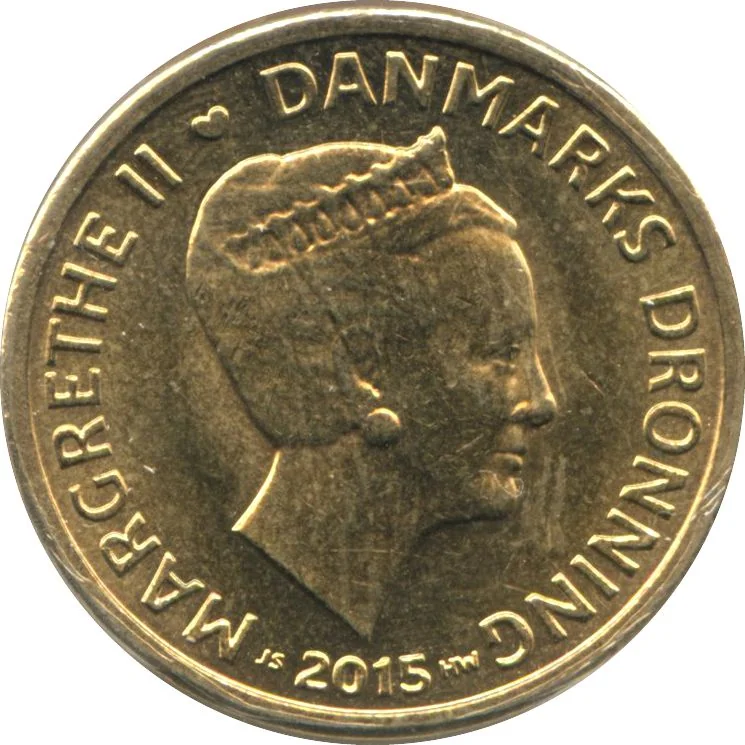
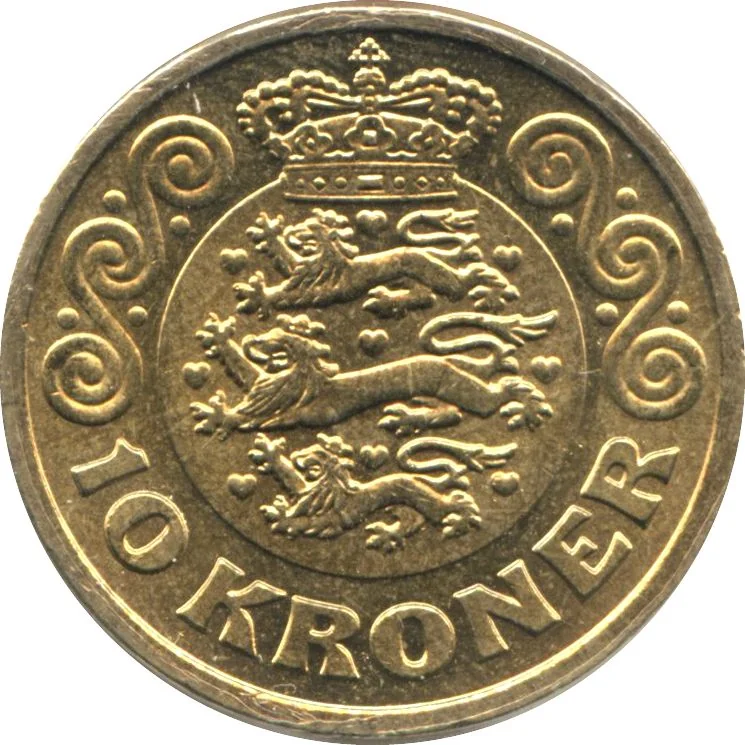
10 Kroner – Denmark
Denmark
Context
Years: 2013–2022
Issuer: Denmark 
Ruler: Margrethe II
Currency:
(since 1873)
Total mintage: 1,246,000
Material
Diameter: 23.4 mm
Weight: 7 g
Thickness: 2.2 mm
Shape: Round
Composition: Aluminium bronze
Magnetic: No
Technique: Milled
Alignment: Medal alignment
flip
References
KM: #Click to copy to clipboard954
Numista: #65243
Value
Exchange value: 10 DKK = $1.58
Inflation-adjusted value: 12.13 DKK
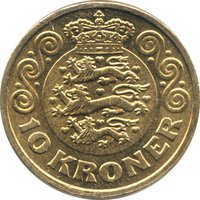
Obverse
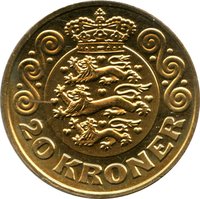
Reverse
Edge
Plain
Mints
| Name | Mark |
|---|---|
| Mint of Finland | — |
| Royal Danish Mint | — |
Mintings
| Year | Mint Mark | Mintage | Quality | Collection |
|---|---|---|---|---|
| 2013 | — | 741,000 | ||
| 2013 | — | 1,200 | Proof | |
| 2014 | JS;HW | 500,000 | ||
| 2014 | JS;HW | — | Proof | |
| 2015 | JS;HW | 800 | Proof | |
| 2015 | JS;HW | — | ||
| 2016 | JS;HW | — | ||
| 2016 | LGS;HW | — | ||
| 2016 | LGS;HW | 800 | Proof | |
| 2017 | — | — | ||
| 2017 | — | 800 | Proof | |
| 2018 | — | — | ||
| 2018 | — | 800 | Proof | |
| 2019 | — | — | ||
| 2019 | — | 600 | Proof | |
| 2020 | — | — | Proof | |
| 2020 | — | — | ||
| 2021 | ♥︎ | — | Proof | |
| 2021 | ♥︎ | — | ||
| 2022 | ♥︎ | — | ||
| 2022 | ♥︎ | — | Proof |
Historical background
In 2013, Denmark's currency situation was defined by its long-standing policy of maintaining a stable exchange rate between the Danish krone (DKK) and the euro. This was managed through the European Exchange Rate Mechanism II (ERM II), a system Denmark joined in 1999 after opting out of adopting the euro. The primary objective of Danmarks Nationalbank (the central bank) was to keep the krone within a narrow band of +/- 2.25% around a central rate of 7.46038 kroner per euro, a commitment known as the fixed exchange rate policy.
The context of 2013 was particularly notable due to the lingering effects of the European debt crisis, which had spurred significant capital inflows into Denmark as a perceived "safe haven" within Europe. This demand for Danish assets put considerable upward pressure on the krone, threatening to push it above the strong-side limit of its permitted band. To counteract this, Danmarks Nationalbank intervened heavily in foreign exchange markets, selling kroner and buying foreign currency to suppress its value. It also maintained a historically low and negative interest rate regime, with its certificate of deposit rate at 0.05%, to discourage speculative inflows and defend the peg.
Ultimately, these measures were successful in maintaining currency stability throughout the year. The krone remained firmly within its required band, demonstrating the credibility of Denmark's commitment to its fixed exchange rate policy. This period underscored the central bank's willingness to use its tools aggressively, setting a precedent for the even more intense interventions that would be required during similar pressure in 2015. The situation highlighted the core trade-off of the policy: while it provided stability for trade and investment, it required Denmark to effectively outsource its monetary policy to the European Central Bank's stance, limiting its own independent tools to address domestic economic conditions.
The context of 2013 was particularly notable due to the lingering effects of the European debt crisis, which had spurred significant capital inflows into Denmark as a perceived "safe haven" within Europe. This demand for Danish assets put considerable upward pressure on the krone, threatening to push it above the strong-side limit of its permitted band. To counteract this, Danmarks Nationalbank intervened heavily in foreign exchange markets, selling kroner and buying foreign currency to suppress its value. It also maintained a historically low and negative interest rate regime, with its certificate of deposit rate at 0.05%, to discourage speculative inflows and defend the peg.
Ultimately, these measures were successful in maintaining currency stability throughout the year. The krone remained firmly within its required band, demonstrating the credibility of Denmark's commitment to its fixed exchange rate policy. This period underscored the central bank's willingness to use its tools aggressively, setting a precedent for the even more intense interventions that would be required during similar pressure in 2015. The situation highlighted the core trade-off of the policy: while it provided stability for trade and investment, it required Denmark to effectively outsource its monetary policy to the European Central Bank's stance, limiting its own independent tools to address domestic economic conditions.
🌱 Common