

10 zlotys (Warsaw) – Poland
Add to wishlist
Circulating commemorative coins
Commemoration: 700th Anniversary of Warsaw
Poland
Context
Year: 1965
Issuer: Poland
Period:
(1952—1989)
Currency:
(1949—1994)
Demonetization: 1 January 1978
Total mintage: 3,492,000
Material
Diameter: 31 mm
Weight: 12.9 g
Thickness: 2 mm
Shape: Round
Composition: Copper-nickel
Technique: Milled
Alignment: Medal alignment
flip
References
Y: #
Numista: #6514
Value
Exchange value: 10 PLZ
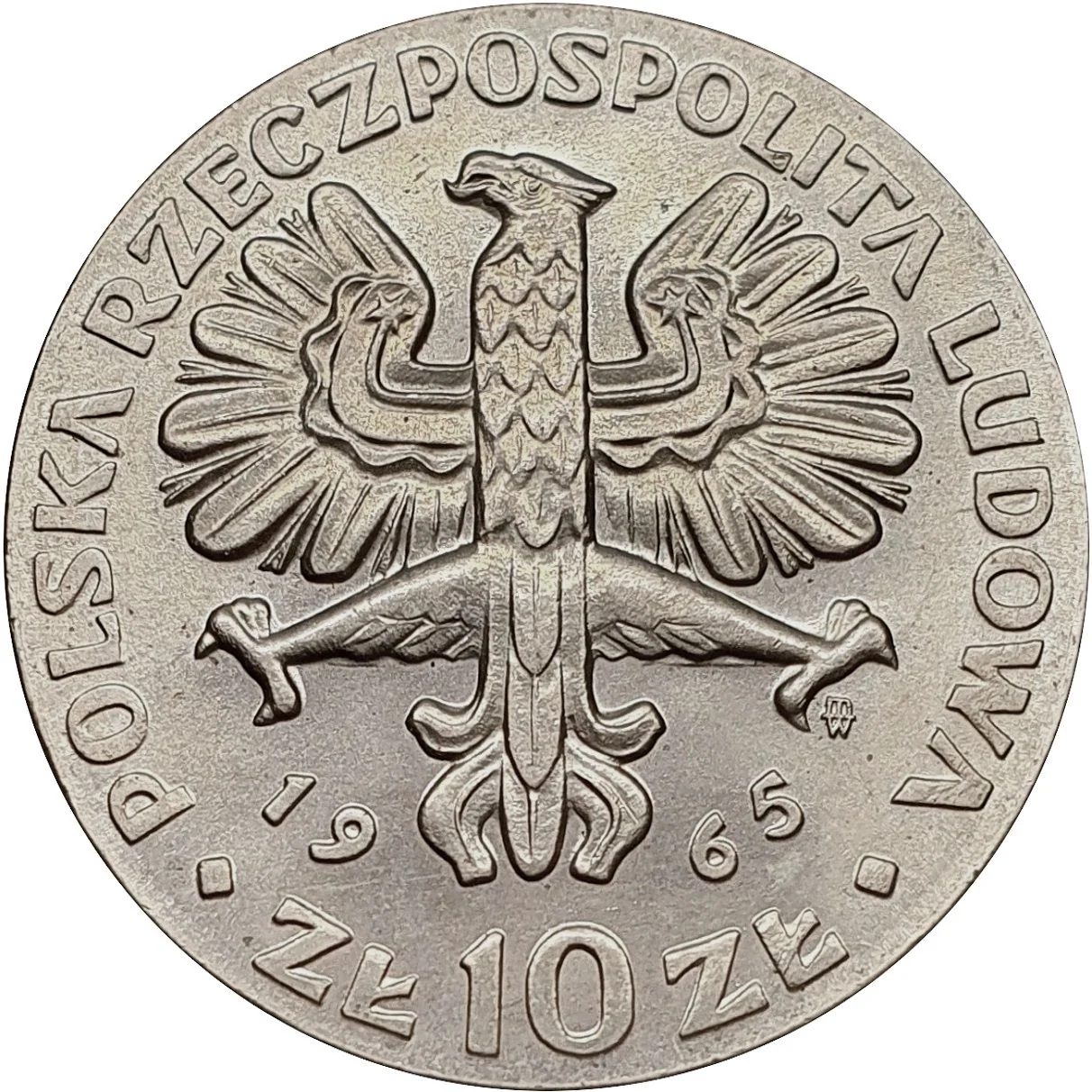
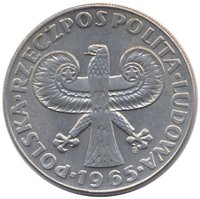
Obverse
Description:
The Polish national coat of arms.
Inscription:
POLSKA RZECZPOSPOLITA LUDOWA
mw
19 65
·ZŁ 10 ZŁ·
mw
19 65
·ZŁ 10 ZŁ·
Translation:
PEOPLE'S REPUBLIC OF POLAND
10 ZŁOTYCH 10 ZŁOTYCH
19 65
10 ZŁOTYCH 10 ZŁOTYCH
19 65
Script: Latin
Language: Polish
Engraver: Wacław Kowalik
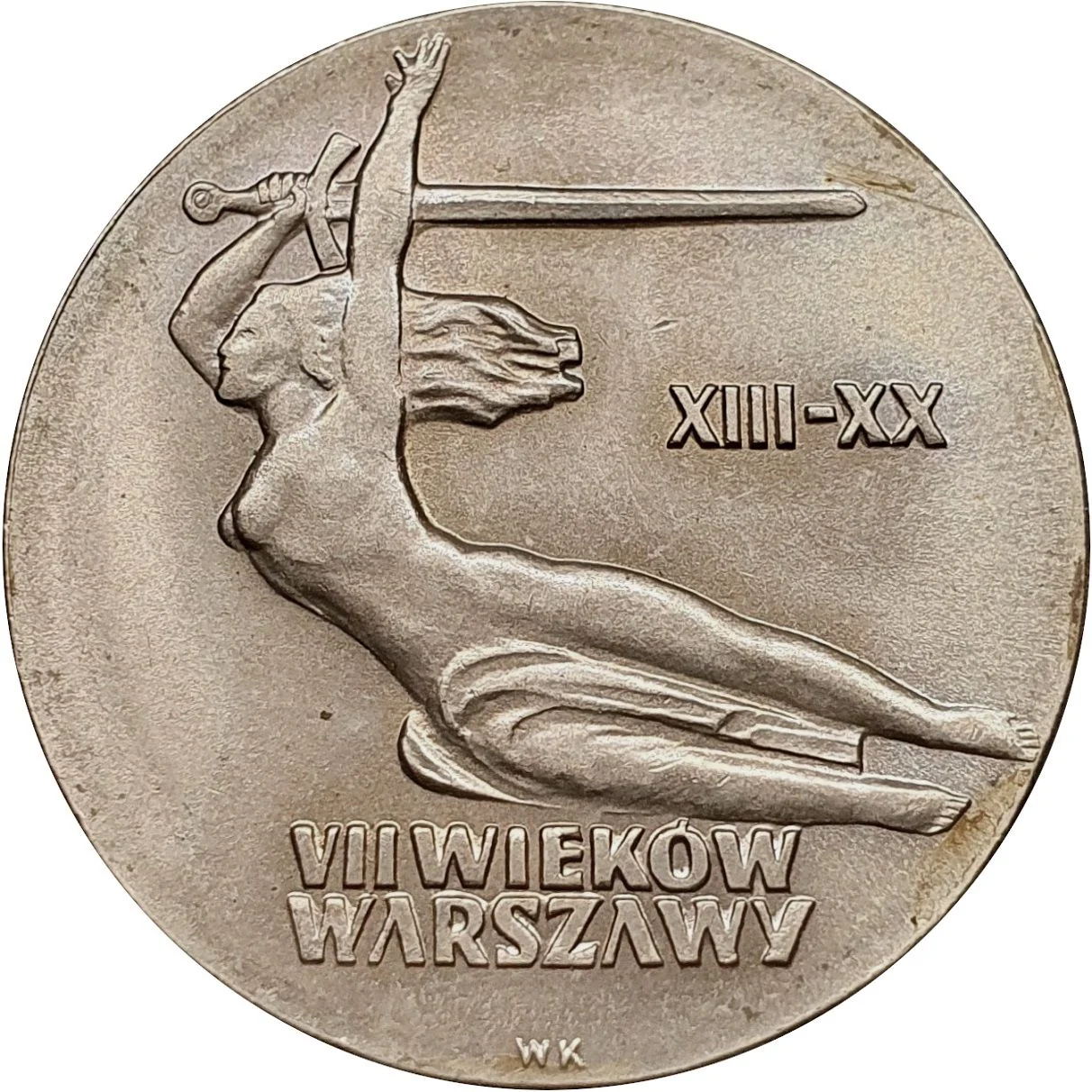
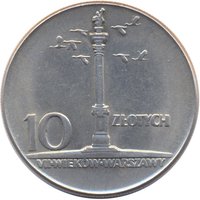
Reverse
Description:
Sword-wielding nude woman.
Inscription:
XIII-XX
VII WIEKÓW
WARSZAWY
W K
VII WIEKÓW
WARSZAWY
W K
Translation:
Thirteenth-Twentieth
Seven Centuries
of Warsaw
W K
Seven Centuries
of Warsaw
W K
Script: Latin
Language: Polish
Engraver: Wacław Kowalik
Edge
Milled
Mints
| Name | Mark |
|---|---|
| Mint of Poland | MW |
Mintings
| Year | Mint Mark | Mintage | Quality | Collection |
|---|---|---|---|---|
| 1965 | MW | 3,492,000 |
Historical background
In 1965, Poland's currency situation was characterized by the rigidities and contradictions of a centrally planned economy under the Gomułka regime. The official currency, the złoty (PLZ), was a non-convertible "soft currency," meaning it could not be freely exchanged for hard currencies like the US dollar or used in international trade. Its value was set by administrative fiat rather than market forces, with an official exchange rate that bore little relation to its actual purchasing power or scarcity. Internally, this system created a stable but artificial price structure for basic goods, masking underlying economic inefficiencies.
Beneath this surface stability, a significant black market for foreign currency thrived, primarily dealing in US dollars and West German marks. This parallel economy was fueled by Poles receiving remittances from family abroad and the growing tourist trade, which exposed the vast gap between the official and real value of the złoty. The government tacitly tolerated this market through state-owned Pewex and Baltona hard-currency shops, where Poles could purchase high-quality, scarce, or Western goods unavailable in regular stores, but only with foreign cash. This created a two-tiered society where access to hard currency meant access to a better standard of living.
The currency situation in 1965 was ultimately a symptom of Poland's struggling economy, burdened by heavy investment in heavy industry and the cost of maintaining a large state apparatus. While there were no major devaluations that year, the pressures were building. The system of fixed prices and the non-convertible złoty discouraged productivity, led to persistent shortages of consumer goods, and distorted economic planning. These underlying monetary and economic weaknesses would contribute to the social unrest and political crises that erupted in 1970 and again in the 1980s.
Beneath this surface stability, a significant black market for foreign currency thrived, primarily dealing in US dollars and West German marks. This parallel economy was fueled by Poles receiving remittances from family abroad and the growing tourist trade, which exposed the vast gap between the official and real value of the złoty. The government tacitly tolerated this market through state-owned Pewex and Baltona hard-currency shops, where Poles could purchase high-quality, scarce, or Western goods unavailable in regular stores, but only with foreign cash. This created a two-tiered society where access to hard currency meant access to a better standard of living.
The currency situation in 1965 was ultimately a symptom of Poland's struggling economy, burdened by heavy investment in heavy industry and the cost of maintaining a large state apparatus. While there were no major devaluations that year, the pressures were building. The system of fixed prices and the non-convertible złoty discouraged productivity, led to persistent shortages of consumer goods, and distorted economic planning. These underlying monetary and economic weaknesses would contribute to the social unrest and political crises that erupted in 1970 and again in the 1980s.
🌱 Common