

500 francs (Independence) – Belgium
Add to wishlist
Non-circulating coins
Commemoration: 150th Anniversary of Independence
Belgium
Context
Year: 1980
Issuer: Belgium
Ruler: Baudouin I
Currency:
(1832—2001)
Demonetization: 3 September 1990
Total mintage: 52,700
Material
References
KM: #
Numista: #6463
Value
Exchange value: 500 BEF
Bullion value: $31.28
Inflation-adjusted value: 1755.98 BEF
Obverse
Description:
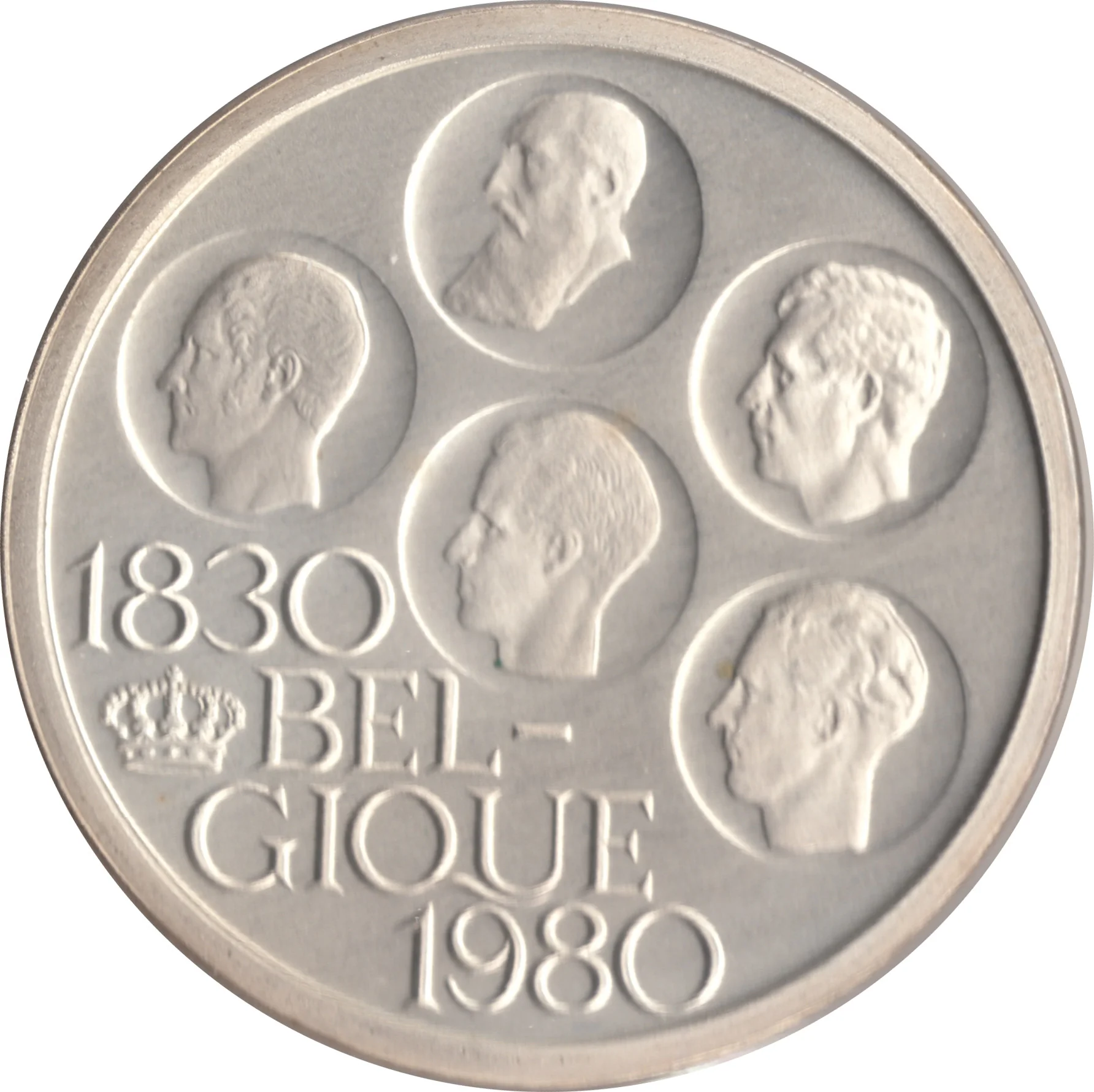
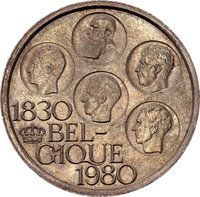
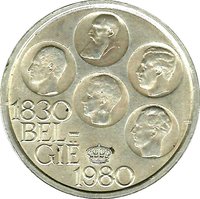
Five Belgian kings facing left in medallions. Jubilee years flank French legend, with small crown above the lower date.
Inscription:
1830
BEL-GIQUE
1980
BEL-GIQUE
1980
Translation:
1830
BELGIUM
1980
BELGIUM
1980
Script: Latin
Engraver: Paul Huybrechts
Reverse
Description:
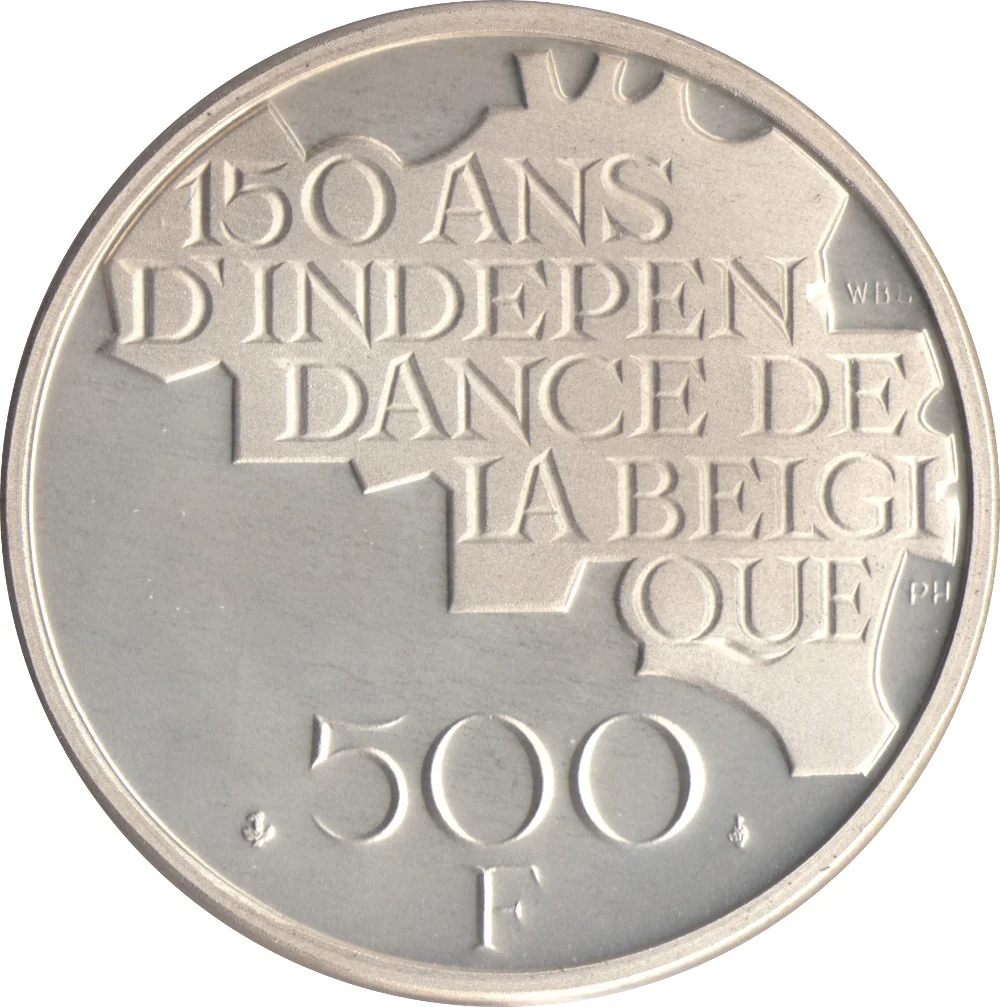
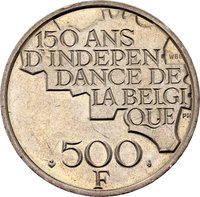
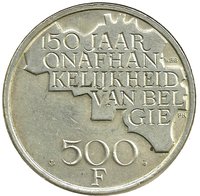
Map of Belgium with French text. Value below, split by mint and privy mark. Designer initials at right.
Inscription:
150 ANS D'INDEPENDANCE DE LA BELGIQUE
500F
WBB
PH
500F
WBB
PH
Translation:
150 Years of Belgium's Independence
500F
WBB
PH
500F
WBB
PH
Script: Latin
Language: French
Engraver: Paul Huybrechts
Edge
Plain
Mints
| Name | Mark |
|---|---|
| Royal Mint of Belgium | — |
Mintings
| Year | Mint Mark | Mintage | Quality | Collection |
|---|---|---|---|---|
| 1980 | — | 52,700 | Proof |
Historical background
In 1980, Belgium’s currency situation was defined by its participation in the European Monetary System (EMS), established in 1979. The Belgian franc (BEF) was a member of the Exchange Rate Mechanism (ERM), which aimed to reduce exchange rate variability and achieve monetary stability in Europe by pegging currencies within agreed fluctuation bands. For Belgium, a small, open economy with a high dependence on international trade, this framework was crucial. It provided a disciplinary anchor against the high inflation of the 1970s and helped stabilize the franc against major partners like Germany and France, which were its largest trading partners.
Domestically, the Belgian economy faced significant challenges that pressured its currency policy. The country was grappling with high public debt, persistent inflation (though declining from earlier peaks), and structural issues stemming from the costly process of federalizing the state. The National Bank of Belgium was therefore tasked with a delicate balancing act: maintaining the franc's parity within the EMS required high interest rates and strict monetary policy, which in turn constrained economic growth and exacerbated unemployment. This period was often marked by speculative pressures on the franc, testing the central bank's resolve.
Consequently, the currency situation in 1980 was one of managed stability within a European framework, but achieved at a considerable domestic cost. The commitment to the EMS "strong franc" policy was a central tenet, seen as essential for import price stability and economic credibility. However, it came with the trade-off of tighter financial conditions during a period of economic difficulty, setting the stage for the devaluations the Belgian franc would undergo within the EMS later in the decade (in 1982 and 1990) as the government sought to restore competitiveness.
Domestically, the Belgian economy faced significant challenges that pressured its currency policy. The country was grappling with high public debt, persistent inflation (though declining from earlier peaks), and structural issues stemming from the costly process of federalizing the state. The National Bank of Belgium was therefore tasked with a delicate balancing act: maintaining the franc's parity within the EMS required high interest rates and strict monetary policy, which in turn constrained economic growth and exacerbated unemployment. This period was often marked by speculative pressures on the franc, testing the central bank's resolve.
Consequently, the currency situation in 1980 was one of managed stability within a European framework, but achieved at a considerable domestic cost. The commitment to the EMS "strong franc" policy was a central tenet, seen as essential for import price stability and economic credibility. However, it came with the trade-off of tighter financial conditions during a period of economic difficulty, setting the stage for the devaluations the Belgian franc would undergo within the EMS later in the decade (in 1982 and 1990) as the government sought to restore competitiveness.
🌱 Common