

1000 rubles (Battle of Gangut) – Russian Federation
Add to wishlist
Non-circulating coins
Commemoration: 300 years from winning battle of Gangut by Russian navy
Russia
Context
Year: 2014
Country: Russia
Issuer: Russian Federation
Period:
(since 1991)
Currency:
(since 1998)
Total mintage: 250
Material
Diameter: 50 mm
Weight: 156.4 g
Gold Weight:: 156.24 g
Thickness: 5.7 mm
Shape: Round
Composition: 99.9% Gold
Standard: Silver 5 ounces
Magnetic: No
Technique: Milled
Alignment: Medal alignment
flip
References
Value
Exchange value: 1000 RUB
Bullion value: $23970.39
Inflation-adjusted value: 2613.47 RUB
Obverse
Description:
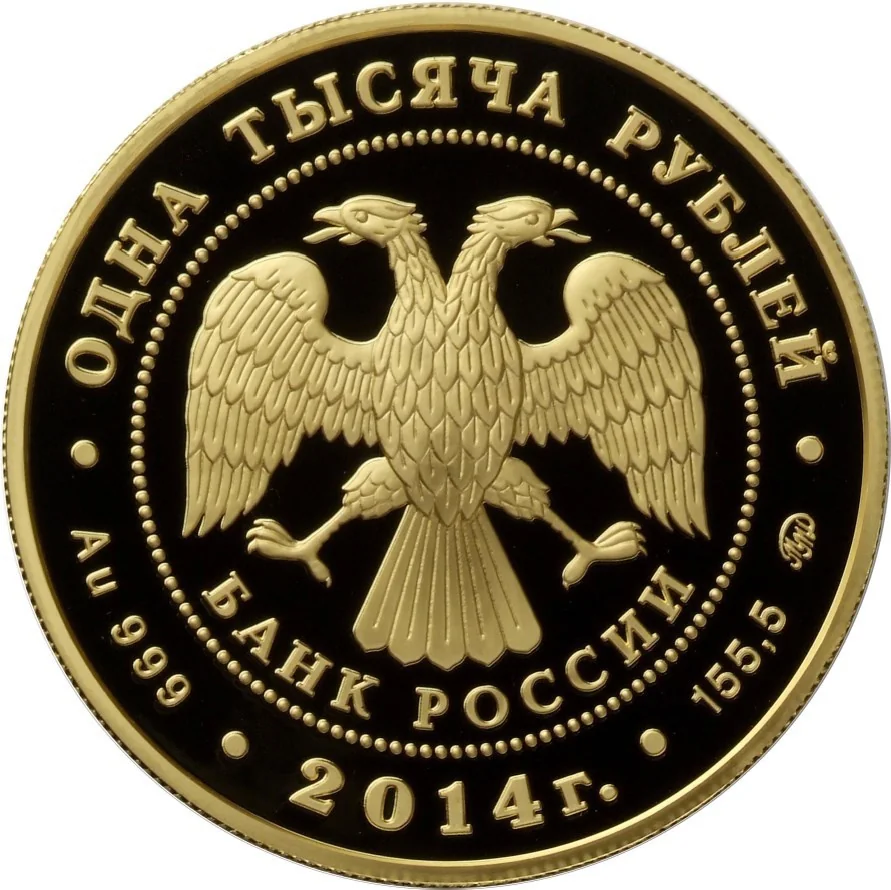
Central: Bank of Russia emblem [two-headed eagle, wings down, with "БАНК РОССИИ" below]. Encircled by dots and inscriptions: top — "ОДНА ТЫСЯЧА РУБЛЕЙ", bottom — year. Left letters: metal/fineness. Right: fine metal content and mint mark.
Inscription:
ОДНА ТЫСЯЧА РУБЛЕЙ
БАНК РОССИИ
• Au 999 • 2014 г. • 155,5 ММД •
БАНК РОССИИ
• Au 999 • 2014 г. • 155,5 ММД •
Translation:
ONE THOUSAND RUBLES
BANK OF RUSSIA
• Au 999 • 2014 • 155,5 MMD •
BANK OF RUSSIA
• Au 999 • 2014 • 155,5 MMD •
Language: Russian
Designer and engraver: Alexander Vasilyevich Baklanov
Reverse
Description:
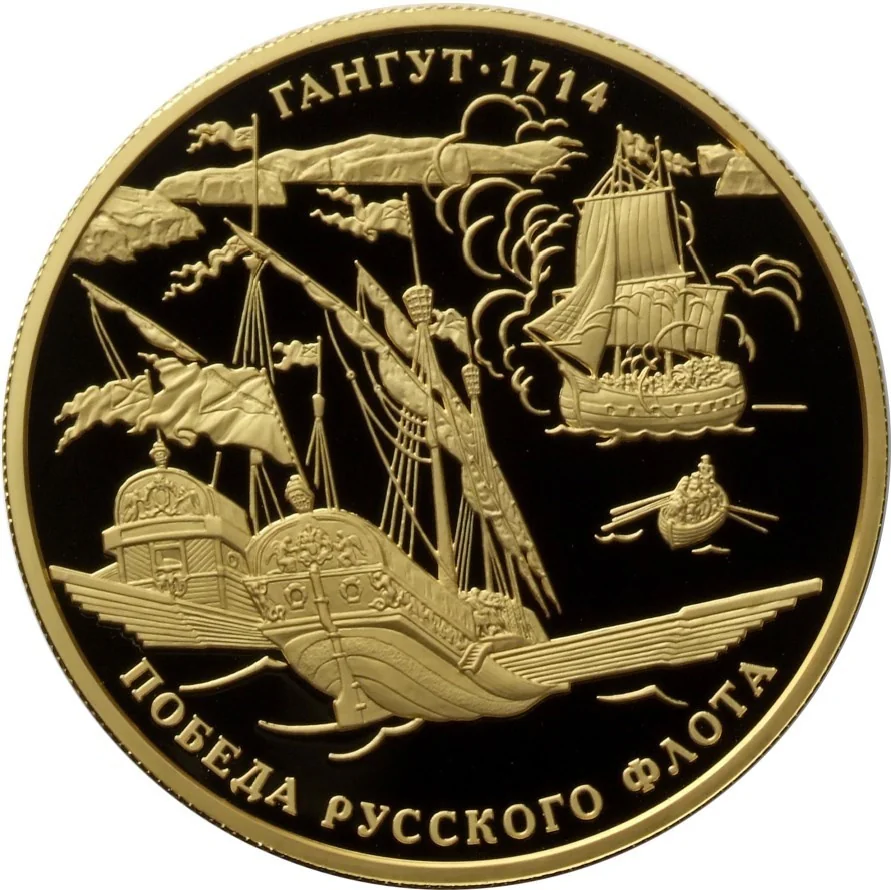
A naval battle scene on a mirrored disc: a rowing-sailing ship in the foreground, a ship flying the Saint Andrew flag to its left, and a smoking ship with a sloop to the right. Around the rim: "ГАНГУТ • 1714" above and "ПОБЕДА РУССКОГО ФЛОТА" below.
Inscription:
ГАНГУТ • 1714
ПОБЕДА РУССКОГО ФЛОТА
ПОБЕДА РУССКОГО ФЛОТА
Translation:
GANGUT • 1714
VICTORY OF THE RUSSIAN FLEET
VICTORY OF THE RUSSIAN FLEET
Script: Cyrillic
Language: Russian
Engraver: Vladimir Borisovich Ananyin
Designer: Lidiya Alexandrovna Evdokimova
Edge
210 corrugations
Categories
| Geography> Sea |
| Transportation> Watercraft |
| History> War |
Mints
| Name | Mark |
|---|---|
| Moscow Mint | (ММД) |
Mintings
| Year | Mint Mark | Mintage | Quality | Collection |
|---|---|---|---|---|
| 2014 | ММД | 250 | Proof |
Historical background
The currency situation in the Russian Federation in 2014 was defined by a severe and rapid depreciation of the ruble, culminating in a full-blown currency crisis by year's end. The primary trigger was a sharp decline in global oil prices, which began in mid-2014, severely impacting Russia's export-dependent economy, as oil and gas revenues constituted nearly half of the federal budget. This external shock was dramatically compounded by the imposition of Western economic sanctions following Russia's annexation of Crimea and its involvement in the conflict in Eastern Ukraine. These sanctions restricted major Russian state banks and corporations' access to Western capital markets, crippling their ability to refinance foreign debt and leading to massive capital flight, estimated at over $150 billion for the year.
In response, the Central Bank of Russia (CBR) initially spent over $80 billion of its foreign exchange reserves in a futile attempt to defend the ruble's value, before allowing it to float freely in November. This move, coupled with a dramatic interest rate hike from 10.5% to 17% in a single December night, failed to immediately stabilize the currency. The ruble's value against the US dollar effectively halved between June and December, with a particularly steep collapse in mid-December, sparking fears of a banking crisis and panic buying of imported goods.
The crisis had profound domestic consequences, causing a spike in inflation, a deep recession in 2015, and a significant erosion of household purchasing power. However, it also prompted a policy shift towards greater financial sovereignty. The floating exchange rate acted as a shock absorber for the budget, and the subsequent years saw a concerted effort to de-dollarize the economy, build up sovereign reserves, and reduce external debt, fundamentally reshaping Russia's financial landscape in the long term.
In response, the Central Bank of Russia (CBR) initially spent over $80 billion of its foreign exchange reserves in a futile attempt to defend the ruble's value, before allowing it to float freely in November. This move, coupled with a dramatic interest rate hike from 10.5% to 17% in a single December night, failed to immediately stabilize the currency. The ruble's value against the US dollar effectively halved between June and December, with a particularly steep collapse in mid-December, sparking fears of a banking crisis and panic buying of imported goods.
The crisis had profound domestic consequences, causing a spike in inflation, a deep recession in 2015, and a significant erosion of household purchasing power. However, it also prompted a policy shift towards greater financial sovereignty. The floating exchange rate acted as a shock absorber for the budget, and the subsequent years saw a concerted effort to de-dollarize the economy, build up sovereign reserves, and reduce external debt, fundamentally reshaping Russia's financial landscape in the long term.
✨ Legendary