

50 leva – Bulgaria
Add to wishlist
Bulgaria
Context
Material
Diameter: 27 mm
Weight: 10 g
Thickness: 2.2 mm
Shape: Round
Composition: Copper-nickel
Technique: Milled
Alignment: Coin alignment
flip
References
KM: #
Numista: #6448
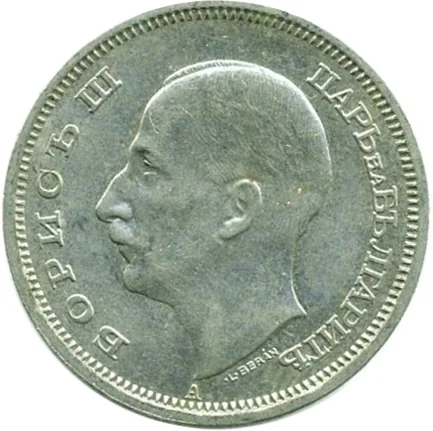
Obverse
Description:
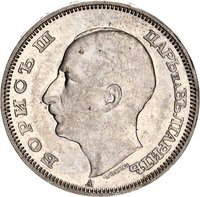
Tsar Boris III of Bulgaria, left.
Inscription:
БОРИСЪ III
ЦАРЬнаБЪЛГАРИТѢ
∙L∙BERAN
A
ЦАРЬнаБЪЛГАРИТѢ
∙L∙BERAN
A
Translation:
BORIS III
TSAR OF BULGARIA
∙L∙BERAN
TSAR OF BULGARIA
∙L∙BERAN
Script: Cyrillic
Languages: Bulgarian, Church Slavonic
Engraver: Lajos Berán
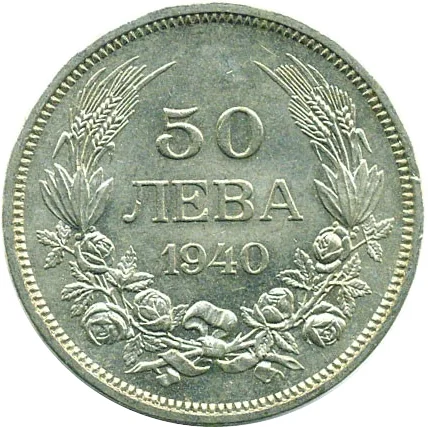
Reverse
Edge
Smooth with inscription
Legend:
БОЖЕ ПАЗИ БЪЛГАРИЯ *
Translation:
God Save Bulgaria *
Language: Bulgarian
Mints
| Name | Mark |
|---|---|
| Berlin | A |
Mintings
| Year | Mint Mark | Mintage | Quality | Collection |
|---|---|---|---|---|
| 1940 | A | 12,340,000 |
Historical background
In 1940, Bulgaria's currency situation was defined by its complex political alignment and the economic pressures of the early Second World War. The official currency was the Bulgarian lev, managed by the Bulgarian National Bank, but its stability was heavily contingent on foreign influence. The country, under the authoritarian rule of Tsar Boris III, was formally neutral but increasingly within the German economic and political sphere. This was solidified by the 1940 Kladovo Agreement, which effectively tied Bulgaria to the Nazi economic bloc, the "Reichsmark zone."
Consequently, the lev's value was pegged to and supported by the German Reichsmark at a fixed rate, rather than to gold or other hard currencies. This linkage provided a degree of artificial stability for wartime trade with Germany and its allies, ensuring a market for Bulgarian agricultural and raw material exports. However, it also meant Bulgaria's economy and currency were directly vulnerable to German wartime financial policies and the escalating costs of the conflict. Inflationary pressures were mounting, though not yet hyperinflationary, as the government began financing its spending through increased borrowing from the central bank.
Underneath this controlled official economy, a growing black market for scarce goods and foreign currency (like the US dollar or Swiss franc) began to emerge, reflecting underlying public anxiety and the distortions of a wartime command economy. The situation was a precarious balancing act: the peg to the Reichsmark facilitated crucial trade and German support for Bulgaria's territorial ambitions, but it also set the stage for severe economic dislocation and currency instability in the coming years as the war turned against the Axis powers.
Consequently, the lev's value was pegged to and supported by the German Reichsmark at a fixed rate, rather than to gold or other hard currencies. This linkage provided a degree of artificial stability for wartime trade with Germany and its allies, ensuring a market for Bulgarian agricultural and raw material exports. However, it also meant Bulgaria's economy and currency were directly vulnerable to German wartime financial policies and the escalating costs of the conflict. Inflationary pressures were mounting, though not yet hyperinflationary, as the government began financing its spending through increased borrowing from the central bank.
Underneath this controlled official economy, a growing black market for scarce goods and foreign currency (like the US dollar or Swiss franc) began to emerge, reflecting underlying public anxiety and the distortions of a wartime command economy. The situation was a precarious balancing act: the peg to the Reichsmark facilitated crucial trade and German support for Bulgaria's territorial ambitions, but it also set the stage for severe economic dislocation and currency instability in the coming years as the war turned against the Axis powers.
🌱 Very Common