


100 francs – Guinea
Add to wishlist
Guinea

Obverse
Description:
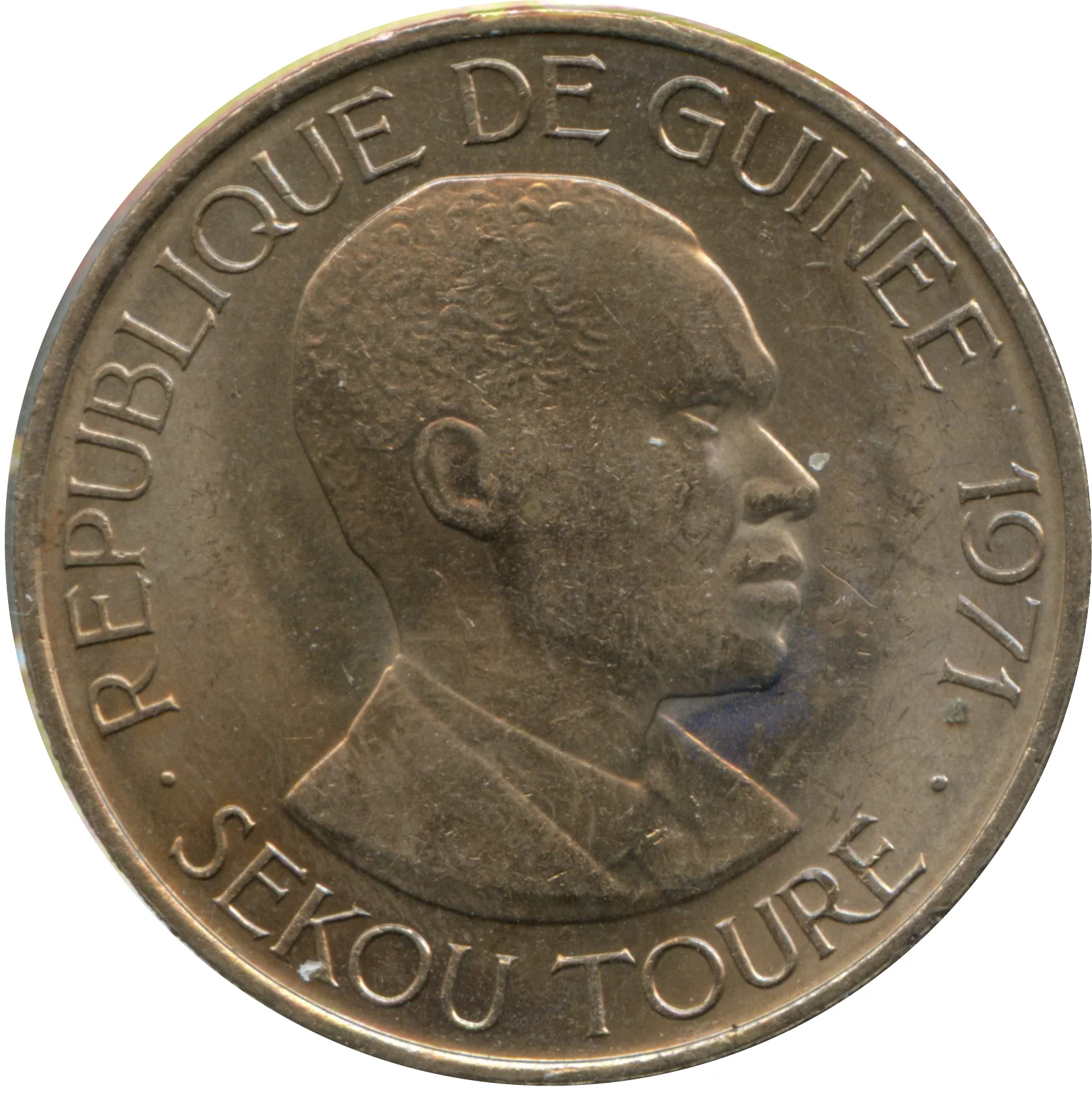
Ahmed Sékou Touré bust, right profile.
Inscription:
REPUBLIQUE DE GUINEE 1971
· SEKOU TOURE ·
· SEKOU TOURE ·
Translation:
REPUBLIC OF GUINEA 1971
· SEKOU TOURE ·
· SEKOU TOURE ·
Script: Latin
Language: French
Engraver: Paul Vincze
Reverse
Description:
Wreath denomination
Inscription:
LE PREMIER MARS 1960
100 FRANCS GUINEENS
·TRAVAIL-JUSTICE-SOLIDARITE·
100 FRANCS GUINEENS
·TRAVAIL-JUSTICE-SOLIDARITE·
Translation:
The First of March 1960
100 Guinean Francs
·LABOR-JUSTICE-SOLIDARITY·
100 Guinean Francs
·LABOR-JUSTICE-SOLIDARITY·
Script: Latin
Language: French
Engraver: Paul Vincze
Edge
Reeded
Categories
| Person> Politician |
| Symbol> Wreath |
Mints
| Name | Mark |
|---|---|
| Royal Mint (Tower Hill) | — |
Mintings
| Year | Mint Mark | Mintage | Quality | Collection |
|---|---|---|---|---|
| 1971 | — | 2,585,000 |
Historical background
In 1971, the Republic of Guinea was operating under a unique and isolated monetary system, a direct consequence of its political rupture with France. Upon achieving independence in 1958, Guinea's immediate rejection of French colonial authority led France to withdraw all administrative and financial support, including the removal of the West African CFA franc. In response, President Ahmed Sékou Touré's government launched its own currency, the Guinean franc (GNF), in 1960, symbolizing economic sovereignty but also cutting the country off from the Franc Zone and broader international financial systems.
By 1971, the Guinean economy and its currency were under severe strain due to a combination of factors. The state's adoption of a centrally planned "Command Economy," inspired by socialist models, led to inefficient production, shortages of goods, and a thriving black market. Furthermore, the government's policy of financing ambitious state projects and deficits by simply printing more money resulted in significant inflation. The official exchange rate became increasingly divorced from reality, as the black market rate for the Guinean franc was many times higher than the government-set value, severely undermining both domestic confidence and foreign trade.
This precarious monetary situation was compounded by Guinea's political isolation and the "Economic Sabotage" plot of 1971, a period of intense internal repression. The government, blaming economic difficulties on foreign agents and internal enemies, tightened controls but failed to address the structural flaws. Consequently, by the end of 1971, the Guinean franc was a largely non-convertible currency, representing an economy crippled by isolation, mismanagement, and the profound challenges of pursuing an independent path outside of established regional and international financial frameworks.
By 1971, the Guinean economy and its currency were under severe strain due to a combination of factors. The state's adoption of a centrally planned "Command Economy," inspired by socialist models, led to inefficient production, shortages of goods, and a thriving black market. Furthermore, the government's policy of financing ambitious state projects and deficits by simply printing more money resulted in significant inflation. The official exchange rate became increasingly divorced from reality, as the black market rate for the Guinean franc was many times higher than the government-set value, severely undermining both domestic confidence and foreign trade.
This precarious monetary situation was compounded by Guinea's political isolation and the "Economic Sabotage" plot of 1971, a period of intense internal repression. The government, blaming economic difficulties on foreign agents and internal enemies, tightened controls but failed to address the structural flaws. Consequently, by the end of 1971, the Guinean franc was a largely non-convertible currency, representing an economy crippled by isolation, mismanagement, and the profound challenges of pursuing an independent path outside of established regional and international financial frameworks.
⭐ Rare