

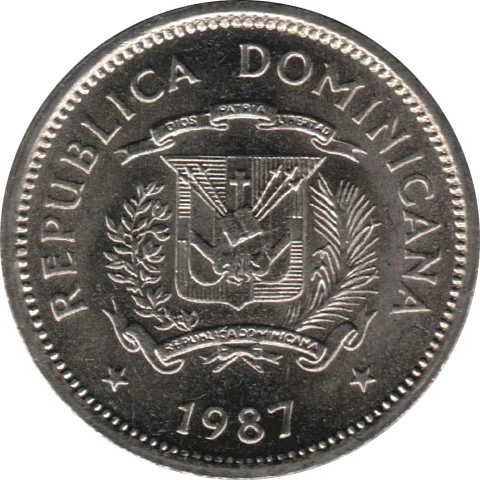
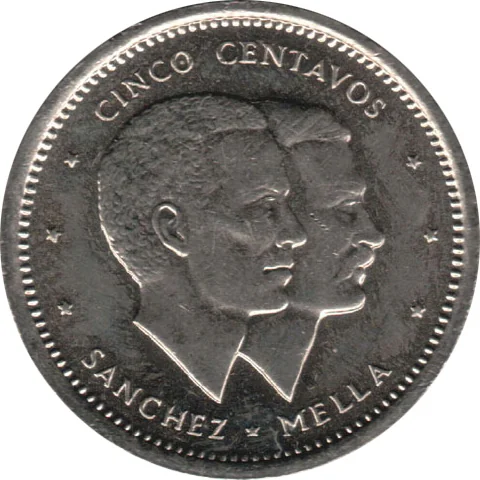
5 Centavos – Dominican Republic
Dominican Republic
Context
Years: 1983–1987
Issuer: Dominican Republic 
Period:
(since 1966)
Currency:
(since 1937)
Total mintage: 36,902,500
Material
Diameter: 21.2 mm
Weight: 5 g
Thickness: 1.85 mm
Shape: Round
Composition: Copper-nickel
Technique: Milled
Alignment: Coin alignment
flip
References
KM: #Click to copy to clipboard59
Numista: #6424
Value
Exchange value: 0.05 DOP
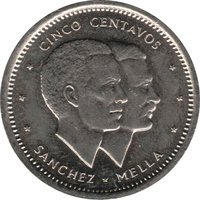
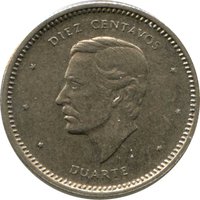
Obverse
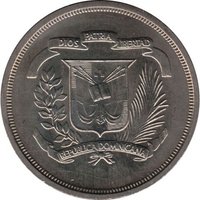
Reverse
Edge
Plain
Mints
| Name | Mark |
|---|---|
| Royal Canadian Mint of Winnipeg | — |
| Royal Mint | — |
| Mexican Mint | Mo |
Mintings
Historical background
In 1983, the Dominican Republic was navigating a period of significant economic strain and structural adjustment, with its currency, the Dominican Peso (DOP), under considerable pressure. The country was emerging from the turbulent 1970s, which had been marked by high global oil prices, falling sugar and commodity export revenues, and heavy external borrowing. This legacy left the government of President Salvador Jorge Blanco grappling with a severe foreign debt crisis, rampant inflation, and a large fiscal deficit, all of which eroded confidence in the national currency and drained international reserves.
The official exchange rate was fixed by the central bank, but a wide and thriving black market for US dollars exposed the peso's overvaluation. This parallel market rate was significantly higher than the official rate, reflecting strong demand for hard currency and a lack of faith in the peso. The government's attempts to maintain the peg and control the currency became unsustainable, leading to periodic devaluations that were often too little and too late, causing economic disruption and public discontent.
Consequently, 1983 was a pivotal year that set the stage for a major economic shift. Under pressure from the International Monetary Fund (IMF) to stabilize the economy, the government implemented a series of austerity measures. These painful reforms, including cuts to subsidies on basic goods and fuel, would ultimately spark widespread social protests in 1984. The currency instability of this period directly paved the way for a more flexible exchange rate system in the following years, moving away from the rigid and unsustainable peg that characterized the early 1980s.
The official exchange rate was fixed by the central bank, but a wide and thriving black market for US dollars exposed the peso's overvaluation. This parallel market rate was significantly higher than the official rate, reflecting strong demand for hard currency and a lack of faith in the peso. The government's attempts to maintain the peg and control the currency became unsustainable, leading to periodic devaluations that were often too little and too late, causing economic disruption and public discontent.
Consequently, 1983 was a pivotal year that set the stage for a major economic shift. Under pressure from the International Monetary Fund (IMF) to stabilize the economy, the government implemented a series of austerity measures. These painful reforms, including cuts to subsidies on basic goods and fuel, would ultimately spark widespread social protests in 1984. The currency instability of this period directly paved the way for a more flexible exchange rate system in the following years, moving away from the rigid and unsustainable peg that characterized the early 1980s.
🌱 Very Common