

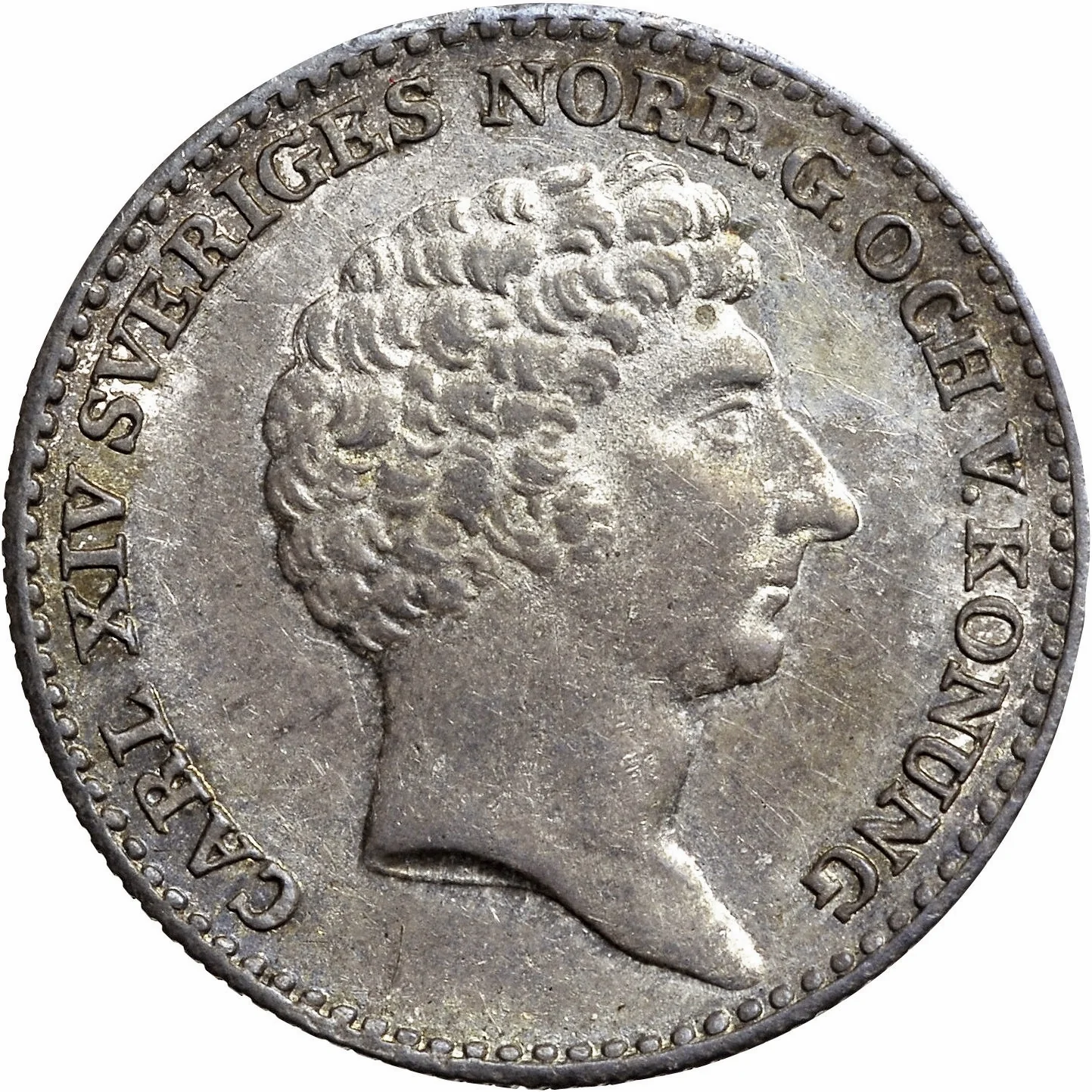
⅙ Riksdaler – Sweden
Sweden
Context
Years: 1828–1829
Issuer: Sweden 
Ruler: Charles XIV John
Currency:
(1798—1830)
Demonetized: Yes
Total mintage: 3,063
Material
References
KM: #Click to copy to clipboard615
Numista: #64141
Value
Bullion value: $12.24
Obverse
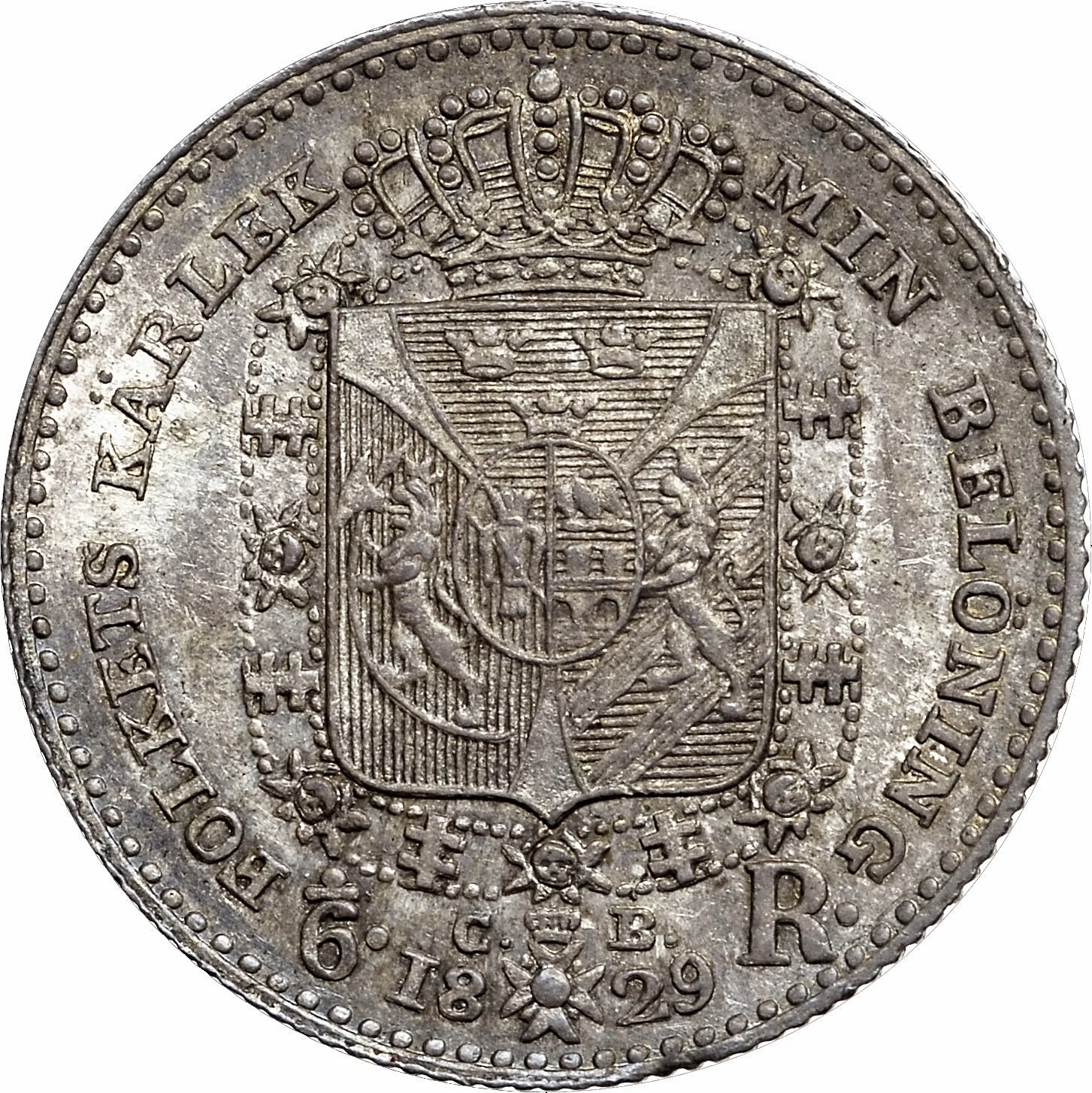
Reverse
Description:
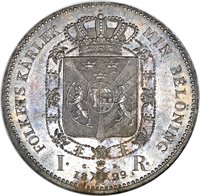
Shield flanked by crowned lions, topped with three crowns. Seraphim chain divides date and mintmark below; motto along rim. Chain features seven angel heads.
Inscription:
FOLKETS KÄRLEK MIN BELÖNING
./6. R.
C. B.
18 29
./6. R.
C. B.
18 29
Translation:
The People's Love My Reward
./6. R.
C. B.
18 29
./6. R.
C. B.
18 29
Script: Latin
Language: Swedish
Edge
Lettering
Categories
| Symbols> Coat of Arms |
Mintings
| Year | Mint Mark | Mintage | Quality | Collection |
|---|---|---|---|---|
| 1828 | CB | 1,024 | ||
| 1829 | CB | 2,039 |
Historical background
In 1828, Sweden operated under a complex and strained monetary system, a legacy of the Napoleonic Wars. The country was on a silver standard de jure, but in practice, the currency was dominated by the riksdaler riksmynt, a paper money issued by the central bank, the Riksbank. This paper money was theoretically convertible to silver, but the bank had suspended convertibility in 1809 due to war financing needs, leading to significant depreciation. Consequently, Sweden had a dual system: a silver-based riksdaler specie for international trade and a fluctuating, less valuable paper riksdaler riksmynt for domestic use, causing confusion and economic friction.
The period was marked by deflationary pressure and a drive towards monetary stability. Following the war, a major goal was to restore the value of the paper currency and eventually resume silver convertibility, a policy known as växelkursrestriktion (exchange rate restriction). By 1828, this policy had been in effect for over a decade, slowly increasing the value of the paper riksdaler towards its par value with silver. While successful in curbing inflation and restoring some confidence, this deliberate deflation also created economic hardship, particularly for debtors who had to repay loans with increasingly valuable currency.
Thus, the currency situation in 1828 was one of transition and austerity. The Riksbank, under the leadership of Lars von Engeström, was rigorously managing the money supply to continue the appreciation of the paper riksdaler. The ultimate aim was to unify the monetary system and return to a secure silver standard, a goal that would be realized a few years later in 1834. The policies of 1828, therefore, represented the difficult and contractionary final phase of a long stabilization effort following the fiscal excesses of the early 19th century.
The period was marked by deflationary pressure and a drive towards monetary stability. Following the war, a major goal was to restore the value of the paper currency and eventually resume silver convertibility, a policy known as växelkursrestriktion (exchange rate restriction). By 1828, this policy had been in effect for over a decade, slowly increasing the value of the paper riksdaler towards its par value with silver. While successful in curbing inflation and restoring some confidence, this deliberate deflation also created economic hardship, particularly for debtors who had to repay loans with increasingly valuable currency.
Thus, the currency situation in 1828 was one of transition and austerity. The Riksbank, under the leadership of Lars von Engeström, was rigorously managing the money supply to continue the appreciation of the paper riksdaler. The ultimate aim was to unify the monetary system and return to a secure silver standard, a goal that would be realized a few years later in 1834. The policies of 1828, therefore, represented the difficult and contractionary final phase of a long stabilization effort following the fiscal excesses of the early 19th century.
✨ Legendary