

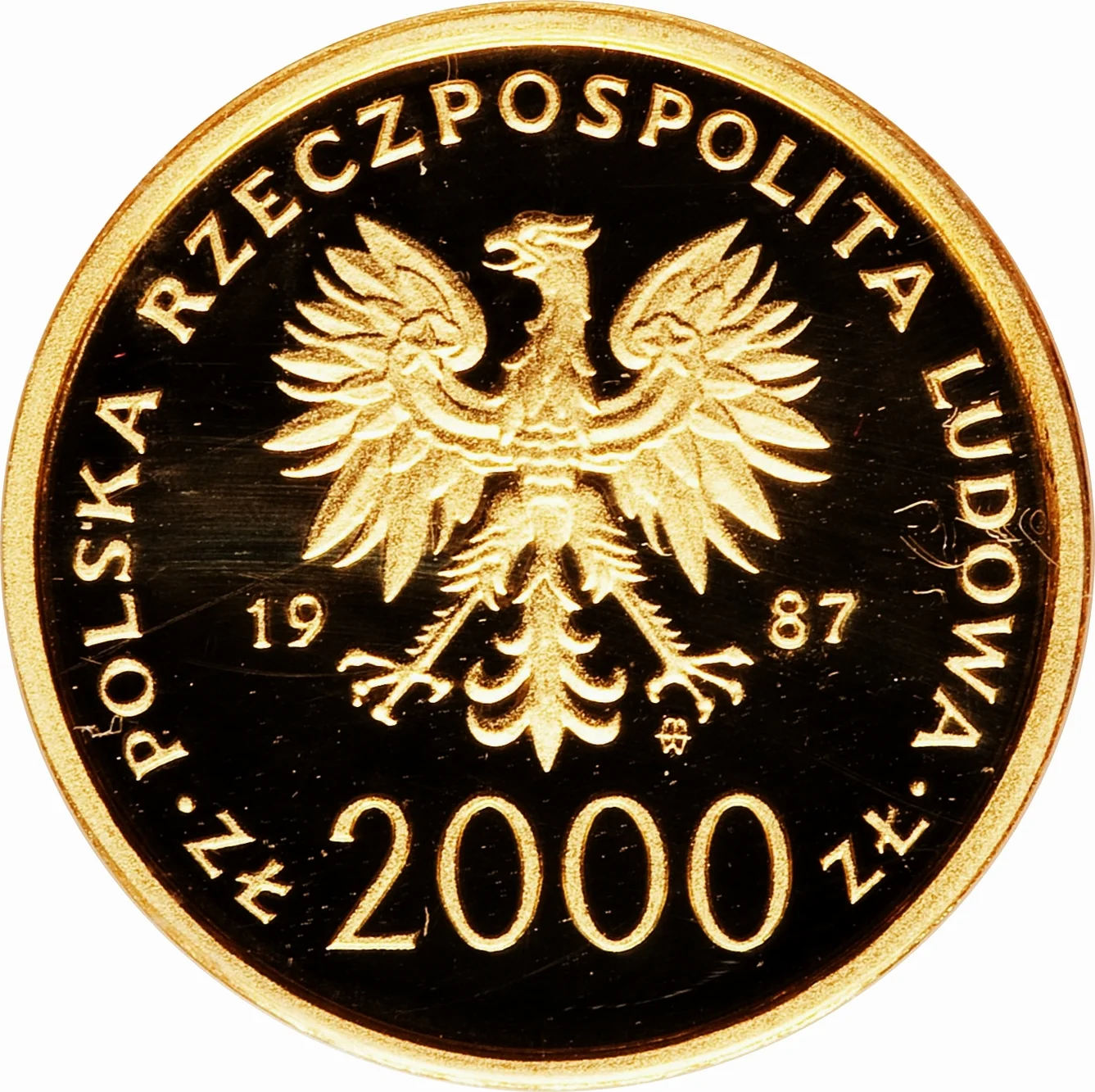
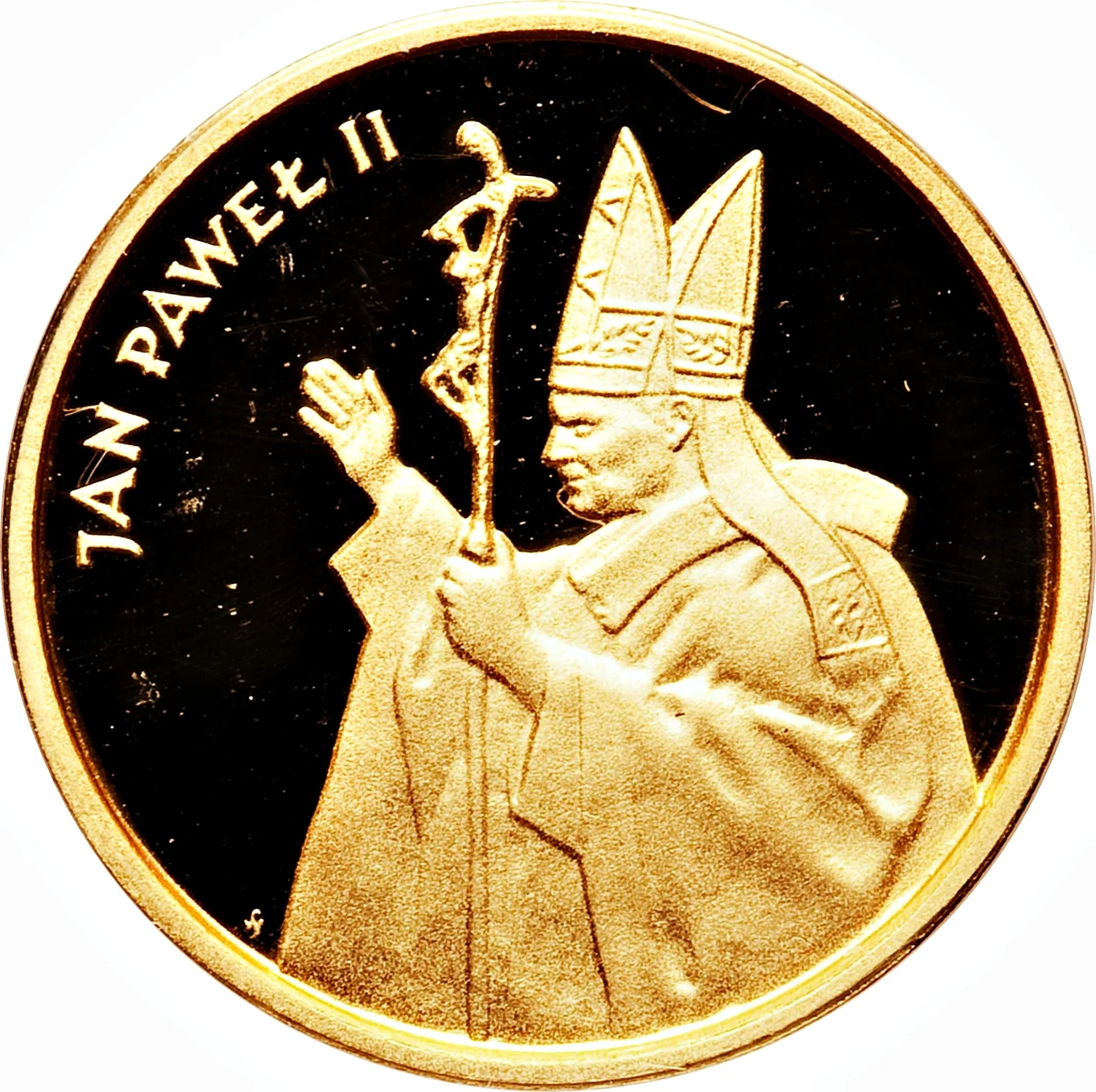
2000 Zlotys – Poland
Non-circulating coins
Commemoration: Visit of Pope Ioannes Paulus II
Poland
Context
Year: 1987
Issuer: Poland 
Period:
(1952—1989)
Currency:
(1949—1994)
Demonetized: Yes
Total mintage: 201
Material
Diameter: 22 mm
Weight: 7.78 g
Gold weight: 7.77 g
Shape: Round
Composition: 99.9% Gold
Standard: Silver quarter ounce
Magnetic: No
Technique: Milled
Alignment: Medal alignment
flip
References
Y: #Click to copy to clipboard169
Numista: #63793
Value
Exchange value: 2000 PLZ
Bullion value: $1299.09
Inflation-adjusted value: 2223662.30 PLZ
Obverse
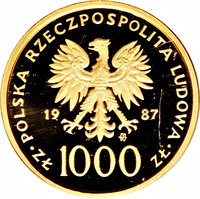
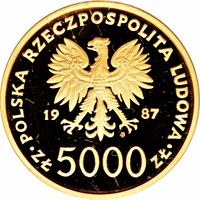
Inscription:
· POLSKA RZECZPOSPOLITA LUDOWA ·
19 87
mw
ZŁ 2000 ZŁ
19 87
mw
ZŁ 2000 ZŁ
Translation:
· POLISH PEOPLE'S REPUBLIC ·
19 87
mw
ZŁ 2000 ZŁ
19 87
mw
ZŁ 2000 ZŁ
Script: Latin
Language: Polish
Engraver: Stanisława Wątróbska-Frindt
Reverse
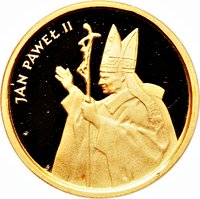
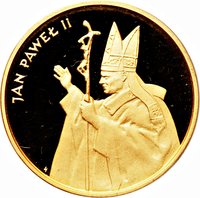
Inscription:
JAN PAWEŁ II
SWF
SWF
Translation:
John Paul II
Sede Vacante Feria Quarta
Sede Vacante Feria Quarta
Script: Latin
Engraver: Stanisława Wątróbska-Frindt
Edge
Plain
Categories
| Person> Religious figure |
Mints
| Name | Mark |
|---|---|
| Mint of Poland | (MW) |
Mintings
| Year | Mint Mark | Mintage | Quality | Collection |
|---|---|---|---|---|
| 1987 | MW | 201 | Proof |
Historical background
In 1987, Poland's currency situation was a critical symptom of the deepening crisis within its centrally planned economy. The Polish złoty (PLN) was a non-convertible currency, artificially pegged by the communist government at an official rate that bore no relation to its real market value. This created a vast black market for foreign currency, particularly US dollars and West German marks, where the złoty traded at a fraction of its official rate. This "dollarization" of the economy was pervasive, as hard currency became essential for purchasing scarce goods, accessing luxury items, or even for meaningful savings, severely undermining confidence in the national currency.
The root causes were systemic: decades of economic mismanagement, massive foreign debt accumulated in the 1970s, chronic shortages of consumer goods, and hyperinflation that had peaked earlier in the decade. Although the martial law period of the early 1980s had imposed a grim stability, by 1987 inflationary pressures were again building. The government, led by General Wojciech Jaruzelski, was attempting limited reforms without abandoning socialist principles, but its efforts to control prices and wages only distorted the economy further. Production was inefficient, and the złoty's inability to be exchanged internationally stifled trade and investment.
This monetary dysfunction was a key factor pushing the authorities toward negotiations with the banned Solidarity trade union. The regime recognized that economic recovery—and accessing crucial Western loans—was impossible without political stabilization and more radical market reforms. Thus, the currency chaos of 1987 set the stage for the pivotal political transformations that would follow, culminating in the Round Table Talks of 1989 and the eventual transition to a market economy, where establishing a stable, convertible złoty became a paramount goal.
The root causes were systemic: decades of economic mismanagement, massive foreign debt accumulated in the 1970s, chronic shortages of consumer goods, and hyperinflation that had peaked earlier in the decade. Although the martial law period of the early 1980s had imposed a grim stability, by 1987 inflationary pressures were again building. The government, led by General Wojciech Jaruzelski, was attempting limited reforms without abandoning socialist principles, but its efforts to control prices and wages only distorted the economy further. Production was inefficient, and the złoty's inability to be exchanged internationally stifled trade and investment.
This monetary dysfunction was a key factor pushing the authorities toward negotiations with the banned Solidarity trade union. The regime recognized that economic recovery—and accessing crucial Western loans—was impossible without political stabilization and more radical market reforms. Thus, the currency chaos of 1987 set the stage for the pivotal political transformations that would follow, culminating in the Round Table Talks of 1989 and the eventual transition to a market economy, where establishing a stable, convertible złoty became a paramount goal.
✨ Legendary