

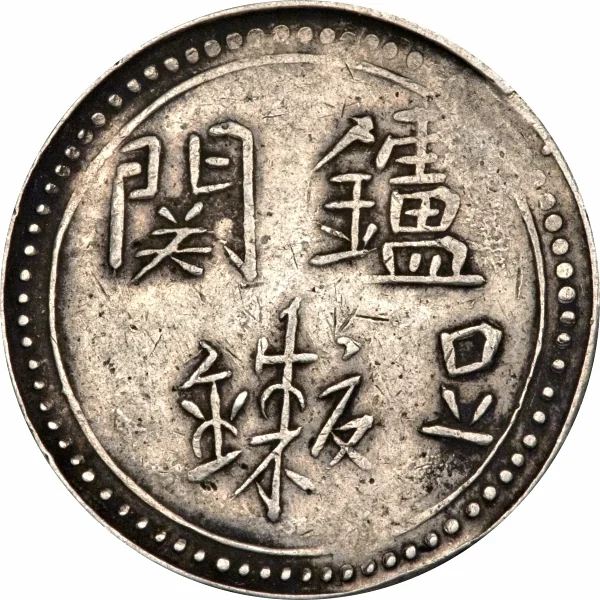
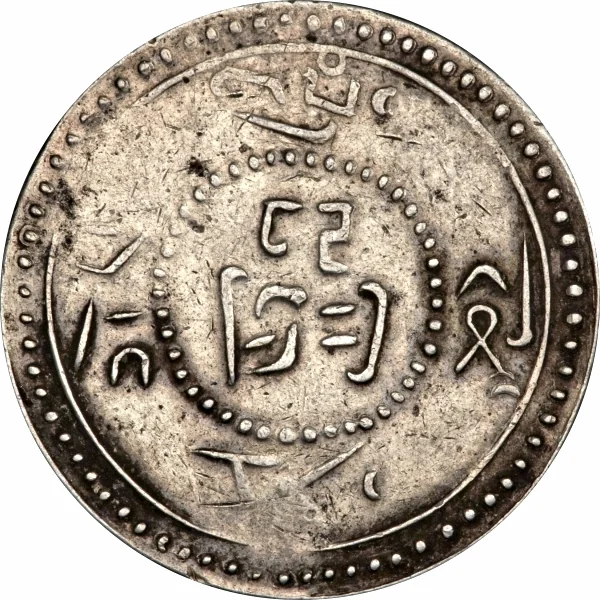
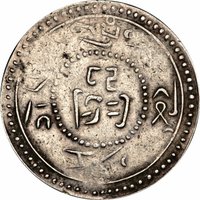
Obverse
Description:
四汉字
Inscription:
関 鑪
[?]
[?]
Translation:
Guan Lu
Scripts: Chinese (traditional, regular script)
Language: Classical Chinese
Reverse
Edge
Plain
Mints
| Name | Mark |
|---|---|
| Kangding, Sichuan | — |
Mintings
| Year | Mint Mark | Mintage | Quality | Collection |
|---|---|---|---|---|
| — | — | — | ||
| 1903 | — | — |
Historical background
In 1902, the currency situation in Tibet was a complex tapestry of local tradition, regional influence, and imperial pressure. The primary circulating medium was the Tibetan silver tangka (or srang), a coin minted in Lhasa and other centers like Derge. However, the monetary system was not unified; the tangka's weight and silver purity varied significantly between different issuing authorities, leading to confusion in trade. Alongside these, Chinese silver sycee ingots, Indian rupees, and even Nepalese mohars circulated, particularly in border regions, reflecting Tibet's position at the crossroads of empires.
This monetary fragmentation was exacerbated by growing British imperial ambition. The Indian rupee, backed by the powerful British Raj, was making increasing inroads, especially in southern Tibet near the trade routes to Sikkim and Bhutan. British trade agents and the Younghusband Expedition (which would invade in 1903-04) actively promoted the rupee's use to facilitate commerce and extend economic influence. This created a de facto currency competition, undermining the authority of the Lhasa government and the Qing officials stationed in Tibet.
Internally, the Tibetan government under the 13th Dalai Lama faced the challenge of asserting sovereignty through a stable currency, while externally, it was caught between two weakening powers: the declining Qing Dynasty, which claimed suzerainty but had limited practical control over Tibetan minting, and the expanding British Empire. The year 1902 thus represents a precarious moment on the eve of major military conflict, with the currency market mirroring the broader political struggle for control over Tibet's economic and political future.
This monetary fragmentation was exacerbated by growing British imperial ambition. The Indian rupee, backed by the powerful British Raj, was making increasing inroads, especially in southern Tibet near the trade routes to Sikkim and Bhutan. British trade agents and the Younghusband Expedition (which would invade in 1903-04) actively promoted the rupee's use to facilitate commerce and extend economic influence. This created a de facto currency competition, undermining the authority of the Lhasa government and the Qing officials stationed in Tibet.
Internally, the Tibetan government under the 13th Dalai Lama faced the challenge of asserting sovereignty through a stable currency, while externally, it was caught between two weakening powers: the declining Qing Dynasty, which claimed suzerainty but had limited practical control over Tibetan minting, and the expanding British Empire. The year 1902 thus represents a precarious moment on the eve of major military conflict, with the currency market mirroring the broader political struggle for control over Tibet's economic and political future.
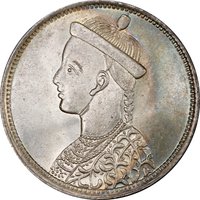
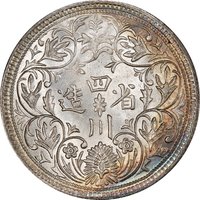

✨ Legendary