

10 dinars – Jordan
Add to wishlist
Non-circulating coins
Commemoration: Visit of Pope Paul VI
Jordan
Context
Year: 1969
Islamic (Hijri) Year:: 1389
Issuer: Jordan
Ruler: Hussein bin Talal
Currency:
(since 1949)
Total mintage: 1,870
Material
References
KM: #
Numista: #63018
Value
Exchange value: 10 JOD
Bullion value: $3837.19
Obverse
Description:
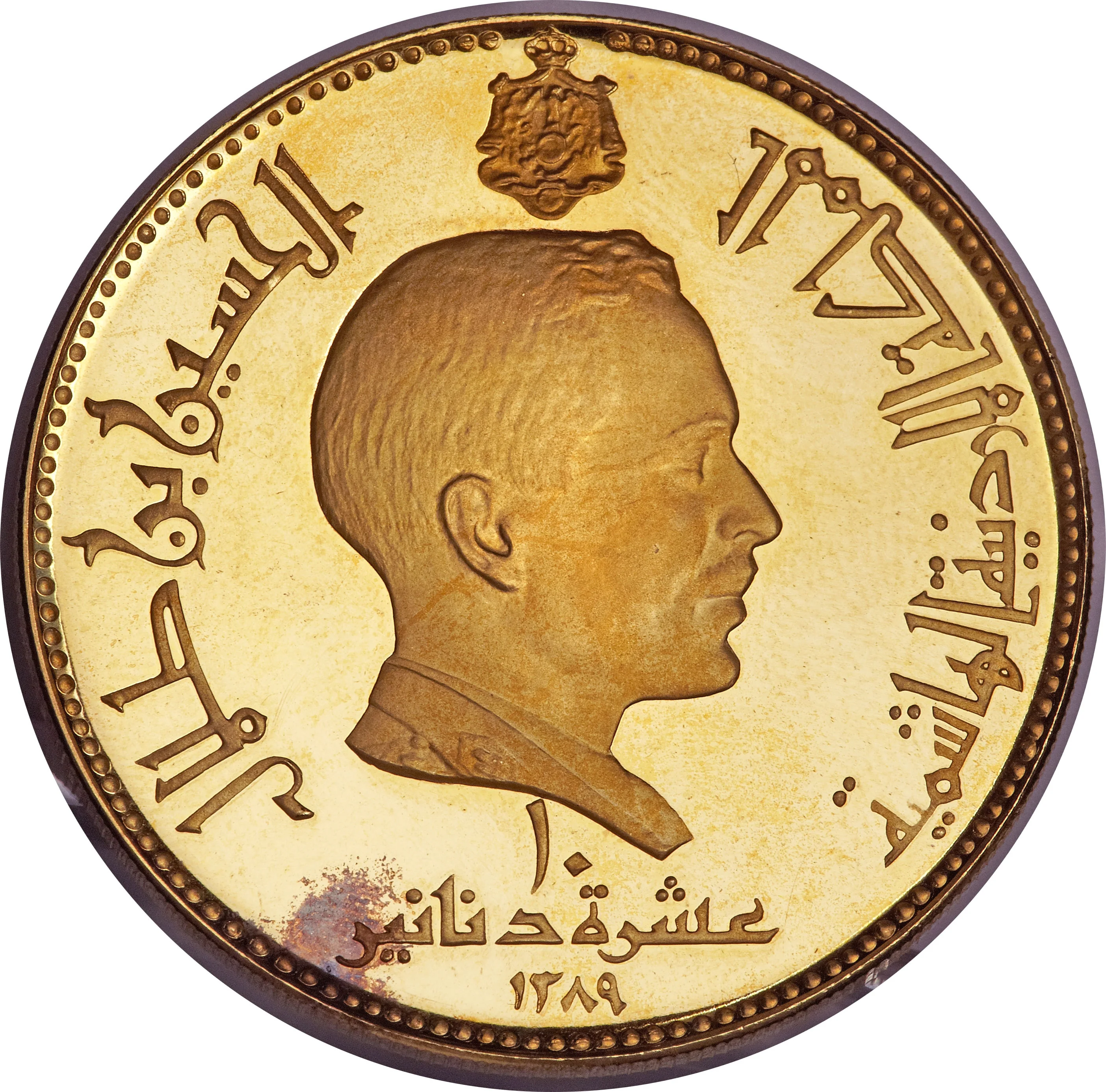
King Husayn facing right, with denomination and date below.
Inscription:
١٠
١٣٨۶
١٣٨۶
Reverse
Description:
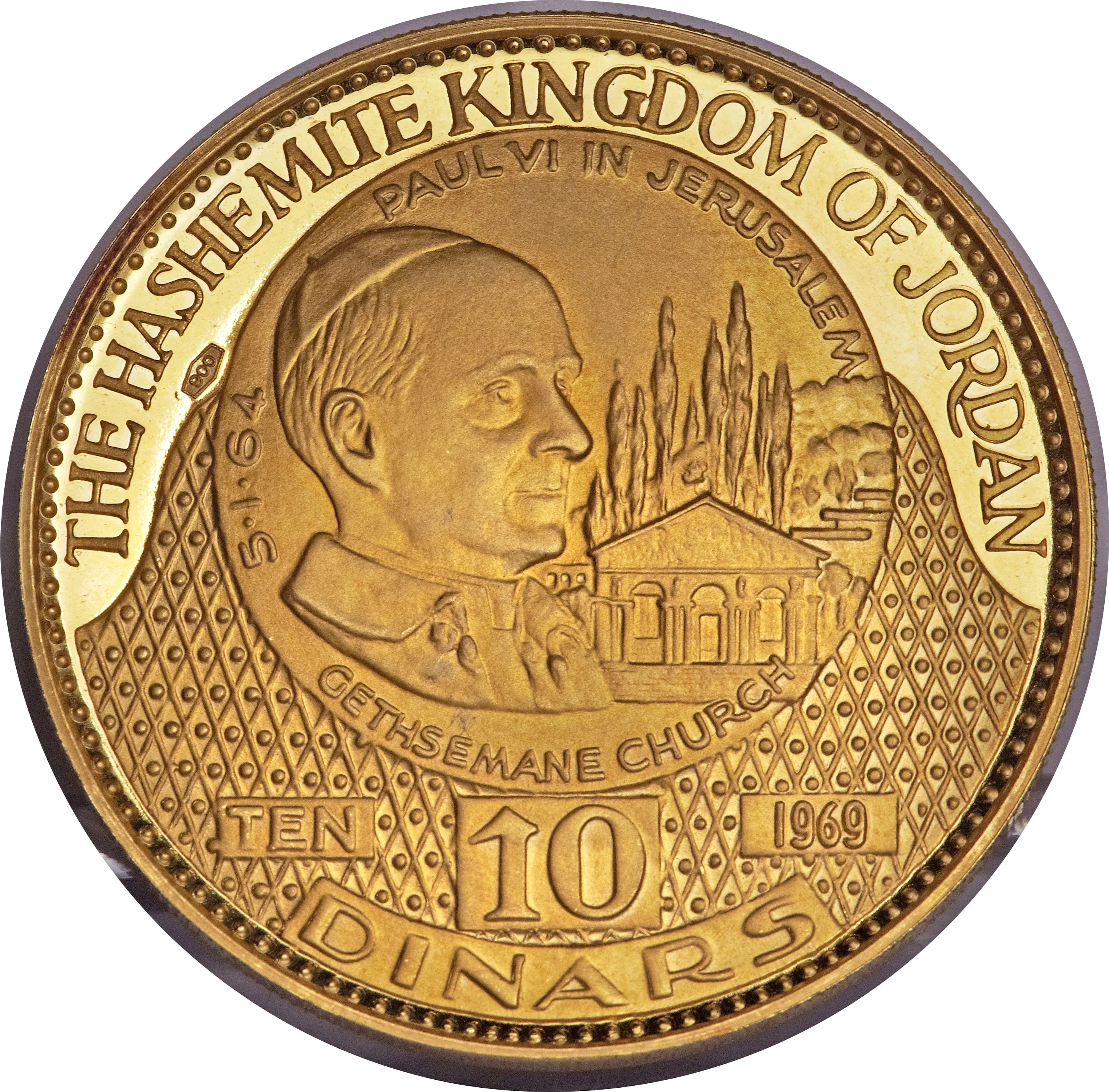
Pope Paul VI facing right, Gethsemane church behind, with denomination and date below.
Inscription:
THE HASHEMITE KINGDOM
900
5.1.64 PAUL VI IN JERUSALEM
GETHSEMANE CHURCH
TEN 1969
10 DINARS
900
5.1.64 PAUL VI IN JERUSALEM
GETHSEMANE CHURCH
TEN 1969
10 DINARS
Edge
Reeded
Categories
| Building> Religious building |
| Person> Monarch |
| Person> Religious figure |
Mintings
| Year | Mint Mark | Mintage | Quality | Collection |
|---|---|---|---|---|
| 1969 | — | 1,870 | Proof |
Historical background
In 1969, Jordan's currency situation was defined by its reliance on the Jordanian dinar (JOD), which was pegged to and fully backed by the British pound sterling. This arrangement was a legacy of the British Mandate period and provided significant stability, as the dinar was convertible at a fixed rate of one dinar to one pound sterling. The country's central bank, the Central Bank of Jordan (established in 1964), managed this peg, holding substantial reserves in sterling to ensure confidence in the currency. This stability was crucial for a nation with limited natural resources, relying on foreign aid, remittances, and a growing services sector.
However, the stability of this system faced a major external shock in late 1967 with the devaluation of the British pound. In response, Jordan severed the direct peg to the sterling and instead pegged the dinar to the US dollar at a rate of 1 JOD = 2.80 USD, a parity that remains fundamentally in place today. This decisive move in November 1967 was aimed at protecting the value of Jordan's reserves and maintaining monetary stability following the turbulence of the 1967 Arab-Israeli War, which had resulted in the loss of the West Bank and a massive influx of refugees.
By 1969, the currency situation was in a period of cautious transition and consolidation under the new dollar peg. The Central Bank was focused on building up dollar reserves and managing the money supply to control inflation, which was a growing concern due to increased government spending on defense and development. The economy was under strain, but the swift re-pegging two years prior had successfully averted a currency crisis, providing a stable foundation as King Hussein's government navigated a complex political and economic landscape.
However, the stability of this system faced a major external shock in late 1967 with the devaluation of the British pound. In response, Jordan severed the direct peg to the sterling and instead pegged the dinar to the US dollar at a rate of 1 JOD = 2.80 USD, a parity that remains fundamentally in place today. This decisive move in November 1967 was aimed at protecting the value of Jordan's reserves and maintaining monetary stability following the turbulence of the 1967 Arab-Israeli War, which had resulted in the loss of the West Bank and a massive influx of refugees.
By 1969, the currency situation was in a period of cautious transition and consolidation under the new dollar peg. The Central Bank was focused on building up dollar reserves and managing the money supply to control inflation, which was a growing concern due to increased government spending on defense and development. The economy was under strain, but the swift re-pegging two years prior had successfully averted a currency crisis, providing a stable foundation as King Hussein's government navigated a complex political and economic landscape.
✨ Legendary