

10 Florin – Aruba
Non-circulating coins
Commemoration: Investiture of king Willem-Alexander
Netherlands
Context
Year: 2013
Country: Netherlands 
Issuer: Aruba
Ruler: Willem-Alexander
Currency:
(since 1986)
Total mintage: 750
Material
References
KM: #Click to copy to clipboard55
Numista: #62875
Value
Exchange value: 10 AWG
Bullion value: $206.30
Inflation-adjusted value: 13.45 AWG
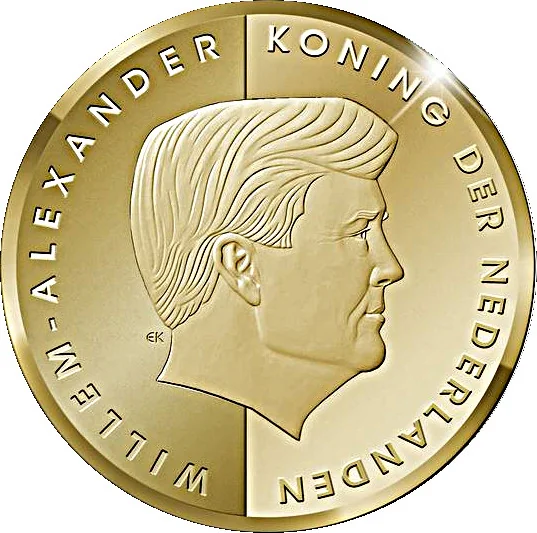
Obverse
Description:
King Willem-Alexander facing right
Inscription:
WILLEM-ALEXANDER KONING DER NEDERLANDEN
EK
EK
Translation:
WILLEM-ALEXANDER KING OF THE NETHERLANDS
Script: Latin
Language: Dutch
Engraver: Elles Kloosterman
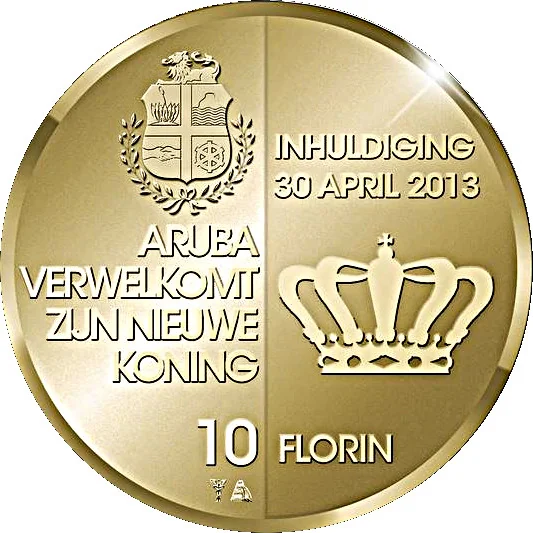
Reverse
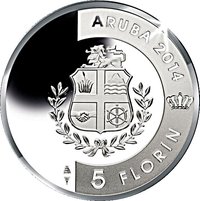
Description:
Aruba's coat of arms left, crown right, denomination below.
Inscription:
INHULDIGING 30 APRIL 2013
ARUBA VERWELKOMT ZIJN NIEUWE KONING
5 FLORIN
ARUBA VERWELKOMT ZIJN NIEUWE KONING
5 FLORIN
Translation:
Inauguration 30 April 2013
Aruba Welcomes Its New King
5 Florin
Aruba Welcomes Its New King
5 Florin
Script: Latin
Languages: Papiamento, Dutch
Engraver: Elles Kloosterman
Edge
Reeded
Mints
| Name | Mark |
|---|---|
| Royal Dutch Mint | — |
Mintings
| Year | Mint Mark | Mintage | Quality | Collection |
|---|---|---|---|---|
| 2013 | — | 750 | Proof |
Historical background
In 2013, Aruba's currency situation was defined by its continued use of the Aruban florin (AWG), which had been pegged to the United States dollar at a fixed and stable rate of 1.79 AWG to 1 USD since 1986. This peg, managed by Aruba's central bank (Centrale Bank van Aruba), provided a crucial anchor for the island's small, open, and tourism-dependent economy. The primary benefit was the elimination of exchange rate volatility for the vital tourism and trade sectors, with the US dollar being the dominant currency for visitors and imports. This stability fostered investor confidence and helped control inflation, which remained relatively low.
However, maintaining this fixed peg required consistent foreign exchange reserves and prudent fiscal policy. The central bank's monetary policy was largely dedicated to defending the peg, limiting its ability to use interest rates for domestic economic stimulation. The years following the global financial crisis had put pressure on Aruba's economy, with elevated public debt and budget deficits posing challenges. In 2013, these fiscal imbalances were a point of focus, as they indirectly tested the sustainability of the currency regime by affecting the country's external position and reserve levels.
Overall, the currency situation in 2013 was one of entrenched stability on the surface, underpinned by a long-standing and credible peg. The system was a cornerstone of Aruba's economic policy, but it operated within the context of ongoing fiscal pressures. The central bank's key task was to maintain sufficient reserves and advocate for fiscal discipline to ensure the continued viability of the fixed exchange rate, which remained widely accepted by both the population and the business community as essential for economic predictability.
However, maintaining this fixed peg required consistent foreign exchange reserves and prudent fiscal policy. The central bank's monetary policy was largely dedicated to defending the peg, limiting its ability to use interest rates for domestic economic stimulation. The years following the global financial crisis had put pressure on Aruba's economy, with elevated public debt and budget deficits posing challenges. In 2013, these fiscal imbalances were a point of focus, as they indirectly tested the sustainability of the currency regime by affecting the country's external position and reserve levels.
Overall, the currency situation in 2013 was one of entrenched stability on the surface, underpinned by a long-standing and credible peg. The system was a cornerstone of Aruba's economic policy, but it operated within the context of ongoing fiscal pressures. The central bank's key task was to maintain sufficient reserves and advocate for fiscal discipline to ensure the continued viability of the fixed exchange rate, which remained widely accepted by both the population and the business community as essential for economic predictability.

✨ Legendary