

50 cents (Queen's reign) – Canada
Add to wishlist
Circulating commemorative coins
Commemoration: 50 years of the Queen's reign
Canada
Context
Material
References
Numista: #62647
Value
Exchange value: 0.50 CAD
Inflation-adjusted value: 0.83 CAD
Obverse
Description:
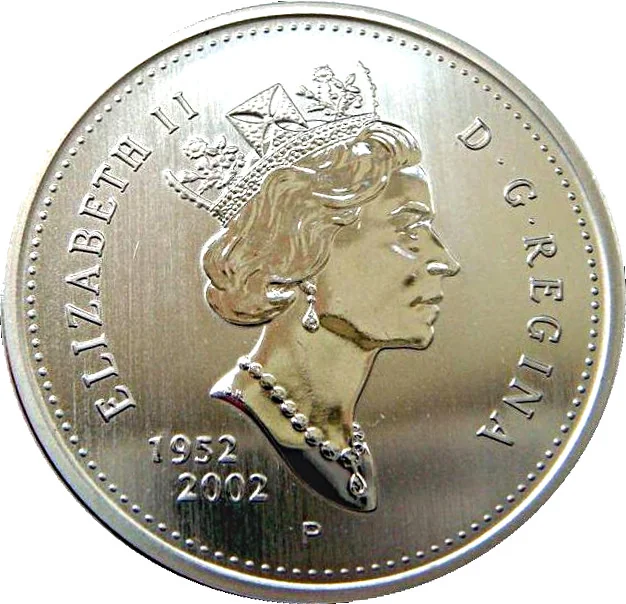
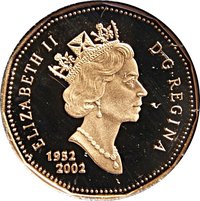
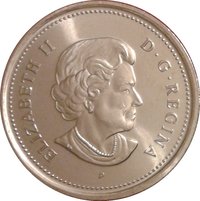
Queen Elizabeth II at 64, wearing the royal diadem and jewels, facing right.
Inscription:
ELIZABETH II
D•G•REGINA
1952
2002
P
D•G•REGINA
1952
2002
P
Translation:
Elizabeth II
By the Grace of God, Queen
1952
2002
P
By the Grace of God, Queen
1952
2002
P
Script: Latin
Engraver: Dora de Pédery-Hunt
Reverse
Description:
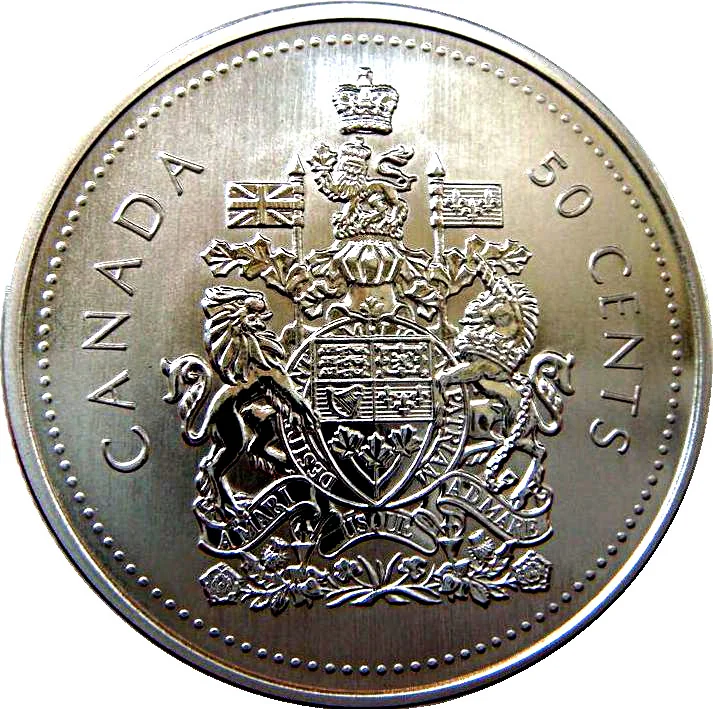
The Royal Coat of Arms of Canada, proclaimed in 1921 and updated in 1994, is encircled by the face value and "CANADA".
Inscription:
CANADA
50 CENTS
50 CENTS
Script: Latin
Engraver: Thomas Shingles
Edge
Reeded
Mints
| Name | Mark |
|---|---|
| Royal Canadian Mint of Ottawa | — |
Mintings
| Year | Mint Mark | Mintage | Quality | Collection |
|---|---|---|---|---|
| 2002 | — | 3,425,000 |
Historical background
In 2002, the Canadian dollar, often colloquially called the "loonie," was in the midst of a sustained period of historic weakness against the US dollar, a defining feature of the era's currency situation. Having traded below 70 cents US for much of the late 1990s, it began a tentative recovery but remained subdued, averaging approximately 63.7 cents US for the year. This multi-year low was driven by several structural factors, including lower commodity prices, a significant interest rate differential that favored US investments, and a general market perception of Canada's lower productivity growth compared to its southern neighbor.
The economic environment was one of cautious global recovery following the dot-com bust and the 9/11 attacks, with the Bank of Canada maintaining a accommodative monetary policy stance. Governor David Dodge, having taken office in 2001, was focused on supporting growth while keeping inflation within the 1-3% target range. The weak currency provided a notable boost to Canada's export-oriented sectors, particularly manufacturing and automotive industries, by making their goods more competitive in the crucial US market. However, it also increased the cost of imports, putting upward pressure on prices for consumers and businesses reliant on foreign goods and capital equipment.
By the end of 2002, the loonie had begun a more pronounced ascent, closing the year near 64 cents US and setting the stage for a dramatic, commodity-driven rally that would define the subsequent decade. This shift was prompted by early signs of a booming global demand for resources, particularly energy from Alberta's oil sands, which would soon reposition the Canadian dollar as a petro-currency. Thus, 2002 served as a pivotal transition year, marking the end of the prolonged trough and the beginning of a new era of currency strength linked to rising commodity super-cycles.
The economic environment was one of cautious global recovery following the dot-com bust and the 9/11 attacks, with the Bank of Canada maintaining a accommodative monetary policy stance. Governor David Dodge, having taken office in 2001, was focused on supporting growth while keeping inflation within the 1-3% target range. The weak currency provided a notable boost to Canada's export-oriented sectors, particularly manufacturing and automotive industries, by making their goods more competitive in the crucial US market. However, it also increased the cost of imports, putting upward pressure on prices for consumers and businesses reliant on foreign goods and capital equipment.
By the end of 2002, the loonie had begun a more pronounced ascent, closing the year near 64 cents US and setting the stage for a dramatic, commodity-driven rally that would define the subsequent decade. This shift was prompted by early signs of a booming global demand for resources, particularly energy from Alberta's oil sands, which would soon reposition the Canadian dollar as a petro-currency. Thus, 2002 served as a pivotal transition year, marking the end of the prolonged trough and the beginning of a new era of currency strength linked to rising commodity super-cycles.

🌟 Uncommon