

10 Pesos – Cuba
Non-circulating coins
Commemoration: Simon Bolivar - Liberator
Cuba
Obverse
Description:
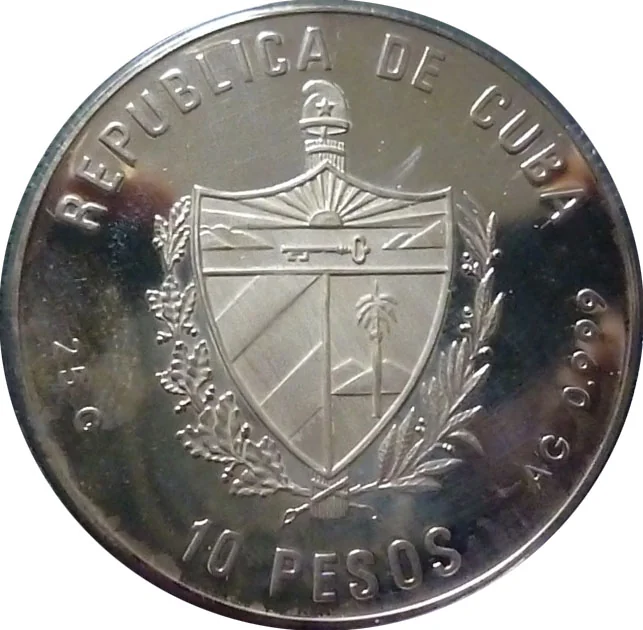
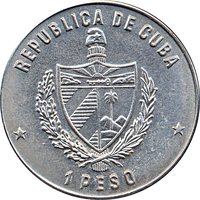
Cuban coat of arms with country name above, face value below, and weight/fineness on the sides.
Inscription:
REPUBLICA DE CUBA
25 G 10 PESOS AG 0.999
25 G 10 PESOS AG 0.999
Translation:
REPUBLIC OF CUBA
25 G 10 PESOS AG 0.999
25 G 10 PESOS AG 0.999
Script: Latin
Language: Spanish
Engraver: Charles Edward Barber
Reverse
Description:
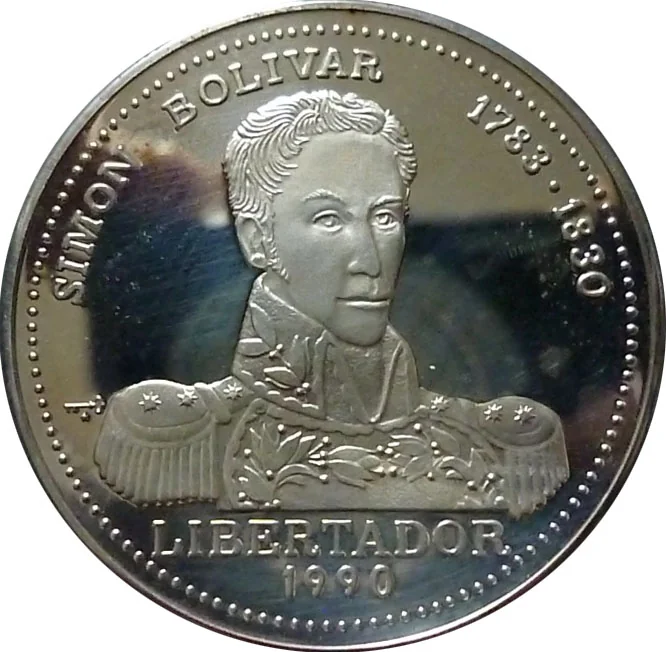
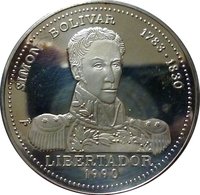
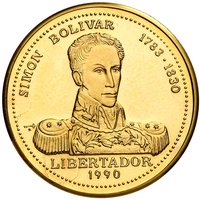
Portrait of Simón Bolívar (1783–1830). Name and dates curve above; title and issue date below; mintmark at left.
Inscription:
SIMON BOLIVAR 1783 • 1830
LIBERTADOR
1990
LIBERTADOR
1990
Translation:
SIMON BOLIVAR 1783 • 1830
LIBERATOR
1990
LIBERATOR
1990
Script: Latin
Language: Spanish
Engraver: Marcial Yáñez Quesada
Designer: Virginia Acebo Toledo
Edge
Plain
Categories
| Symbols> Coat of Arms |
| Event> Birth anniversary |
| Event> Death anniversary |
| Person> Politician |
Mints
| Name | Mark |
|---|---|
| Empresa Cubana de Acuñaciones | — |
Mintings
| Year | Mint Mark | Mintage | Quality | Collection |
|---|---|---|---|---|
| 1990 | — | 3,300 | Proof |
Historical background
The currency situation in Cuba in 1990 stood on the precipice of a profound crisis, marking the final moments of a relatively stable, albeit isolated, mono-monetary system. Since the 1970s, the country operated primarily with the Cuban Peso (CUP), a non-convertible currency sustained by massive subsidies and preferential trade from the Soviet Union. This relationship allowed Cuba to maintain a command economy where the peso, while weak internationally, provided for basic goods and services through a rationing system (libreta) and state-set prices. The economy was artificially insulated, and the possession of foreign currency by citizens was illegal.
However, 1990 was the year the foundation of this system violently collapsed. With the dissolution of the Soviet bloc, Cuba lost approximately 85% of its foreign trade almost overnight, entering the "Special Period in Time of Peace." The Soviet subsidies, which had amounted to billions of dollars annually, vanished, crippling Cuba's ability to import essential goods like food, medicine, and oil. While the formal dual-currency system (introducing the U.S. dollar alongside the peso) would not be fully legalized until 1993, 1990 was the catalyst. The black market for dollars exploded as the state's peso economy began to seize up, creating a de facto but illegal two-tier economy where access to hard currency became the key to survival.
Consequently, 1990 represents the decisive turning point from stability to severe scarcity. The Cuban Peso's purchasing power plummeted as production stalled and import capacity vanished, while the U.S. dollar's underground value soared. This period set the immediate stage for the government's reluctant but necessary legalization of the U.S. dollar in 1993, a desperate measure to attract remittances and stimulate a collapsing economy. Thus, the currency situation of 1990 is defined by the abrupt end of Soviet-backed stability and the chaotic, unregulated birth of the dual-currency reality that would dominate Cuban life for decades.
However, 1990 was the year the foundation of this system violently collapsed. With the dissolution of the Soviet bloc, Cuba lost approximately 85% of its foreign trade almost overnight, entering the "Special Period in Time of Peace." The Soviet subsidies, which had amounted to billions of dollars annually, vanished, crippling Cuba's ability to import essential goods like food, medicine, and oil. While the formal dual-currency system (introducing the U.S. dollar alongside the peso) would not be fully legalized until 1993, 1990 was the catalyst. The black market for dollars exploded as the state's peso economy began to seize up, creating a de facto but illegal two-tier economy where access to hard currency became the key to survival.
Consequently, 1990 represents the decisive turning point from stability to severe scarcity. The Cuban Peso's purchasing power plummeted as production stalled and import capacity vanished, while the U.S. dollar's underground value soared. This period set the immediate stage for the government's reluctant but necessary legalization of the U.S. dollar in 1993, a desperate measure to attract remittances and stimulate a collapsing economy. Thus, the currency situation of 1990 is defined by the abrupt end of Soviet-backed stability and the chaotic, unregulated birth of the dual-currency reality that would dominate Cuban life for decades.
✨ Legendary