

1 rupee (Sri Lanka Air Force) – Sri Lanka
Add to wishlist
Non-circulating coins
Commemoration: 50th Anniversary of the Sri Lanka Air Force
Sri Lanka
Context
Year: 2001
Issuer: Sri Lanka
Issuing organization: Central Bank of Sri Lanka
Period:
(since 1978)
Currency:
(since 1972)
Total mintage: 2,000
Material
Diameter: 25.4 mm
Weight: 7.13 g
Thickness: 2 mm
Shape: Round
Composition: Copper-nickel
Technique: Milled
Alignment: Coin alignment
flip
References
KM: #
Numista: #62453
Value
Exchange value: 1 LKR
Obverse
Description:
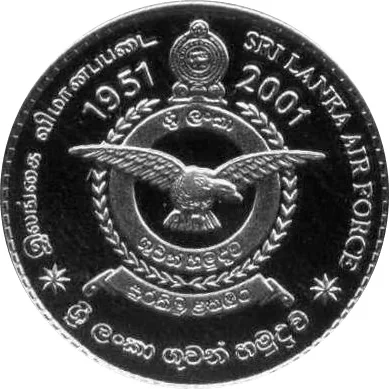
Sri Lankan Air Force badge encircled by inscription and dates.
Inscription:
SRI LANKA AIR FORCE • இலங்கை விமானப்படை • ශ්රි ලංකා ගුවන් හමුදාව
1951 2001
ශ්රී ලංකා
ගුවන් හමුදාව
සුරකිමු ළකඹර
1951 2001
ශ්රී ලංකා
ගුවන් හමුදාව
සුරකිමු ළකඹර
Translation:
SRI LANKA AIR FORCE • Sri Lanka Air Force • Sri Lanka Air Force
1951 2001
Sri Lanka
Air Force
Let us protect the motherland
1951 2001
Sri Lanka
Air Force
Let us protect the motherland
Designer: Padmanjalee Karunathillake
Reverse
Description:
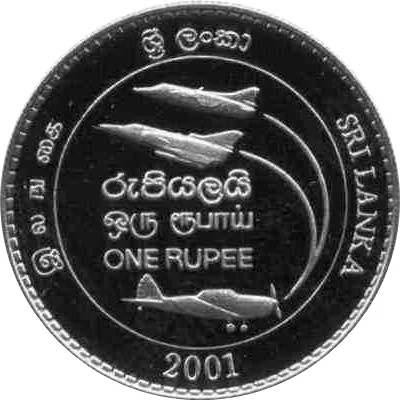
Two jets over a propeller plane inside a circled inscription and date.
Inscription:
இலங்கை ශ්රී ලංකා SRI LANKA
2001
රුපියලයි
ஒரு ரூபாய்
ONE RUPEE
2001
රුපියලයි
ஒரு ரூபாய்
ONE RUPEE
Translation:
Sri Lanka
2001
One Rupee
One Rupee
One Rupee
2001
One Rupee
One Rupee
One Rupee
Designer: Padmanjalee Karunathillake
Edge
Reeded
Categories
| Transportation> Aircraft |
Mints
| Name | Mark |
|---|---|
| Royal Mint | — |
Mintings
| Year | Mint Mark | Mintage | Quality | Collection |
|---|---|---|---|---|
| 2001 | — | 2,000 | Proof |
Historical background
In 2001, Sri Lanka's currency situation was defined by a severe balance of payments crisis and a dramatic loss of confidence in the Sri Lankan Rupee (LKR). The economy was under immense strain from a combination of factors: a costly and intensifying civil war, a global economic slowdown impacting key exports like tea and garments, and a sharp rise in global oil prices. These pressures led to a critical depletion of foreign exchange reserves, which plummeted to less than two months of import cover, forcing the government to seek emergency assistance from the International Monetary Fund (IMF).
Confronted with this crisis, the government, led by Prime Minister Ranil Wickremesinghe after the December parliamentary elections, made a pivotal decision to abandon the managed float of the rupee. In January 2002, the Central Bank of Sri Lanka announced a transition to a free float, allowing market forces to determine the exchange rate. This move immediately led to a sharp devaluation, with the rupee losing approximately 25% of its value against the US dollar in a matter of weeks, falling from around Rs. 89 to over Rs. 110 per dollar. The devaluation was a painful but necessary corrective measure to curb imports, boost export competitiveness, and stabilize the external account.
The currency crisis of 2001 was thus a watershed moment, compelling major economic reforms. The new government's strategy, supported by an IMF standby arrangement, coupled the float with fiscal tightening and a focus on peace negotiations with the LTTE. While the devaluation increased domestic inflation and the cost of living in the short term, it was instrumental in restoring a degree of macroeconomic stability. The period set the stage for a tentative recovery in 2002, as the ensuing ceasefire provided a brief respite and improved investor sentiment alongside the more market-determined exchange rate regime.
Confronted with this crisis, the government, led by Prime Minister Ranil Wickremesinghe after the December parliamentary elections, made a pivotal decision to abandon the managed float of the rupee. In January 2002, the Central Bank of Sri Lanka announced a transition to a free float, allowing market forces to determine the exchange rate. This move immediately led to a sharp devaluation, with the rupee losing approximately 25% of its value against the US dollar in a matter of weeks, falling from around Rs. 89 to over Rs. 110 per dollar. The devaluation was a painful but necessary corrective measure to curb imports, boost export competitiveness, and stabilize the external account.
The currency crisis of 2001 was thus a watershed moment, compelling major economic reforms. The new government's strategy, supported by an IMF standby arrangement, coupled the float with fiscal tightening and a focus on peace negotiations with the LTTE. While the devaluation increased domestic inflation and the cost of living in the short term, it was instrumental in restoring a degree of macroeconomic stability. The period set the stage for a tentative recovery in 2002, as the ensuing ceasefire provided a brief respite and improved investor sentiment alongside the more market-determined exchange rate regime.
✨ Legendary