

5000 rupees (Independence) – Sri Lanka
Add to wishlist
Non-circulating coins
Commemoration: 50th Anniversary of Independence
Sri Lanka
Context
Material
Diameter: 22 mm
Weight: 7.9 g
Gold Weight:: 7.24 g
Thickness: 1.7 mm
Shape: Round
Composition: 91.7% Gold
Standard: Silver quarter ounce
Magnetic: No
Technique: Milled
References
KM: #
Numista: #62435
Value
Exchange value: 5000 LKR
Bullion value: $1112.93
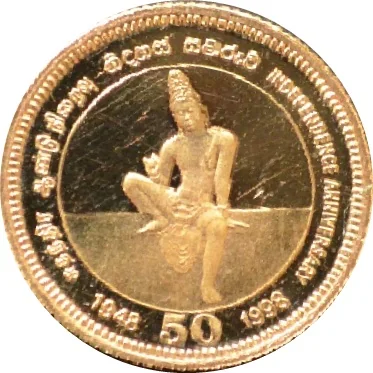
Obverse
Description:
Avalokiteshvara, a future Buddha, seated gracefully amid legend.
Inscription:
INDEPENDENCE ANNIVERSARY 1948 50 1998
Translation:
INDEPENDENCE ANNIVERSARY 1948 50 1998
Language: English
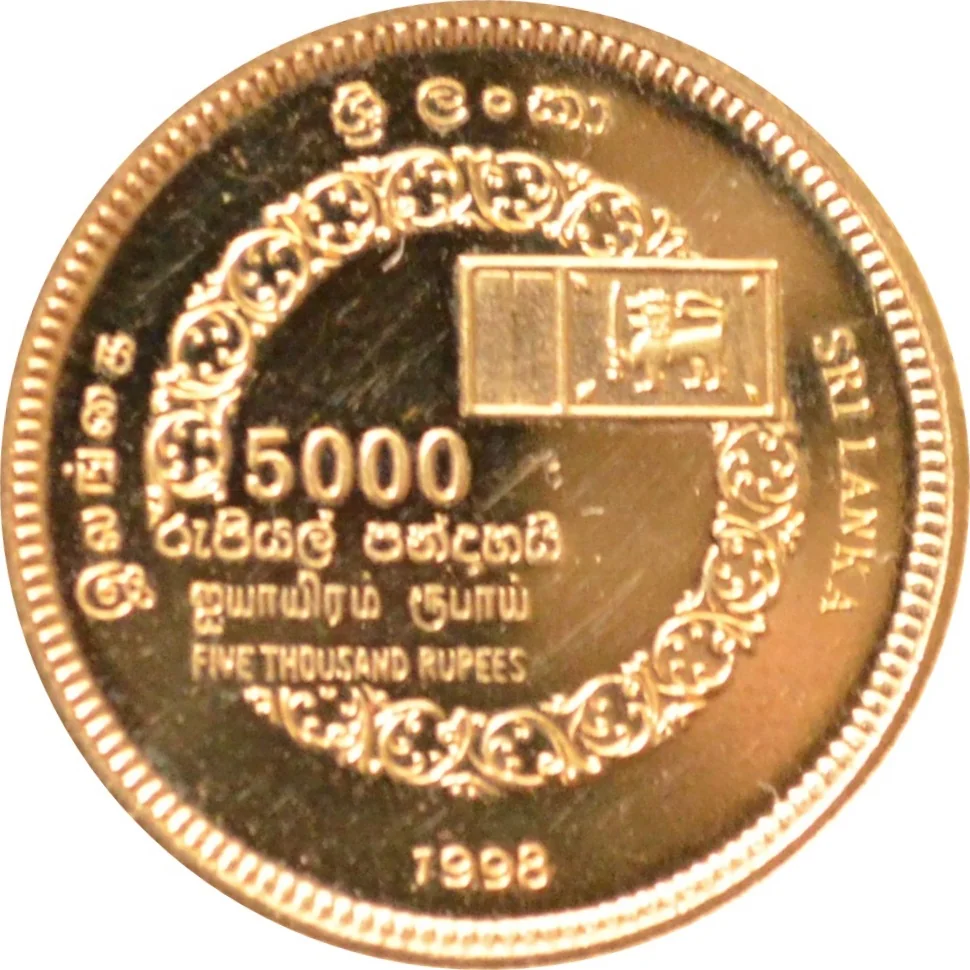
Reverse
Description:
Flag in wreath.
Inscription:
1000 ONE THOUSAND RUPEES 1998 SRI LANKA
Edge
Categories
| Event> Independence |
Mintings
| Year | Mint Mark | Mintage | Quality | Collection |
|---|---|---|---|---|
| 1998 | — | 5,000 | Proof |
Historical background
In 1998, Sri Lanka's currency situation was defined by a managed float regime, where the Central Bank of Sri Lanka (CBSL) actively intervened to control the value of the Sri Lankan Rupee (LKR) against a basket of major currencies, with the US dollar being the primary reference. This period followed the liberalization of the economy in 1977, which moved away from a fixed exchange rate. The CBSL's objective was to maintain export competitiveness and control inflation by preventing excessive volatility, rather than targeting a specific parity. However, this management came under consistent pressure due to a widening trade deficit and the economic fallout from the ongoing civil war, which strained foreign exchange reserves and created a persistent depreciation trend.
The year was marked by significant external shocks that tested this managed system. The East Asian Financial Crisis of 1997-98, while not impacting Sri Lanka as severely as its regional neighbors, led to reduced investor confidence in emerging markets and contributed to capital outflows. Furthermore, a severe drought in 1998 crippled hydroelectric power generation, forcing costly thermal power imports and exacerbating the current account deficit. These factors combined to intensify downward pressure on the Rupee, requiring the CBSL to utilize its reserves for defensive interventions, which were only partially offset by robust garment exports and remittance inflows.
Consequently, 1998 saw a controlled but notable depreciation of the LKR. The Rupee, which had traded around 59 to the US dollar in early 1997, weakened to approximately 66 by the end of 1998. This deliberate, gradual devaluation was an adjustment to economic realities, aimed at keeping exports attractive without triggering a sudden collapse in confidence or runaway inflation. The situation underscored the challenges of maintaining currency stability amidst conflict, global financial turbulence, and domestic supply-side shocks, setting the stage for continued foreign exchange management challenges in the subsequent years.
The year was marked by significant external shocks that tested this managed system. The East Asian Financial Crisis of 1997-98, while not impacting Sri Lanka as severely as its regional neighbors, led to reduced investor confidence in emerging markets and contributed to capital outflows. Furthermore, a severe drought in 1998 crippled hydroelectric power generation, forcing costly thermal power imports and exacerbating the current account deficit. These factors combined to intensify downward pressure on the Rupee, requiring the CBSL to utilize its reserves for defensive interventions, which were only partially offset by robust garment exports and remittance inflows.
Consequently, 1998 saw a controlled but notable depreciation of the LKR. The Rupee, which had traded around 59 to the US dollar in early 1997, weakened to approximately 66 by the end of 1998. This deliberate, gradual devaluation was an adjustment to economic realities, aimed at keeping exports attractive without triggering a sudden collapse in confidence or runaway inflation. The situation underscored the challenges of maintaining currency stability amidst conflict, global financial turbulence, and domestic supply-side shocks, setting the stage for continued foreign exchange management challenges in the subsequent years.

✨ Legendary