

25 Shillings – Somalia
Non-circulating coins
Commemoration: World Fisheries Conference
Somalia
Context
Year: 1984
Issuer: Somalia 
Period:
(1969—1991)
Currency:
(since 1962)
Demonetized: Yes
Total mintage: 100,000
Material
Diameter: 38.61 mm
Weight: 28.28 g
Thickness: 3 mm
Shape: Round
Composition: Copper-nickel
Technique: Milled
Alignment: Medal alignment
flip
References
KM: #Click to copy to clipboard40
Numista: #62315
Value
Exchange value: 25 SOS
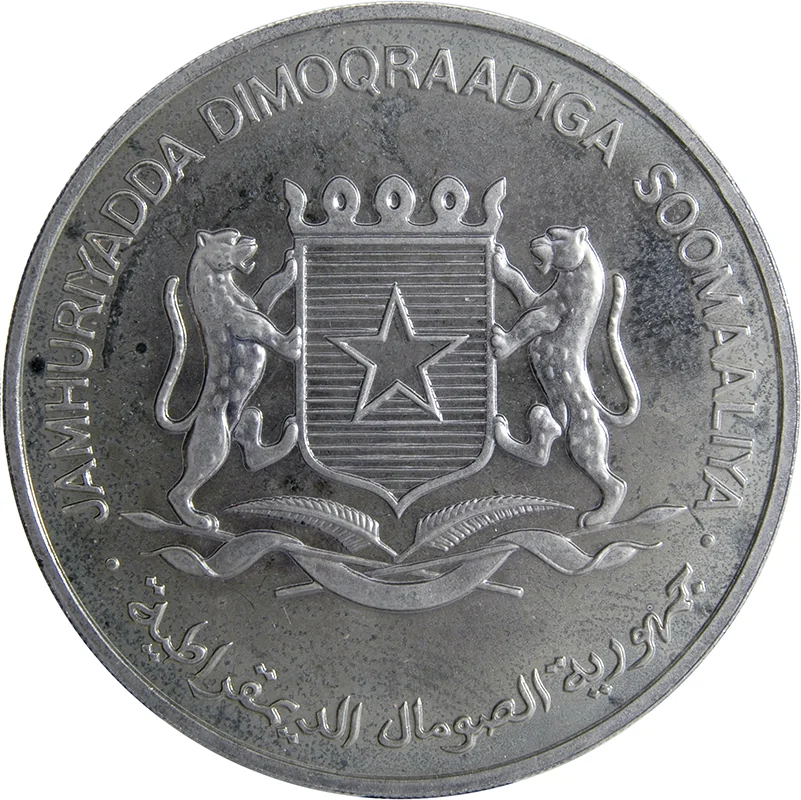
Obverse
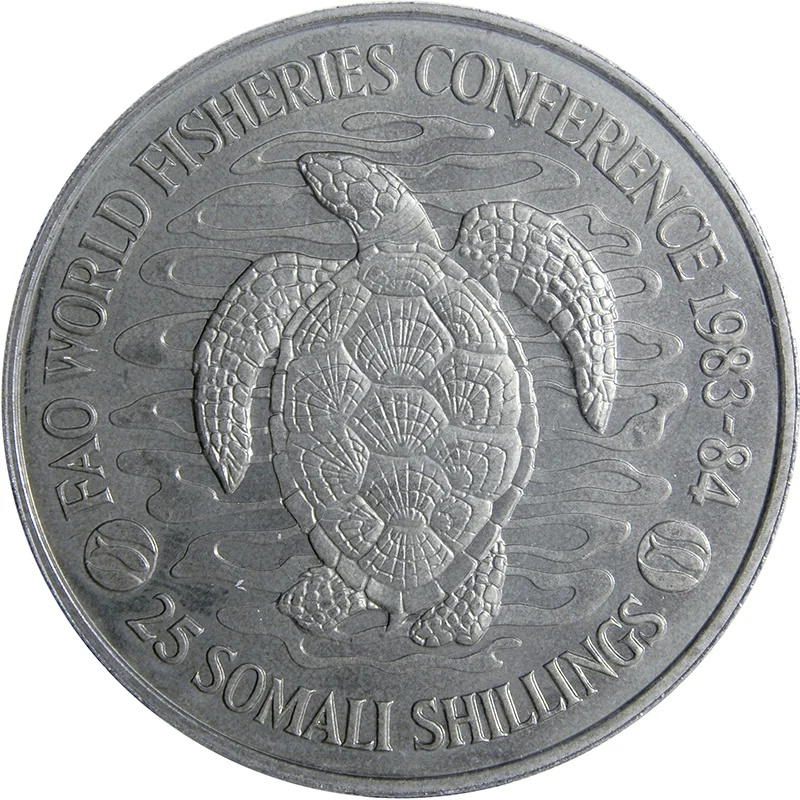
Reverse
Description:
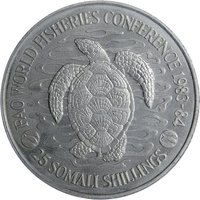
Green sea turtle (*Chelonia mydas*)
Inscription:
FAO. World Fisheries Conference 1983-84
25 SOMALI SHILLINGS
25 SOMALI SHILLINGS
Script: Latin
Edge
Reeded
Categories
| Animal> Turtle or tortoise |
| Symbols> Coat of Arms |
| Organization> FAO |
Mintings
| Year | Mint Mark | Mintage | Quality | Collection |
|---|---|---|---|---|
| 1984 | — | 100,000 |
Historical background
In 1984, Somalia's currency situation was characterized by the widespread circulation of the Somali shilling (SOS) amidst an increasingly fragile economic and political environment. The nation was under the authoritarian rule of President Siad Barre, whose regime maintained an official, overvalued exchange rate through the Central Bank of Somalia. However, this official rate was largely reserved for government transactions and favored importers with political connections, creating a significant disconnect from economic reality. For the general population and most commerce, a thriving black market for foreign exchange, particularly US dollars, determined the true value of the shilling.
The economy was burdened by massive public debt, failed agricultural policies, and costly military expenditures related to the Ogaden War and internal conflicts. These pressures led to persistent and high inflation, which eroded the shilling's purchasing power. The government financed its deficits by printing more currency, a practice that further fueled inflation and deepened the gap between the official and black-market exchange rates. Consequently, confidence in the national currency was steadily declining, with many Somalis preferring to hold hard currency or engage in barter for significant transactions.
This dual-system currency environment in 1984 was a clear symptom of deeper structural problems. It created economic distortions, encouraged corruption, and placed severe hardship on ordinary citizens. While a full-scale collapse was still several years away, the monetary fragilities evident in 4 were critical precursors to the complete breakdown of the national currency and central banking system that would follow the outbreak of civil war in 1991.
The economy was burdened by massive public debt, failed agricultural policies, and costly military expenditures related to the Ogaden War and internal conflicts. These pressures led to persistent and high inflation, which eroded the shilling's purchasing power. The government financed its deficits by printing more currency, a practice that further fueled inflation and deepened the gap between the official and black-market exchange rates. Consequently, confidence in the national currency was steadily declining, with many Somalis preferring to hold hard currency or engage in barter for significant transactions.
This dual-system currency environment in 1984 was a clear symptom of deeper structural problems. It created economic distortions, encouraged corruption, and placed severe hardship on ordinary citizens. While a full-scale collapse was still several years away, the monetary fragilities evident in 4 were critical precursors to the complete breakdown of the national currency and central banking system that would follow the outbreak of civil war in 1991.

⭐ Rare