

1 cent – South Africa
Add to wishlist
Circulating commemorative coins
Commemoration: The end of Charles Robberts Swart's Presidency
South Africa
Context
Year: 1968
Issuer: South Africa
Period:
(since 1961)
Currency:
(since 1961)
Total mintage: 6,000,000
Material
References
KM: #
Numista: #6228
Value
Exchange value: 0.01 ZAR
Inflation-adjusted value: 0.97 ZAR
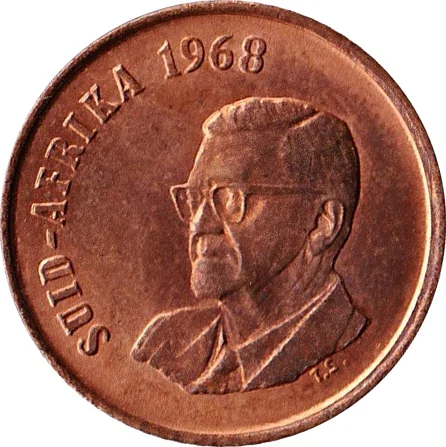
Obverse
Description:
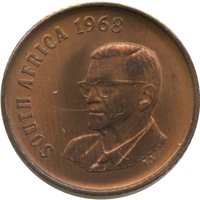
President C.R. Swart facing left, with Afrikaans text.
Inscription:
SUID-AFRIKA 1968
TS
TS
Script: Latin
Engraver: Tommy Sasseen
Reverse
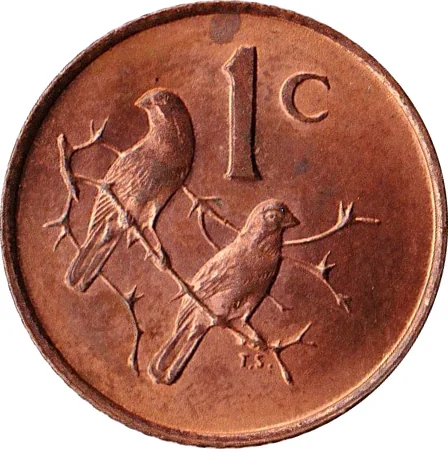
Description:
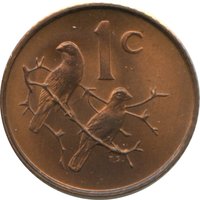
Two Cape sparrows on a branch with a denomination above.
Inscription:
1c
TS
TS
Script: Latin
Engraver: Tommy Sasseen
Edge
Reeded coarsely
Categories
| Person> Politician |
| Animal> Bird |
Mints
| Name | Mark |
|---|---|
| Pretoria | — |
Mintings
| Year | Mint Mark | Mintage | Quality | Collection |
|---|---|---|---|---|
| 1968 | — | 6,000,000 |
Historical background
In 1968, South Africa’s currency situation was defined by the dual pressures of maintaining international solvency and upholding the economic structures of apartheid. The country operated under a fixed exchange rate system, with the South African Rand (ZAR) pegged to the British Pound Sterling until 1967, after which it was pegged to the US Dollar at a rate of R1 = $1.40. This peg was managed by the South African Reserve Bank (SARB), which held substantial gold reserves—a critical asset given that South Africa was the world’s largest gold producer. The stability of the Rand was therefore intrinsically linked to the international gold price and the nation's ability to export the metal, which provided the bulk of its foreign exchange earnings.
However, the year followed the significant devaluation of the Pound Sterling in November 1967, which had forced South Africa to reluctantly devalue the Rand by the same margin (14.3%) to maintain its peg. This 1967 devaluation, while boosting the competitiveness of gold and other exports, also stoked domestic inflation and increased the cost of imported machinery and oil, vital for the industrial economy. By 1968, authorities were grappling with these inflationary consequences while trying to capitalise on the windfall from a rising gold price, which was being driven by global monetary uncertainty and the looming collapse of the London Gold Pool. This provided a crucial buffer for the balance of payments.
Politically, the currency system was strained by the isolating effects of apartheid. While not yet under comprehensive international sanctions, South Africa faced increasing capital volatility and risk aversion from foreign investors. The government employed strict financial and exchange controls to prevent capital flight and preserve foreign reserves, segregating financial markets into a commercial Rand for current account transactions and a more restricted financial Rand for capital flows. Thus, in 1968, the currency landscape was one of managed stability, underpinned by gold but increasingly fortified by controls, reflecting an economy prosperous yet profoundly isolated by its political choices.
However, the year followed the significant devaluation of the Pound Sterling in November 1967, which had forced South Africa to reluctantly devalue the Rand by the same margin (14.3%) to maintain its peg. This 1967 devaluation, while boosting the competitiveness of gold and other exports, also stoked domestic inflation and increased the cost of imported machinery and oil, vital for the industrial economy. By 1968, authorities were grappling with these inflationary consequences while trying to capitalise on the windfall from a rising gold price, which was being driven by global monetary uncertainty and the looming collapse of the London Gold Pool. This provided a crucial buffer for the balance of payments.
Politically, the currency system was strained by the isolating effects of apartheid. While not yet under comprehensive international sanctions, South Africa faced increasing capital volatility and risk aversion from foreign investors. The government employed strict financial and exchange controls to prevent capital flight and preserve foreign reserves, segregating financial markets into a commercial Rand for current account transactions and a more restricted financial Rand for capital flows. Thus, in 1968, the currency landscape was one of managed stability, underpinned by gold but increasingly fortified by controls, reflecting an economy prosperous yet profoundly isolated by its political choices.
🌱 Common