

200 Bahts – Thailand
Non-circulating coins
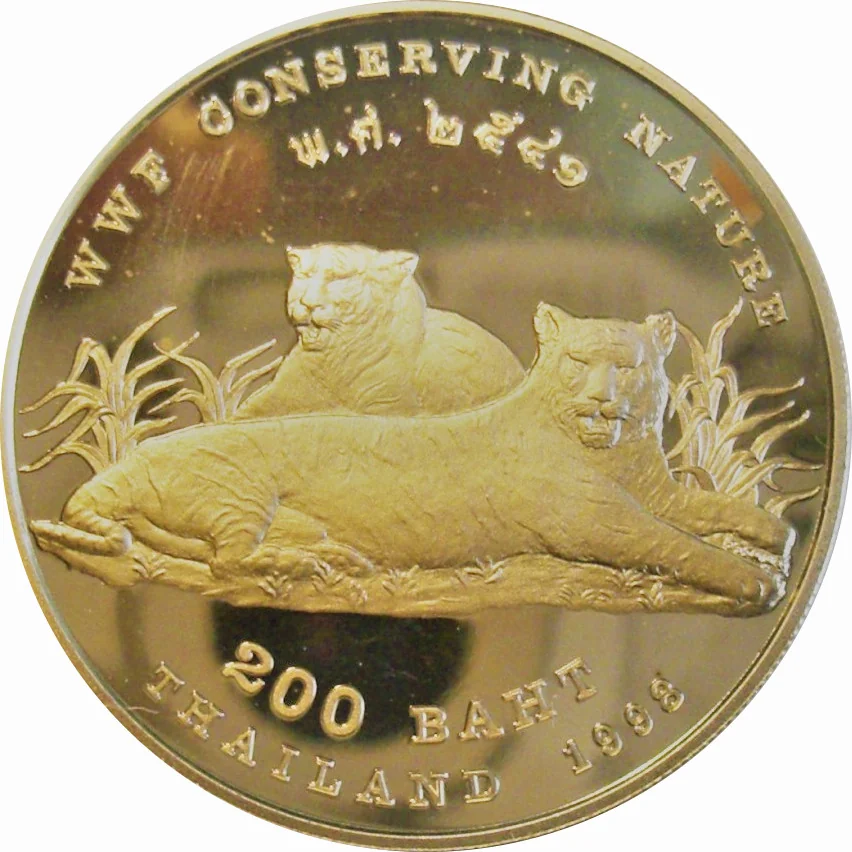
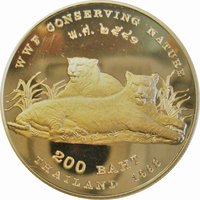
Commemoration: WWF Conserving Nature - Tigers
Thailand
Context
Year: 1998
Thai Year: 2541
Issuer: Thailand 
Ruler: Bhumibol Adulyadej
Currency:
(since 1897)
Total mintage: 15,000
Material
References
Y: #Click to copy to clipboard360
Numista: #111480
Value
Exchange value: 200 THB = $6.44
Bullion value: $62.30
Obverse
Description:
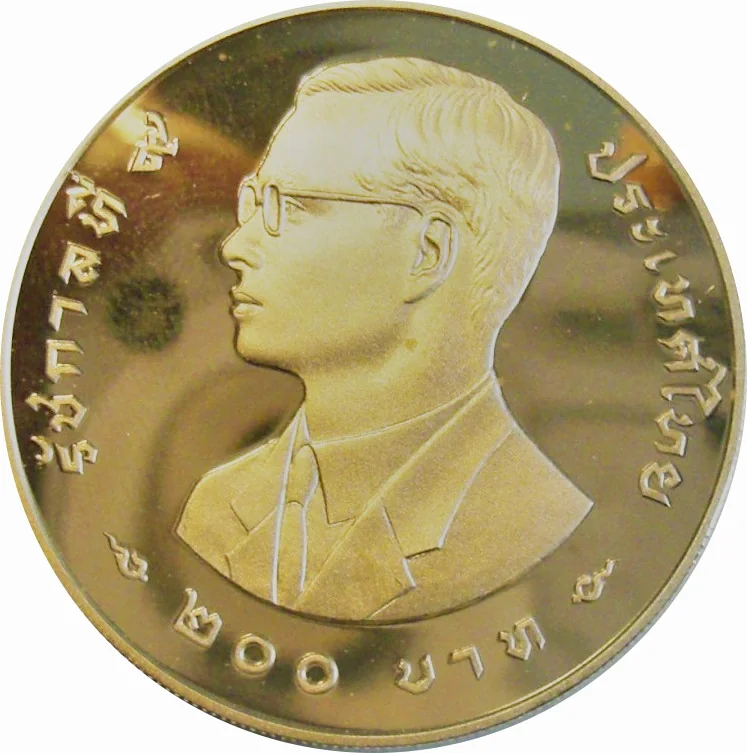
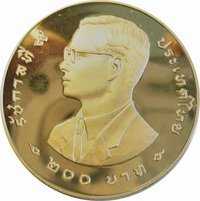
King Bhumibol (Rama IX) in profile.
Reverse
Edge
Reeded.
Categories
| Animal> Feline |
| Organization> WWF |
Mints
| Name | Mark |
|---|---|
| Hungarian mint | — |
Mintings
| Year | Mint Mark | Mintage | Quality | Collection |
|---|---|---|---|---|
| 1998 | — | 15,000 |
Historical background
The currency crisis that struck Thailand in 1998 was the epicenter of the wider Asian Financial Crisis. Its roots lay in the preceding decade of rapid economic growth, fueled by heavy foreign investment and a fixed exchange rate pegging the Thai baht at around 25 to the US dollar. This peg encouraged Thai banks and corporations to borrow massive amounts of low-interest US dollars, creating an unsustainable bubble in real estate and stock markets. By the mid-1990s, Thailand's current account deficit ballooned, its foreign exchange reserves were being depleted to defend the peg, and its financial sector was riddled with non-performing loans, leaving the economy profoundly vulnerable to speculative attack.
In July 1997, after exhausting its reserves in a failed defense, the Bank of Thailand was forced to abandon the peg, allowing the baht to float. It immediately collapsed, losing over half its value by early 1998. This precipitous devaluation triggered a severe economic catastrophe, as the US dollar-denominated debt of Thai companies and banks skyrocketed in baht terms, rendering many insolvent. The government sought a $17.2 billion bailout from the International Monetary Fund (IMF), which imposed strict austerity measures, including high interest rates, budget cuts, and the closure of 56 insolvent finance companies, deepening a sharp recession.
By 1998, Thailand was in the throes of a full-blown economic depression. GDP contracted by over 10%, unemployment soared, and widespread bankruptcies and asset fire sales occurred. The social impact was severe, with a dramatic rise in poverty and social unrest. However, the crisis also forced necessary, albeit painful, structural reforms in the financial and corporate sectors. The events of 1997-1998 fundamentally reshaped Thailand's economic policy, leading to a buildup of substantial foreign reserves, a move to a managed float exchange rate, and more prudent financial regulation, lessons that defined its economic approach for decades to come.
In July 1997, after exhausting its reserves in a failed defense, the Bank of Thailand was forced to abandon the peg, allowing the baht to float. It immediately collapsed, losing over half its value by early 1998. This precipitous devaluation triggered a severe economic catastrophe, as the US dollar-denominated debt of Thai companies and banks skyrocketed in baht terms, rendering many insolvent. The government sought a $17.2 billion bailout from the International Monetary Fund (IMF), which imposed strict austerity measures, including high interest rates, budget cuts, and the closure of 56 insolvent finance companies, deepening a sharp recession.
By 1998, Thailand was in the throes of a full-blown economic depression. GDP contracted by over 10%, unemployment soared, and widespread bankruptcies and asset fire sales occurred. The social impact was severe, with a dramatic rise in poverty and social unrest. However, the crisis also forced necessary, albeit painful, structural reforms in the financial and corporate sectors. The events of 1997-1998 fundamentally reshaped Thailand's economic policy, leading to a buildup of substantial foreign reserves, a move to a managed float exchange rate, and more prudent financial regulation, lessons that defined its economic approach for decades to come.

💎 Extremely Rare