

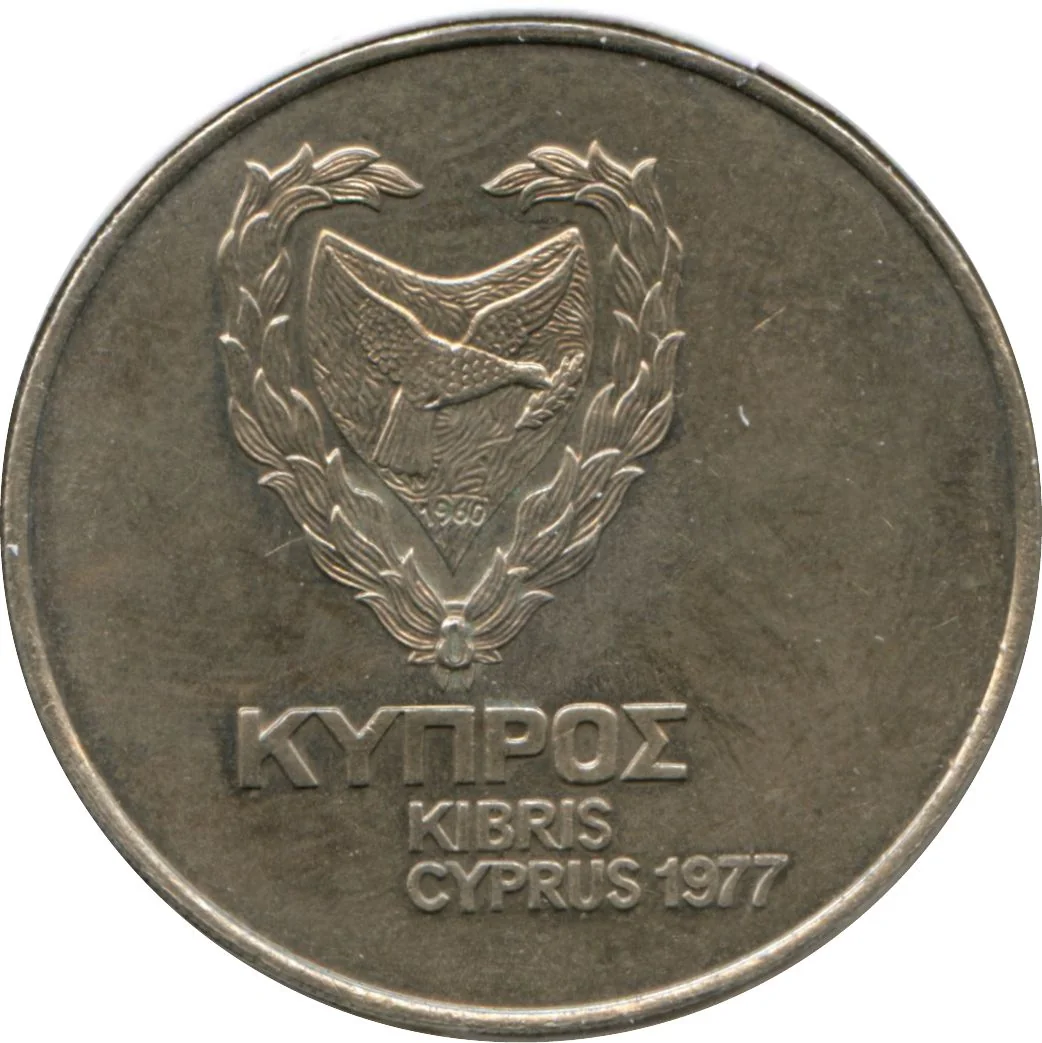
Obverse
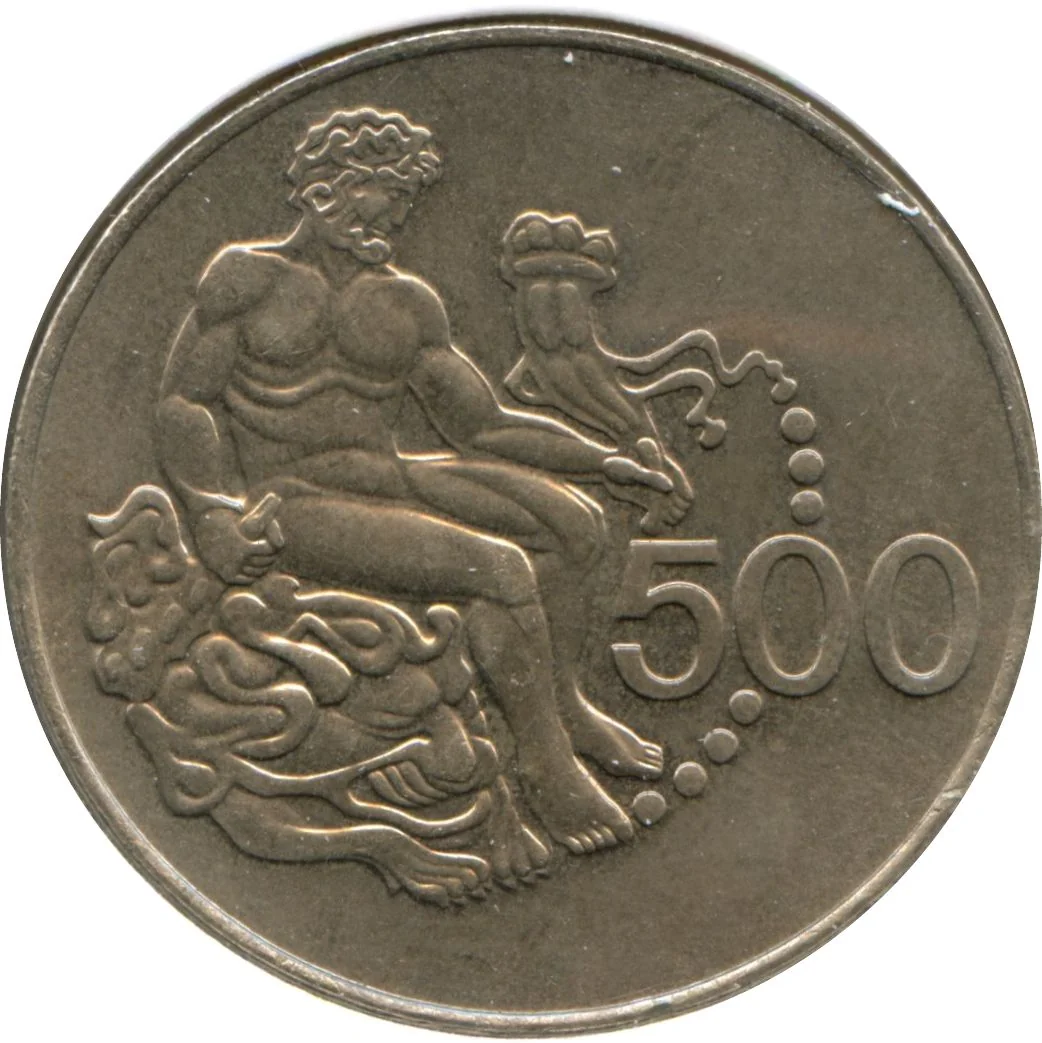
Reverse
Description:
Based on an ancient coin of King Evagoras I of Salamis, it depicts Hercules seated on a rock draped with his lion's skin, holding a horn of plenty.
Inscription:
500
Script: Latin
Designer: Antis Ioannides
Edge
Reeded
Categories
| Symbol> Allegory |
| Symbols> Coat of Arms |
Mints
| Name | Mark |
|---|---|
| Royal Mint | — |
Mintings
| Year | Mint Mark | Mintage | Quality | Collection |
|---|---|---|---|---|
| 1975 | — | 300,000 | ||
| 1977 | — | 200,000 | ||
| 1977 | — | 20,000 | Proof |
Historical background
Following the Turkish invasion of 1974 and the subsequent de facto partition of the island, the Republic of Cyprus faced a profound monetary crisis in 1975. The national currency, the Cypriot pound, was effectively split across the ceasefire line (the Green Line), severing the unified monetary system. In the government-controlled south, a critical shortage of currency notes emerged, as a significant portion of the physical currency supply was trapped in the occupied north. This scarcity threatened to paralyze the economy, which was already reeling from the loss of productive land, the displacement of nearly a third of the population, and a shattered tourism sector.
To address the emergency, the government of President Makarios took drastic action. In July 1975, it declared all Cypriot pound notes in circulation invalid, requiring citizens in the south to exchange them for new notes within a very short timeframe. This currency swap, conducted at banks and post offices, was designed to isolate and demonetize the notes held in the north, thereby preventing a flood of currency from destabilizing the southern economy. Simultaneously, the government imposed strict limits on the amount individuals could withdraw from their bank accounts to prevent capital flight and stabilize the financial system.
These emergency measures were successful in restoring a functional monetary system in the south, but they came at a significant social cost and cemented the island's economic division. The move effectively created two separate currency zones. While the Republic of Cyprus continued with the new Cypriot pound (later the euro), the Turkish Cypriot administration in the north, unrecognized internationally, began using the Turkish lira, formalizing a monetary split that persists to this day. Thus, the 1975 currency crisis was not merely a financial event but a pivotal moment in the economic entrenchment of Cyprus's political partition.
To address the emergency, the government of President Makarios took drastic action. In July 1975, it declared all Cypriot pound notes in circulation invalid, requiring citizens in the south to exchange them for new notes within a very short timeframe. This currency swap, conducted at banks and post offices, was designed to isolate and demonetize the notes held in the north, thereby preventing a flood of currency from destabilizing the southern economy. Simultaneously, the government imposed strict limits on the amount individuals could withdraw from their bank accounts to prevent capital flight and stabilize the financial system.
These emergency measures were successful in restoring a functional monetary system in the south, but they came at a significant social cost and cemented the island's economic division. The move effectively created two separate currency zones. While the Republic of Cyprus continued with the new Cypriot pound (later the euro), the Turkish Cypriot administration in the north, unrecognized internationally, began using the Turkish lira, formalizing a monetary split that persists to this day. Thus, the 1975 currency crisis was not merely a financial event but a pivotal moment in the economic entrenchment of Cyprus's political partition.
🌱 Fairly Common