

50 Centimes – Guadeloupe
France
Context
Years: 1903–1921
Country: France 
Issuer: Guadeloupe
Period:
(1635—1946)
Currency:
(1795—1960)
Demonetized: Yes
Total mintage: 1,200,000
Material
Diameter: 22.3 mm
Weight: 3.6 g
Thickness: 1.2 mm
Shape: Octodecagonal
Composition: Copper-nickel
Technique: Milled
Alignment: Coin alignment
flip
References
KM: #Click to copy to clipboard45
Numista: #6182
Obverse
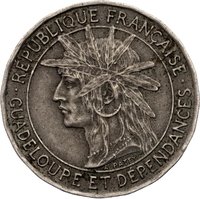
Description:
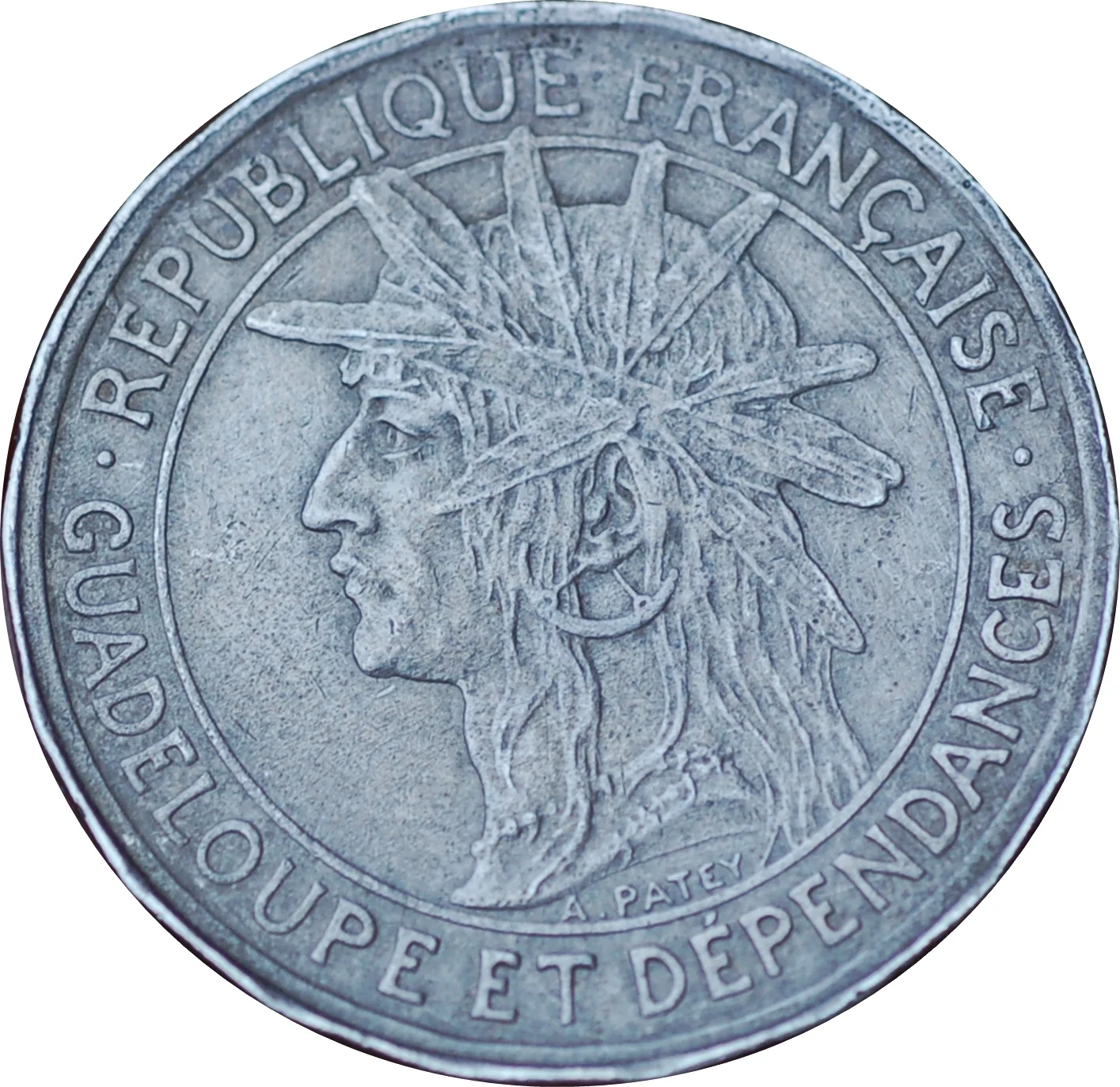
Arawak man bust with feathered headband, facing left in circle; designer A. Patey.
Inscription:
RÉPUBLIQUE FRANÇAISE
A . PATEY
GUADELOUPE ET DÉPENDANCES
A . PATEY
GUADELOUPE ET DÉPENDANCES
Translation:
FRENCH REPUBLIC
A. PATEY
GUADELOUPE AND DEPENDENCIES
A. PATEY
GUADELOUPE AND DEPENDENCIES
Script: Latin
Language: French
Engraver: Henri-Auguste Patey
Reverse
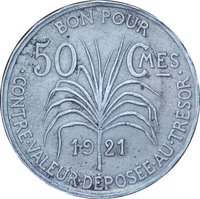
Description:
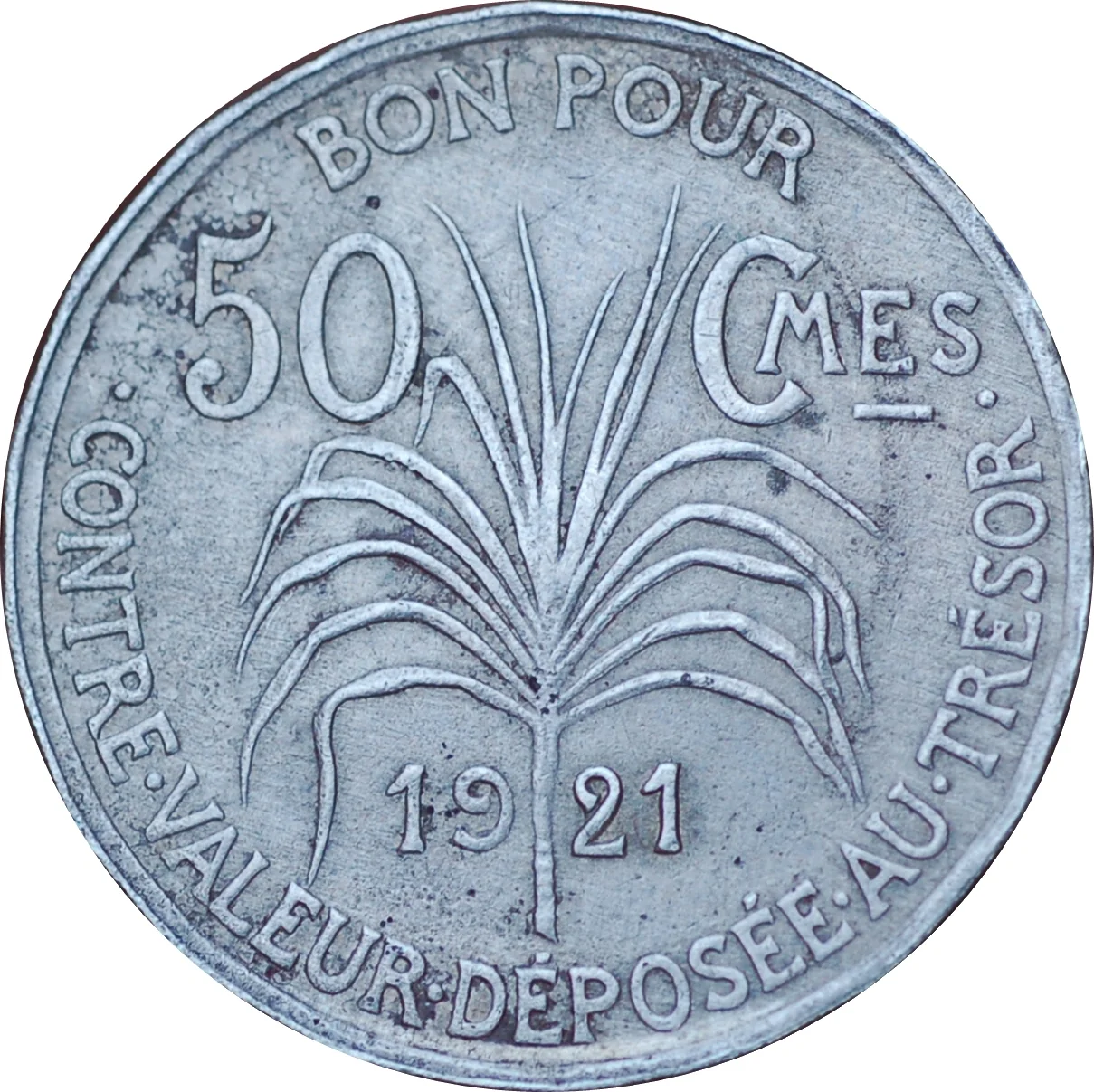
Cane stalk divides date and value.
Inscription:
BON POUR 50 CMES
1921
CONTRE.VALEUR.DÉPOSÉE.AU.TRÉSOR.
1921
CONTRE.VALEUR.DÉPOSÉE.AU.TRÉSOR.
Translation:
Good for 50 Centimes
1921
Countervalue deposited at the Treasury.
1921
Countervalue deposited at the Treasury.
Script: Latin
Language: French
Engraver: Henri-Auguste Patey
Edge
Plain
Categories
| Agriculture |
Mints
| Name | Mark |
|---|---|
| Monnaie de Paris | — |
Mintings
| Year | Mint Mark | Mintage | Quality | Collection |
|---|---|---|---|---|
| 1903 | — | 600,000 | ||
| 1921 | — | 600,000 |
Historical background
In 1903, Guadeloupe, as an overseas department of France, was fully integrated into the French monetary system. The official and sole legal tender was the French Franc, which had been established on the island following the abolition of slavery in 1848 and the consolidation of colonial administration. This meant the banknotes and coins circulating in Paris were also used in Pointe-à-Pitre and Basse-Terre, symbolizing the island's political and economic assimilation into the French Republic.
However, the monetary reality on the ground was more complex due to Guadeloupe's position within the Caribbean economic sphere. While the Franc was dominant for official transactions and imports from France, historical and regional trade links meant that other currencies, particularly the British sovereign and the US dollar, held practical importance. They were often used in maritime commerce, the sugar and rum export trade, and by merchants dealing with neighboring islands not under French control. This created a de facto, though unofficial, multi-currency environment for certain sectors.
The year 1903 fell within a period of relative monetary stability for the Franc, but the local economy was heavily dependent on sugar production, which was subject to volatile global prices. This commodity-based economy meant that the island's financial health was often disconnected from the stability of the metropolitan currency. Consequently, while the Franc provided administrative uniformity, the lived economic experience for many in Guadeloupe was shaped more by the fluctuations of the sugar market and the pragmatic use of foreign currencies in regional trade than by monetary policy set in Paris.
However, the monetary reality on the ground was more complex due to Guadeloupe's position within the Caribbean economic sphere. While the Franc was dominant for official transactions and imports from France, historical and regional trade links meant that other currencies, particularly the British sovereign and the US dollar, held practical importance. They were often used in maritime commerce, the sugar and rum export trade, and by merchants dealing with neighboring islands not under French control. This created a de facto, though unofficial, multi-currency environment for certain sectors.
The year 1903 fell within a period of relative monetary stability for the Franc, but the local economy was heavily dependent on sugar production, which was subject to volatile global prices. This commodity-based economy meant that the island's financial health was often disconnected from the stability of the metropolitan currency. Consequently, while the Franc provided administrative uniformity, the lived economic experience for many in Guadeloupe was shaped more by the fluctuations of the sugar market and the pragmatic use of foreign currencies in regional trade than by monetary policy set in Paris.
🌱 Common