

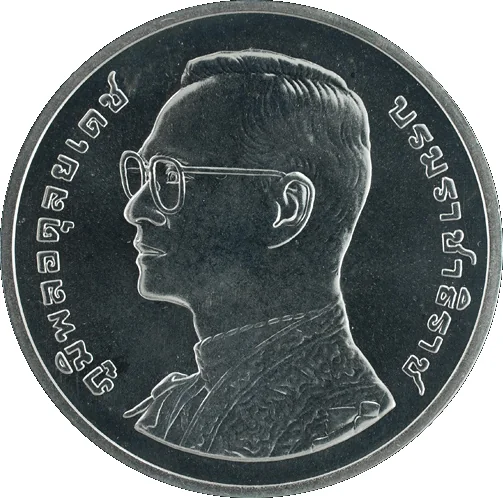
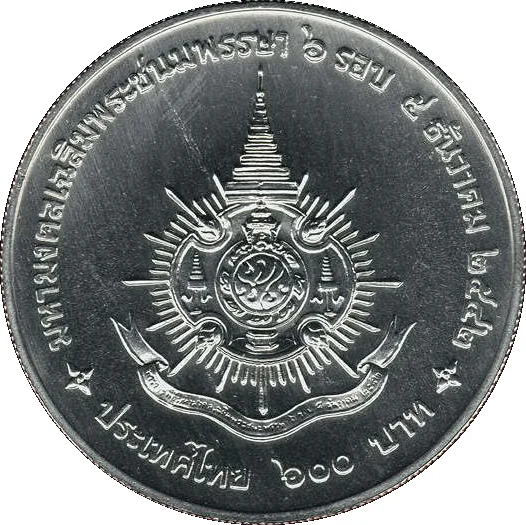
600 Bahts (King Rama IX) – Thailand
Non-circulating coins
Commemoration: 72nd Birthday Anniversary of King Rama IX
Thailand
Context
Year: 1999
Thai Year: 2542
Issuer: Thailand 
Ruler: Bhumibol Adulyadej
Currency:
(since 1897)
Total mintage: 57,822
Material
References
Y: #Click to copy to clipboard356
Numista: #61600
Value
Exchange value: 600 THB = $19.32
Bullion value: $58.79
Obverse
Description:
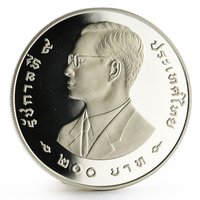
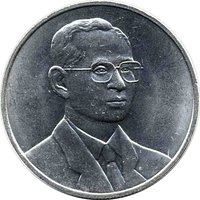
Portrait of King Bhumibol Adulyadej
Inscription:
ภูมิพลอดุลยเดช บรมราชาธิราช
Translation:
Bhumibol Adulyadej The Great Royal King
Language: Thai
Reverse
Description:
Thai 600 Baht commemorative coin for King Bhumibol's 6th Cycle Birthday, 5 December 1999.
Inscription:
มหามงคลเฉลิมพระชนมพรรษา ๖ รอบ ๕ ธันวาคม ๒๕๔๒
ประเทศไทย ๖๐๐ บาท
ประเทศไทย ๖๐๐ บาท
Translation:
Auspicious Occasion on the Celebration of the 6th Cycle Birthday Anniversary, 5th December 1999
Thailand 600 Baht
Thailand 600 Baht
Language: Thai
Edge
Mintings
| Year | Mint Mark | Mintage | Quality | Collection |
|---|---|---|---|---|
| 1999 | — | 47,811 | ||
| 1999 | — | 10,011 | Proof |
Historical background
In 1999, Thailand was in the arduous process of recovery from the 1997 Asian Financial Crisis, which had originated in Bangkok with the collapse of the Thai baht. The currency situation was defined by a managed float regime, adopted in July 1997 after the government was forced to abandon the long-standing peg to the US dollar. This dramatic devaluation, which saw the baht lose over half its value, had left the economy in severe distress, with a banking sector crippled by non-performing loans and a corporate sector burdened by massive foreign-denominated debt.
The year was characterized by fragile stability under the guidance of the International Monetary Fund (IMF). A $17.2 billion IMF bailout package came with strict conditions, including high interest rates to defend the currency and austerity measures to restore fiscal balance. By 1999, these policies, though painful, had succeeded in stabilizing the baht, which traded in a relatively narrow band around 37-40 to the US dollar. This allowed the Bank of Thailand to cautiously begin lowering interest rates to stimulate growth, as the immediate threat of hyper-depreciation and capital flight had subsided.
However, the underlying currency situation remained precarious. The stability was not yet self-sustaining and was heavily reliant on continued IMF support and fragile investor confidence. The devaluation's legacy meant Thailand's economic rebound was export-led, as a weaker baht made goods cheaper abroad, but domestic demand and investment remained weak. The focus for authorities in 1999 was thus on maintaining this hard-won stability while navigating corporate debt restructuring and banking sector reforms to lay the foundation for a more resilient financial system.
The year was characterized by fragile stability under the guidance of the International Monetary Fund (IMF). A $17.2 billion IMF bailout package came with strict conditions, including high interest rates to defend the currency and austerity measures to restore fiscal balance. By 1999, these policies, though painful, had succeeded in stabilizing the baht, which traded in a relatively narrow band around 37-40 to the US dollar. This allowed the Bank of Thailand to cautiously begin lowering interest rates to stimulate growth, as the immediate threat of hyper-depreciation and capital flight had subsided.
However, the underlying currency situation remained precarious. The stability was not yet self-sustaining and was heavily reliant on continued IMF support and fragile investor confidence. The devaluation's legacy meant Thailand's economic rebound was export-led, as a weaker baht made goods cheaper abroad, but domestic demand and investment remained weak. The focus for authorities in 1999 was thus on maintaining this hard-won stability while navigating corporate debt restructuring and banking sector reforms to lay the foundation for a more resilient financial system.
💎 Extremely Rare