

1 dollar – United States
Add to wishlist
United States
Context
Years: 1849–1854
Issuer: United States
Period:
(since 1776)
Currency:
(since 1785)
Total mintage: 11,876,718
Material
References
KM: #
Numista: #6157
Value
Exchange value: 1 USD = $1.00
Bullion value: $231.84
Obverse
Description:
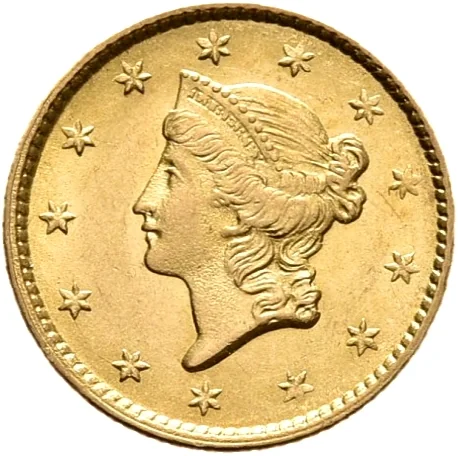
Liberty left, 13 stars.
Inscription:
LIBERTY
L
L
Script: Latin
Engraver: James Barton Longacre
Reverse
Description:
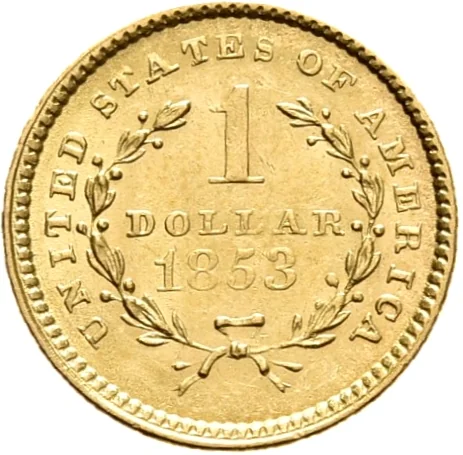
Issued date and denomination of a wreath.
Inscription:
UNITED STATES OF AMERICA
1 DOLLAR
1852
1 DOLLAR
1852
Script: Latin
Engraver: James Barton Longacre
Edge
Reeded
Mints
| Name | Mark |
|---|---|
| United States Mint of Philadelphia | — |
| United States Mint of Charlotte | C |
| United States Mint of Dahlonega | D |
| United States Mint of New Orleans | O |
| United States Mint of San Francisco | S |
Mintings
| Year | Mint Mark | Mintage | Quality | Collection |
|---|---|---|---|---|
| 1849 | — | — | ||
| 1849 | C | 11,634 | ||
| 1849 | D | 21,588 | ||
| 1849 | O | 215,000 | ||
| 1849 | — | 10 | Proof | |
| 1850 | — | 2 | Proof | |
| 1850 | C | 6,966 | ||
| 1850 | D | 8,382 | ||
| 1850 | O | 14,000 | ||
| 1850 | — | 481,953 | ||
| 1851 | — | 3,317,671 | ||
| 1851 | C | 41,267 | ||
| 1851 | D | 9,882 | ||
| 1851 | O | 290,000 | ||
| 1852 | — | 2,045,351 | ||
| 1852 | C | 9,434 | ||
| 1852 | D | 6,360 | ||
| 1852 | O | 140,000 | ||
| 1853 | C | 11,515 | ||
| 1853 | — | 4,076,051 | ||
| 1853 | D | 6,583 | ||
| 1853 | O | 290,000 | ||
| 1854 | — | 855,502 | ||
| 1854 | D | 2,935 | ||
| 1854 | S | 14,632 |
Historical background
In 1849, the United States operated under a disjointed and often chaotic currency system. The official standard was bimetallism, where both gold and silver were legal tender, with their values fixed by law at a 16:1 ratio. However, this ratio rarely matched global market prices, causing the undervalued metal to be hoarded or exported. This led to a practical gold standard in the years following the 1830s, as silver coins largely disappeared from circulation. Alongside scarce federal coinage, a vast array of privately issued banknotes from hundreds of state-chartered banks constituted the primary medium of everyday exchange. These notes traded at varying discounts based on public confidence in the issuing bank, making commerce complex and risky.
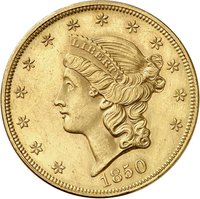
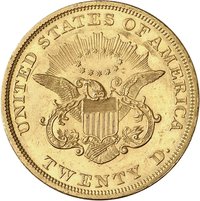
The year 1849 itself was a watershed moment due to the California Gold Rush, which began in 1848 but flooded the economy with new bullion in 1849 and the following decade. This massive influx of gold initially disrupted the fragile bimetallic equilibrium, further devaluing silver and exacerbating its disappearance. While it increased the nation's overall money supply, the new gold did not immediately streamline the system; it simply added another physical commodity to the mix. The federal government's response was to authorize the minting of new gold dollars and double eagles ($20 pieces), directly injecting official coinage into an economy starved for reliable currency.
This complex landscape fueled intense political debate that would dominate the mid-19th century. "Hard money" advocates, often agrarian and debtor interests, distrusted banks and paper money, calling for a government-issued currency or the exclusive use of specie (gold and silver). Opposing them were "soft money" proponents, frequently from commercial and industrial sectors, who supported banknotes to provide the flexible credit needed for economic expansion. The tensions of 1849—between gold and silver, between federal and private currency, and between hard and soft money ideologies—would culminate in the political battles of the Greenback and Free Silver movements later in the century.
The year 1849 itself was a watershed moment due to the California Gold Rush, which began in 1848 but flooded the economy with new bullion in 1849 and the following decade. This massive influx of gold initially disrupted the fragile bimetallic equilibrium, further devaluing silver and exacerbating its disappearance. While it increased the nation's overall money supply, the new gold did not immediately streamline the system; it simply added another physical commodity to the mix. The federal government's response was to authorize the minting of new gold dollars and double eagles ($20 pieces), directly injecting official coinage into an economy starved for reliable currency.
This complex landscape fueled intense political debate that would dominate the mid-19th century. "Hard money" advocates, often agrarian and debtor interests, distrusted banks and paper money, calling for a government-issued currency or the exclusive use of specie (gold and silver). Opposing them were "soft money" proponents, frequently from commercial and industrial sectors, who supported banknotes to provide the flexible credit needed for economic expansion. The tensions of 1849—between gold and silver, between federal and private currency, and between hard and soft money ideologies—would culminate in the political battles of the Greenback and Free Silver movements later in the century.
🌱 Fairly Common