

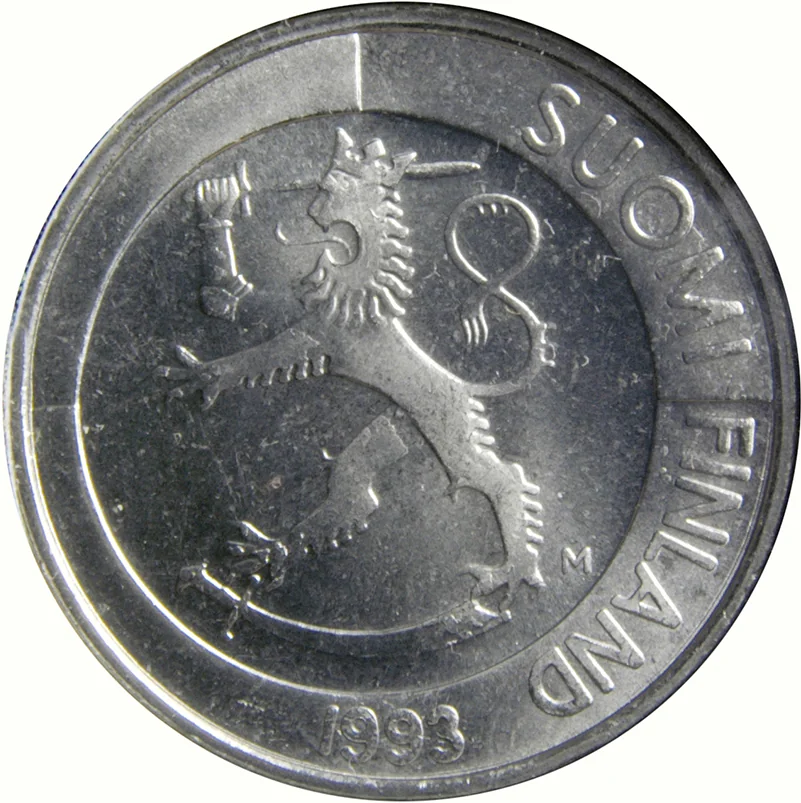
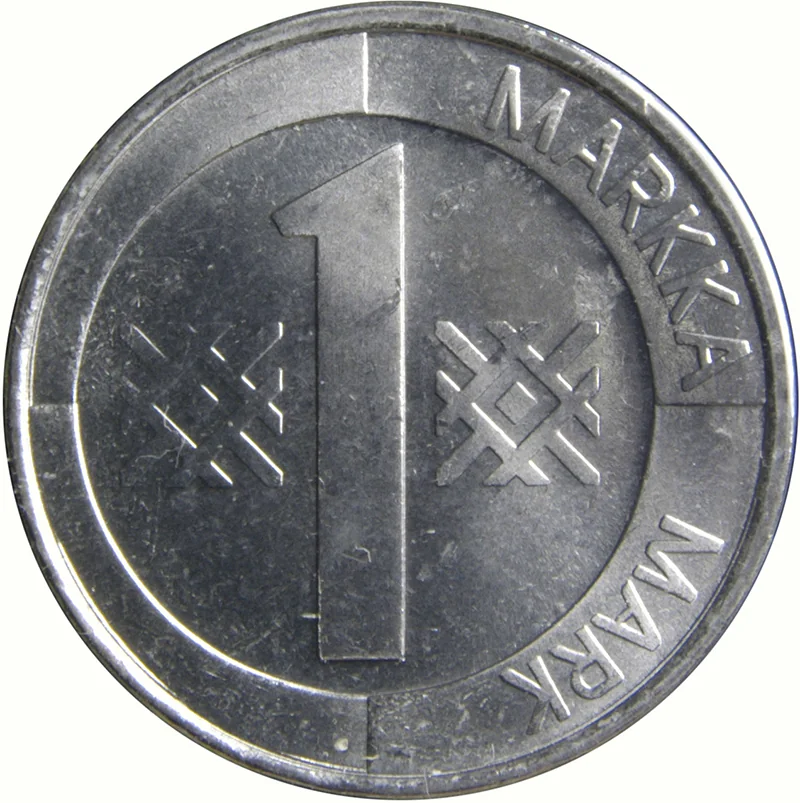
1 markka – Finland
Add to wishlist
Finland
Context
Year: 1993
Issuer: Finland
Period:
(since 1919)
Currency:
(1963—2001)
Demonetized: Yes
Total mintage: 100,000
Material
Diameter: 22.25 mm
Weight: 4.5 g
Shape: Round
Composition: Copper-nickel
Technique: Milled
Alignment: Medal alignment
flip
References
KM: #
Numista: #61551
Value
Exchange value: 1 FIM
Inflation-adjusted value: 1.76 FIM
Obverse
Reverse
Edge
Plain
Categories
| Object> Cold weapons |
| Animal> Feline |
| Symbols> Coat of Arms |
Mints
| Name | Mark |
|---|---|
| Mint of Finland | — |
Mintings
| Year | Mint Mark | Mintage | Quality | Collection |
|---|---|---|---|---|
| 1993 | — | 100,000 | In sets |
Historical background
In 1993, Finland was in the throes of a severe economic and banking crisis, precipitated by the collapse of the Soviet Union—a major trading partner—and a domestic credit and real estate bubble. This period, known as the "Finnish Great Depression," saw GDP plummet by over 10% and unemployment soar. A central feature of the crisis was intense pressure on the Finnish markka (FIM), which was tied to the European Currency Unit (ECU) within the European Exchange Rate Mechanism (ERM). Speculative attacks, driven by doubts over Finland's ability to maintain its peg amidst the deep recession and high interest rates, drained the Bank of Finland's foreign currency reserves.
This pressure culminated in a decisive break on September 8, 1992, when Finland was forced to abandon the markka's fixed exchange rate and let it float freely. While this event occurred in late 1992, its profound consequences defined the currency situation throughout 1993. The markka depreciated sharply, losing approximately 30% of its value against the Deutsche Mark by early 1993. This dramatic devaluation, while painful for citizens' purchasing power, provided a critical shock absorber for the economy by making Finnish exports more competitive on the global market, laying a foundation for eventual recovery.
Throughout 1993, the floating markka remained volatile but began to stabilize as the government implemented strict austerity measures and the banking crisis was gradually addressed. The currency's depreciation was a double-edged sword: it increased the cost of imports and foreign debt servicing but was instrumental in reviving the vital forestry and technology export sectors. This turbulent experience with currency instability and the desire for deeper European integration strongly influenced Finland's subsequent decision to join the European Union in 1995 and later to adopt the euro at its inception in 1999, seeking the monetary stability the markka had lacked during the crisis.
This pressure culminated in a decisive break on September 8, 1992, when Finland was forced to abandon the markka's fixed exchange rate and let it float freely. While this event occurred in late 1992, its profound consequences defined the currency situation throughout 1993. The markka depreciated sharply, losing approximately 30% of its value against the Deutsche Mark by early 1993. This dramatic devaluation, while painful for citizens' purchasing power, provided a critical shock absorber for the economy by making Finnish exports more competitive on the global market, laying a foundation for eventual recovery.
Throughout 1993, the floating markka remained volatile but began to stabilize as the government implemented strict austerity measures and the banking crisis was gradually addressed. The currency's depreciation was a double-edged sword: it increased the cost of imports and foreign debt servicing but was instrumental in reviving the vital forestry and technology export sectors. This turbulent experience with currency instability and the desire for deeper European integration strongly influenced Finland's subsequent decision to join the European Union in 1995 and later to adopt the euro at its inception in 1999, seeking the monetary stability the markka had lacked during the crisis.
⭐ Somewhat Rare