

50 Centimes – French West Africa
Context
Year: 1944
Issuer: French West Africa
Period:
(1944—1946)
Currency:
(1895—1944)
Demonetized: Yes
Total mintage: 10,000,000
Material

References
KM: #Click to copy to clipboard1
Numista: #11139
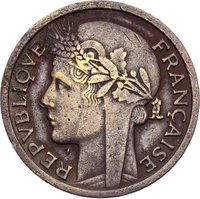
Obverse
Description:
Marianne's head in a Phrygian cap adorned with a wreath of olive, oak, and wheat leaves.
Inscription:
REPVBLIQUE FRANÇAISE
Translation:
FRENCH REPUBLIC
Script: Latin
Language: French
Engraver: Pierre-Alexandre Morlon
Reverse
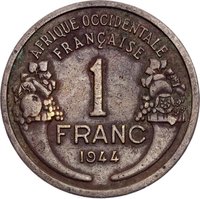
Description:
Value flanked by Cornucopias.
Inscription:
AFRIQUE OCCIDENTALE
FRANÇAISE
50
CENTIMES
1944
FRANÇAISE
50
CENTIMES
1944
Translation:
FRENCH WEST AFRICA
50
CENTS
1944
50
CENTS
1944
Script: Latin
Language: French
Engraver: Pierre-Alexandre Morlon
Edge
Plain
Categories
| Symbol> Allegory |
| Symbol> Phrygian cap |
| Symbol> Cornucopia |
Mints
| Name | Mark |
|---|---|
| Royal Mint (Tower Hill) | — |
Mintings
| Year | Mint Mark | Mintage | Quality | Collection |
|---|---|---|---|---|
| 1944 | — | 10,000,000 | ||
| 1944 | — | — | Proof |
Historical background
In 1944, the currency situation in French West Africa (Afrique Occidentale Française, or AOF) was defined by its integration into the broader "Franc Zone" and the exigencies of World War II. The region used the CFA franc (Colonies Françaises d'Afrique), which had been created in 1945. However, the groundwork for this system was laid in the immediate pre-liberation period of 1944. The currency was not freely convertible and was strictly managed by the Banque de l'Afrique Occidentale (BAO), a private issuing bank operating under a French government charter. Its value was pegged to a fixed, overvalued exchange rate with the metropolitan French franc, a policy designed to tightly bind the colonial economy to that of Vichy France and, following the Allied landings in North Africa, to the Free French authorities.
The war profoundly shaped monetary conditions. The AOF, under Vichy control until late 1942, was largely cut off from metropolitan France and experienced severe shortages of goods and currency notes. This led to increased use of barter and the clandestine circulation of British West African shillings in border areas. Furthermore, the French government in exile in Algiers and the Allies financed their operations in part by drawing on the resources of the colonies, including through advances from the BAO. This resulted in significant inflationary pressures across the AOF, as money supply increased without a corresponding growth in available goods, eroding purchasing power and causing economic hardship for the local population.
Politically, the year 1944 was a pivotal juncture. The Brazzaville Conference of January-February 1944, convened by Charles de Gaulle, rejected independence but promised postwar reforms and greater economic integration within the French empire. This set the stage for the formal creation of the new CFA franc in December 1945, which would solidify the monetary relationship for decades. Thus, in 1944, the currency system was a tool of colonial control, strained by wartime exigencies, and on the brink of being reconfirmed and rebranded to serve France's postwar vision of a tightly knit, yet reformed, imperial bloc.
The war profoundly shaped monetary conditions. The AOF, under Vichy control until late 1942, was largely cut off from metropolitan France and experienced severe shortages of goods and currency notes. This led to increased use of barter and the clandestine circulation of British West African shillings in border areas. Furthermore, the French government in exile in Algiers and the Allies financed their operations in part by drawing on the resources of the colonies, including through advances from the BAO. This resulted in significant inflationary pressures across the AOF, as money supply increased without a corresponding growth in available goods, eroding purchasing power and causing economic hardship for the local population.
Politically, the year 1944 was a pivotal juncture. The Brazzaville Conference of January-February 1944, convened by Charles de Gaulle, rejected independence but promised postwar reforms and greater economic integration within the French empire. This set the stage for the formal creation of the new CFA franc in December 1945, which would solidify the monetary relationship for decades. Thus, in 1944, the currency system was a tool of colonial control, strained by wartime exigencies, and on the brink of being reconfirmed and rebranded to serve France's postwar vision of a tightly knit, yet reformed, imperial bloc.
🌱 Fairly Common