

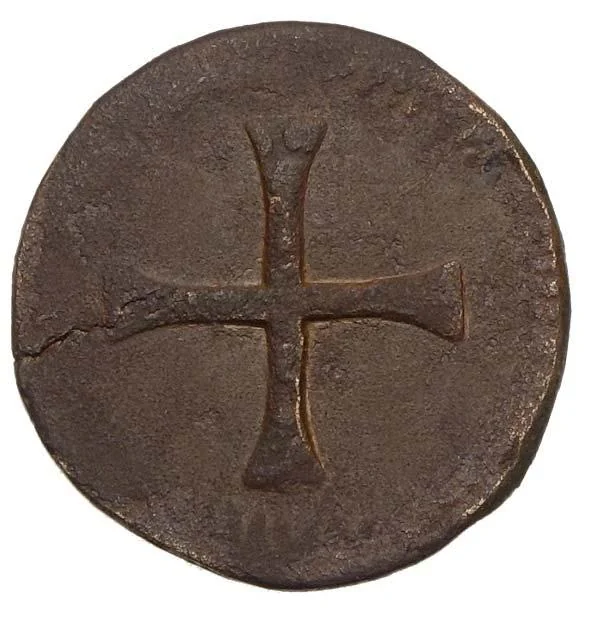

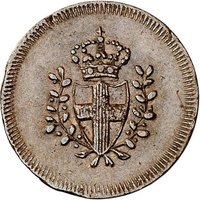
Obverse
Description:
Cross.
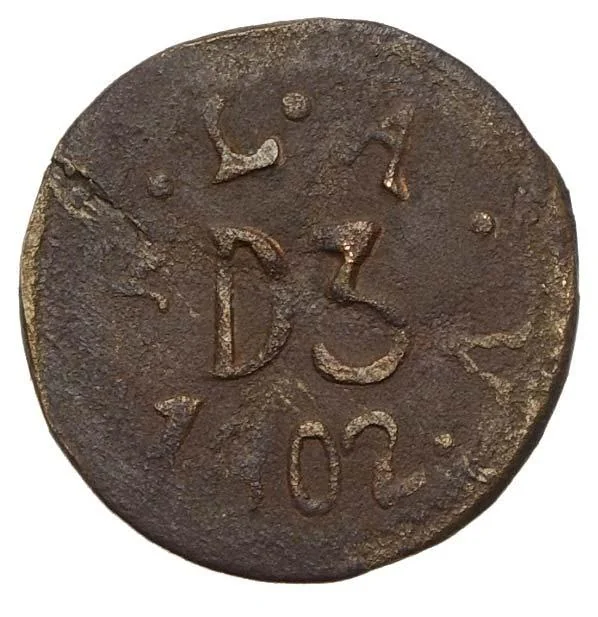
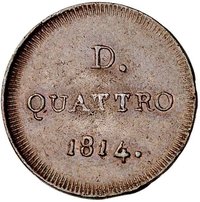
Reverse
Description:
Value and date below. Legend around rim.
Inscription:
R.L.A.V.
D.3
1802
D.3
1802
Translation:
By the decree of the Argentine Republic.
1802
1802
Language: Latin
Edge
Plain
Mints
| Name | Mark |
|---|---|
| Genoa | — |
Mintings
| Year | Mint Mark | Mintage | Quality | Collection |
|---|---|---|---|---|
| 1802 | — | — |
Historical background
The Ligurian Republic, a French client state established in 1797 on the territory of the former Republic of Genoa, faced profound monetary instability by 1802. Its economy was strained by French-imposed war contributions, the costs of hosting a large French garrison, and the disruption of traditional maritime trade. The state inherited a complex mix of circulating coins, including old Genovese luigini and silver scudi, alongside the new republican currency—the lira genovese—which was pegged to the French franc. However, chronic budget deficits led the government to authorize excessive paper money (cedole) issuance, which quickly began to depreciate against specie.
This depreciation created a classic bimetalic crisis. As the paper currency lost public confidence, people hoarded gold and silver coins, leading to a severe shortage of physical currency for daily transactions. The government's attempts to enforce the acceptance of paper at face value failed, and a thriving black market for specie emerged where cedole traded at a significant discount. This situation crippled commerce, eroded salaries, and caused widespread social discontent among a population already burdened by high taxes and economic hardship.
By late 1802, the currency system was in a state of effective collapse, mirroring the political fragility of the Republic itself. The monetary chaos was a direct factor in weakening the Ligurian government's authority, paving the way for its annexation by France in June 1805. Thus, the currency situation of 1802 was not merely an economic issue but a critical symptom of the Republic's dependency and unsustainable position within Napoleon's imperial system.
This depreciation created a classic bimetalic crisis. As the paper currency lost public confidence, people hoarded gold and silver coins, leading to a severe shortage of physical currency for daily transactions. The government's attempts to enforce the acceptance of paper at face value failed, and a thriving black market for specie emerged where cedole traded at a significant discount. This situation crippled commerce, eroded salaries, and caused widespread social discontent among a population already burdened by high taxes and economic hardship.
By late 1802, the currency system was in a state of effective collapse, mirroring the political fragility of the Republic itself. The monetary chaos was a direct factor in weakening the Ligurian government's authority, paving the way for its annexation by France in June 1805. Thus, the currency situation of 1802 was not merely an economic issue but a critical symptom of the Republic's dependency and unsustainable position within Napoleon's imperial system.
✨ Legendary