

1⁄12 anna – India - British
Add to wishlist
India
Context
Years: 1904–1910
Country: India
Issuer: India - British
Ruler: Edward VII
Currency:
(1770—1947)
Demonetized: Yes
Total mintage: 81,041,000
Material
References
KM: #
Numista: #11133
Obverse
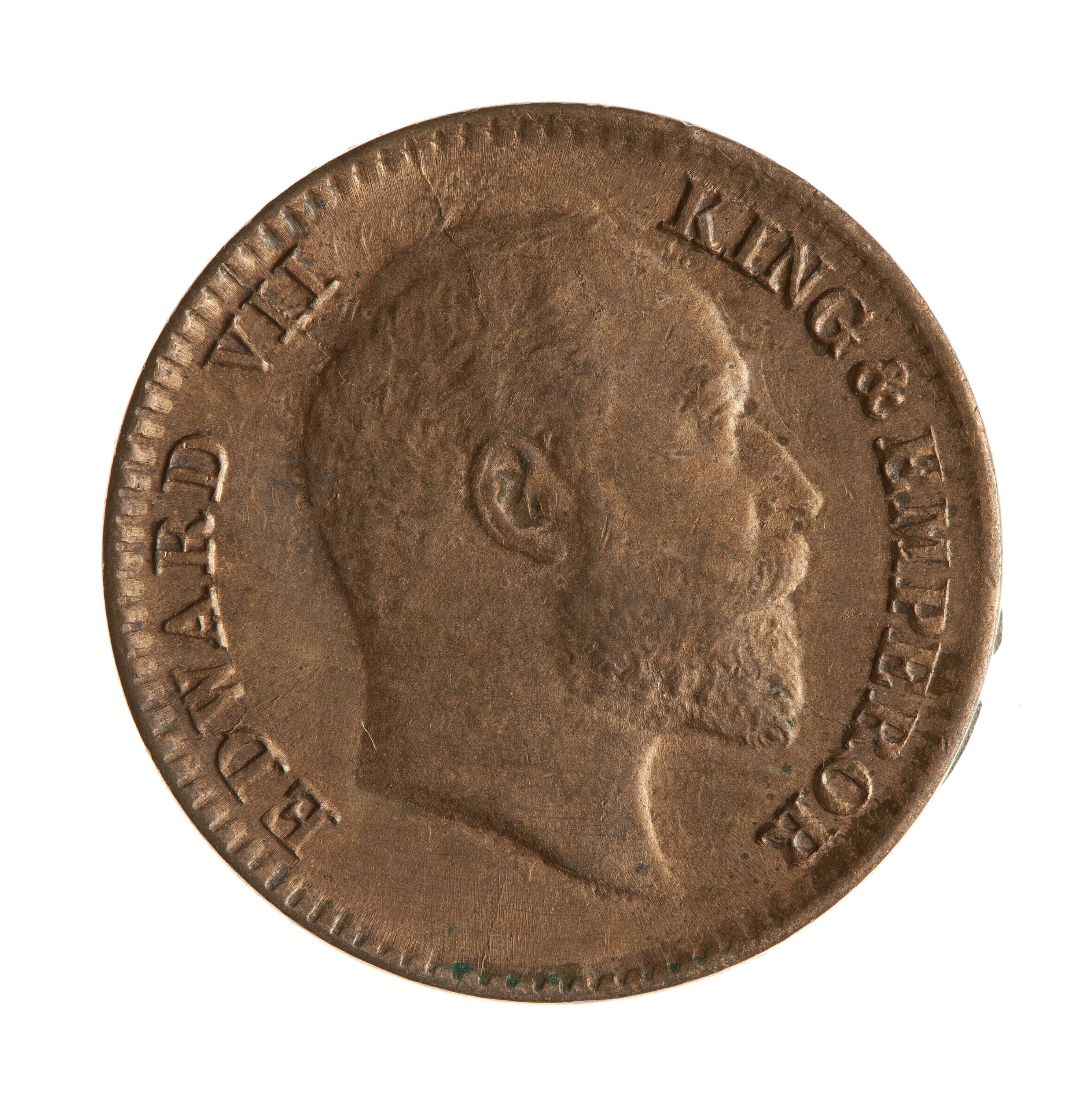
Description:
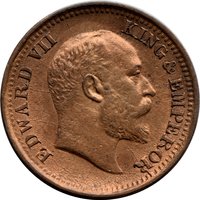
Edward VII bust, right profile
Inscription:
EDWARD VII KING & EMPEROR
Translation:
EDWARD VII KING & EMPEROR
Script: Latin
Engraver: George William de Saulles
Reverse
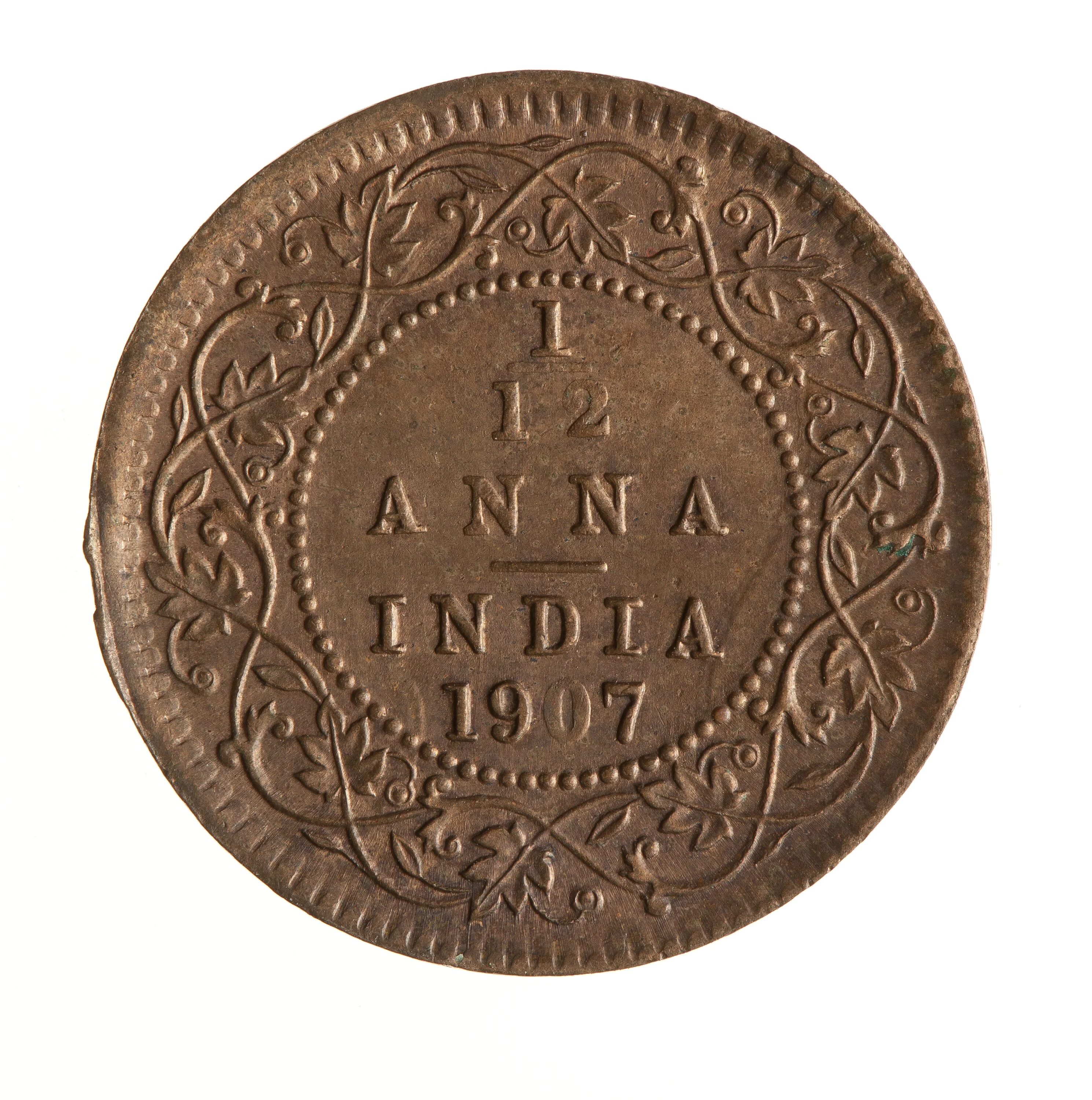
Description:
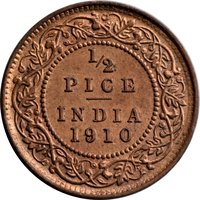
Denomination and date encircled by beads, surrounded by wreath.
Inscription:
1/12
ANNA
INDIA
1909
ANNA
INDIA
1909
Script: Latin
Edge
Plain
Mints
| Name | Mark |
|---|---|
| Kolkata / Calcutta / Murshidabad | — |
Mintings
| Year | Mint Mark | Mintage | Quality | Collection |
|---|---|---|---|---|
| 1904 | — | — | ||
| 1905 | — | — | ||
| 1906 | — | 2,184,000 | ||
| 1906 | — | — | Proof | |
| 1907 | — | 20,985,000 | ||
| 1907 | — | — | Proof | |
| 1907 | — | — | Prooflike | |
| 1908 | — | 22,036,000 | ||
| 1908 | — | — | Proof | |
| 1908 | — | — | Prooflike | |
| 1909 | — | 12,316,000 | ||
| 1909 | — | — | Prooflike | |
| 1910 | — | — | Prooflike | |
| 1910 | — | 23,520,000 |
Historical background
In 1904, the currency system of British India was a managed monometallic silver standard, but one under significant strain and international scrutiny. The Indian rupee's value was pegged to silver, yet its exchange rate with gold-based currencies like the British pound sterling was fixed by government fiat at 1s 4d (16 pence). This created a complex and often unstable dynamic. While domestically the silver rupee circulated freely, internationally the plummeting global price of silver—due to increased production and demonetisation by Western nations—meant the intrinsic bullion value of the rupee was falling. The Government of India, therefore, had to constantly intervene to maintain the artificial official exchange rate, leading to costly gold purchases and provoking criticism from both London and Indian nationalists.
The system's fragility was a direct legacy of the closing of the Indian Mints to the free coinage of silver in 1893 (the "Closing of the Mints"). This move, aimed at stabilising the rupee, had successfully halted its depreciation but created a rupee that was effectively a token coin, its face value higher than its metal content. By 1904, the currency was primarily backed by a substantial Gold Exchange Standard reserve held in London, which was used to convert rupees into sterling at the fixed rate. This mechanism tied India's financial stability tightly to British fiscal policy and drew gold out of the Indian economy, a point of political contention.
Economically, the situation presented a paradox of a stable internal currency but an externally vulnerable one. The fixed high exchange rate (1s 4d) was favoured by the British government and officials receiving remittances in sterling, but it was deeply unpopular with Indian exporters, particularly the jute and cotton producers of Bengal and Bombay, who found their goods becoming more expensive on the world market. The Indian National Congress and figures like Dadabhai Naoroji criticised the "drain of wealth" exacerbated by this system. Thus, in 1904, the currency question remained unresolved, sitting at the uneasy intersection of colonial economic management, global metallic shifts, and growing Indian nationalist economic critique, setting the stage for the eventual move to a formal gold exchange standard in 1899, which was still being consolidated in practice.
The system's fragility was a direct legacy of the closing of the Indian Mints to the free coinage of silver in 1893 (the "Closing of the Mints"). This move, aimed at stabilising the rupee, had successfully halted its depreciation but created a rupee that was effectively a token coin, its face value higher than its metal content. By 1904, the currency was primarily backed by a substantial Gold Exchange Standard reserve held in London, which was used to convert rupees into sterling at the fixed rate. This mechanism tied India's financial stability tightly to British fiscal policy and drew gold out of the Indian economy, a point of political contention.
Economically, the situation presented a paradox of a stable internal currency but an externally vulnerable one. The fixed high exchange rate (1s 4d) was favoured by the British government and officials receiving remittances in sterling, but it was deeply unpopular with Indian exporters, particularly the jute and cotton producers of Bengal and Bombay, who found their goods becoming more expensive on the world market. The Indian National Congress and figures like Dadabhai Naoroji criticised the "drain of wealth" exacerbated by this system. Thus, in 1904, the currency question remained unresolved, sitting at the uneasy intersection of colonial economic management, global metallic shifts, and growing Indian nationalist economic critique, setting the stage for the eventual move to a formal gold exchange standard in 1899, which was still being consolidated in practice.
🌱 Common