

1 lev – Bulgaria
Add to wishlist
Non-circulating coins
Commemoration: Bulgarian Iconography
Bulgaria
Context
Material
Diameter: 24.5 mm
Weight: 15.55 g
Gold Weight:: 15.53 g
Shape: Round
Composition: 99.9% Gold
Standard: Silver half ounce
Magnetic: No
Technique: Milled
Alignment: Medal alignment
flip
References
KM: #
Numista: #60933
Value
Exchange value: 1 BGN
Bullion value: $2381.40
Obverse
Description:
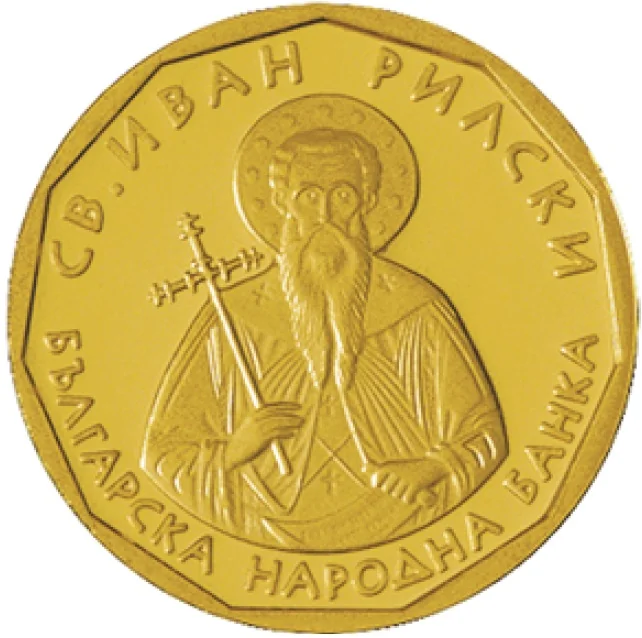
This coin, issued September 2, 2002, honors St. Ivan Rilsky (c. 876–946), Bulgaria’s first hermit and founder of its grandest monastery.
Inscription:
СВ. ИВАН РИЛСКИ
БЪЛГАРСКА НАРОДНА БАНКА
БЪЛГАРСКА НАРОДНА БАНКА
Translation:
ST. JOHN OF RILA
BULGARIAN NATIONAL BANK
BULGARIAN NATIONAL BANK
Script: Cyrillic
Language: Bulgarian
Engraver: Petar Stoikov
Reverse
Description:
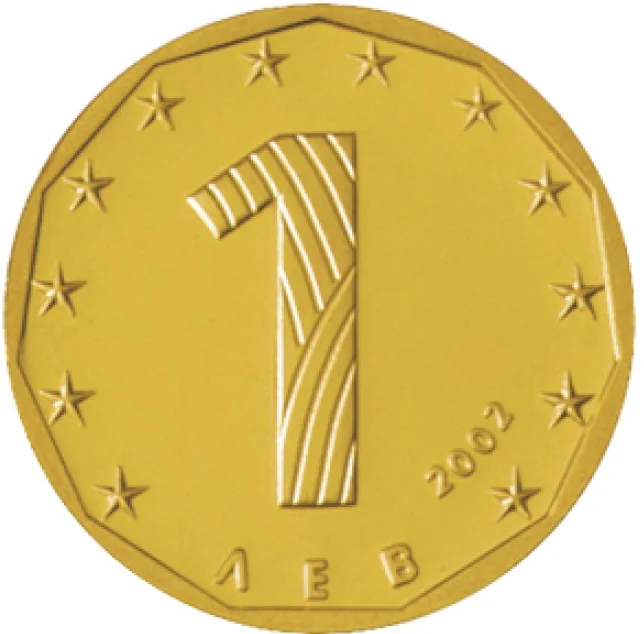
Denomination, date.
Inscription:
1
2002
ЛЕВ
2002
ЛЕВ
Translation:
One Lev
2002
2002
Script: Cyrillic
Engraver: Petar Stoikov
Edge
Plain
Mints
| Name | Mark |
|---|---|
| Bulgarian Mint | — |
Mintings
| Year | Mint Mark | Mintage | Quality | Collection |
|---|---|---|---|---|
| 2002 | — | 2,000 |
Historical background
In 2002, Bulgaria was in a period of significant monetary stability, anchored by its unique currency board arrangement established in 1997 following a severe financial and hyperinflation crisis. The national currency, the lev (BGN), was firmly pegged at a fixed rate of 1,000 "old" lev to 1 Deutsche Mark, a parity that was seamlessly transferred to 1.95583 new lev per euro upon Germany's adoption of the common European currency in 1999. This currency board strictly mandated that every lev in circulation be fully backed by foreign reserves, primarily euros, eliminating the central bank's discretionary monetary policy and imposing rigorous fiscal discipline.
This framework had successfully tamed inflation and restored confidence, but by 2002 it also presented specific challenges and debates. While the economy was stabilizing and growing, the rigid peg limited tools for adjusting to economic shocks and kept interest rates higher than the eurozone average. Furthermore, the country's strategic goal of European Union accession—achieved in 2007—made eventual Eurozone membership a key objective. Therefore, the central discussion in 2002 was not about the stability of the lev, which was unquestioned, but about the pathway and timing for eventually replacing it with the euro.
Consequently, the currency situation in 2002 was one of a successful but transitional stability. The lev operated as a de facto proxy for the euro, providing a bedrock for economic planning and foreign investment. The focus for policymakers had shifted from crisis management to long-term integration, laying the technical and institutional groundwork to meet the Maastricht criteria and prepare for the future adoption of the euro, a process that would, however, take nearly two more decades to complete.
This framework had successfully tamed inflation and restored confidence, but by 2002 it also presented specific challenges and debates. While the economy was stabilizing and growing, the rigid peg limited tools for adjusting to economic shocks and kept interest rates higher than the eurozone average. Furthermore, the country's strategic goal of European Union accession—achieved in 2007—made eventual Eurozone membership a key objective. Therefore, the central discussion in 2002 was not about the stability of the lev, which was unquestioned, but about the pathway and timing for eventually replacing it with the euro.
Consequently, the currency situation in 2002 was one of a successful but transitional stability. The lev operated as a de facto proxy for the euro, providing a bedrock for economic planning and foreign investment. The focus for policymakers had shifted from crisis management to long-term integration, laying the technical and institutional groundwork to meet the Maastricht criteria and prepare for the future adoption of the euro, a process that would, however, take nearly two more decades to complete.
💎 Extremely Rare