

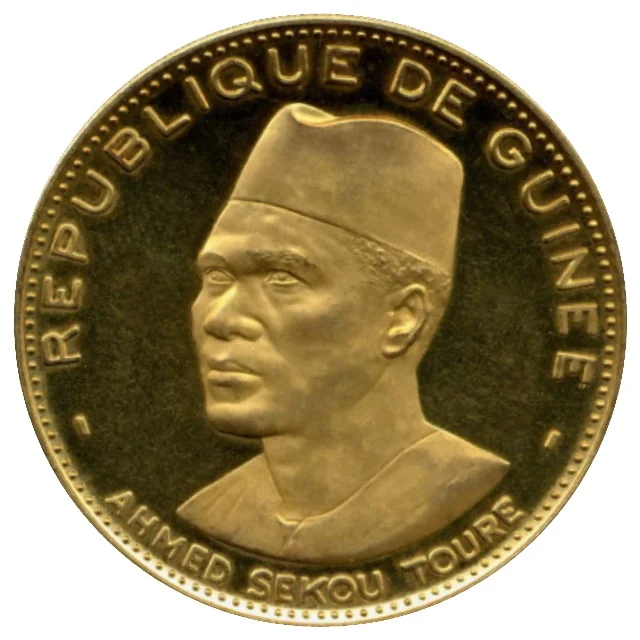
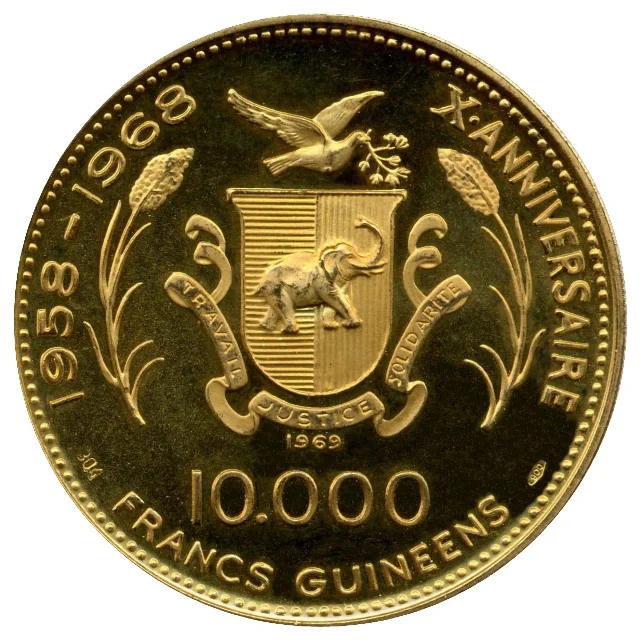
10000 Francs – Guinea
Non-circulating coins
Commemoration: Ahmed Sekou Touré
Guinea
Context

Material
References
KM: #Click to copy to clipboard20
Numista: #60902
Value
Bullion value: $6012.48
Obverse
Reverse
Edge
Reeded
Mints
| Name | Mark |
|---|---|
| Milan | — |
Mintings
| Year | Mint Mark | Mintage | Quality | Collection |
|---|---|---|---|---|
| 1969 | — | 2,300 | Proof |
Historical background
In 1969, Guinea's currency situation was defined by its continued use of the Guinean franc, a currency established following its dramatic break from the CFA franc zone upon achieving independence from France in 1958. President Sékou Touré's government, pursuing a radical path of socialist economic autonomy, created its own central bank and currency to assert full monetary sovereignty. This move, while politically symbolic, immediately isolated Guinea from regional financial systems and complicated its international trade.
The decade that followed independence led to significant economic challenges by 1969. The state's adoption of a centrally planned economy, combined with the flight of French technical expertise and capital, resulted in declining production, particularly in the vital bauxite and agricultural sectors. Consequently, the Guinean franc faced substantial inflationary pressures. The government's response included strict currency controls, the issuance of new banknote series to combat hoarding and black markets, and an official fixed exchange rate that vastly overvalued the currency compared to its dwindling real value.
Internationally, the Guinean franc was non-convertible, and the country had limited foreign exchange reserves. Trade was often conducted through bilateral barter agreements with Eastern Bloc and other sympathetic nations. By 1969, the currency situation reflected the broader economic difficulties of Touré's isolationist policies: a nominally independent monetary system was in place, but it functioned within a struggling, insular economy characterized by scarcity, parallel markets, and a growing disconnect between the official economy and the daily realities of its citizens.
The decade that followed independence led to significant economic challenges by 1969. The state's adoption of a centrally planned economy, combined with the flight of French technical expertise and capital, resulted in declining production, particularly in the vital bauxite and agricultural sectors. Consequently, the Guinean franc faced substantial inflationary pressures. The government's response included strict currency controls, the issuance of new banknote series to combat hoarding and black markets, and an official fixed exchange rate that vastly overvalued the currency compared to its dwindling real value.
Internationally, the Guinean franc was non-convertible, and the country had limited foreign exchange reserves. Trade was often conducted through bilateral barter agreements with Eastern Bloc and other sympathetic nations. By 1969, the currency situation reflected the broader economic difficulties of Touré's isolationist policies: a nominally independent monetary system was in place, but it functioned within a struggling, insular economy characterized by scarcity, parallel markets, and a growing disconnect between the official economy and the daily realities of its citizens.
✨ Legendary