

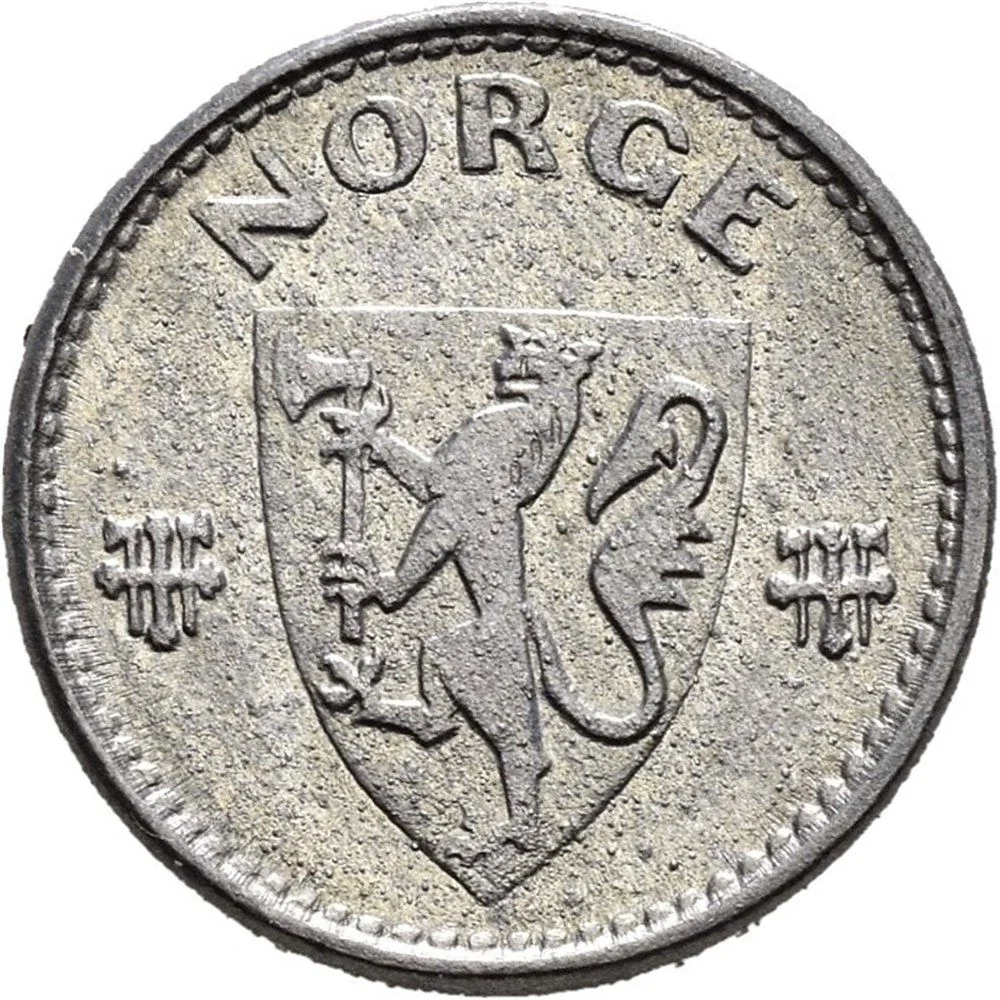
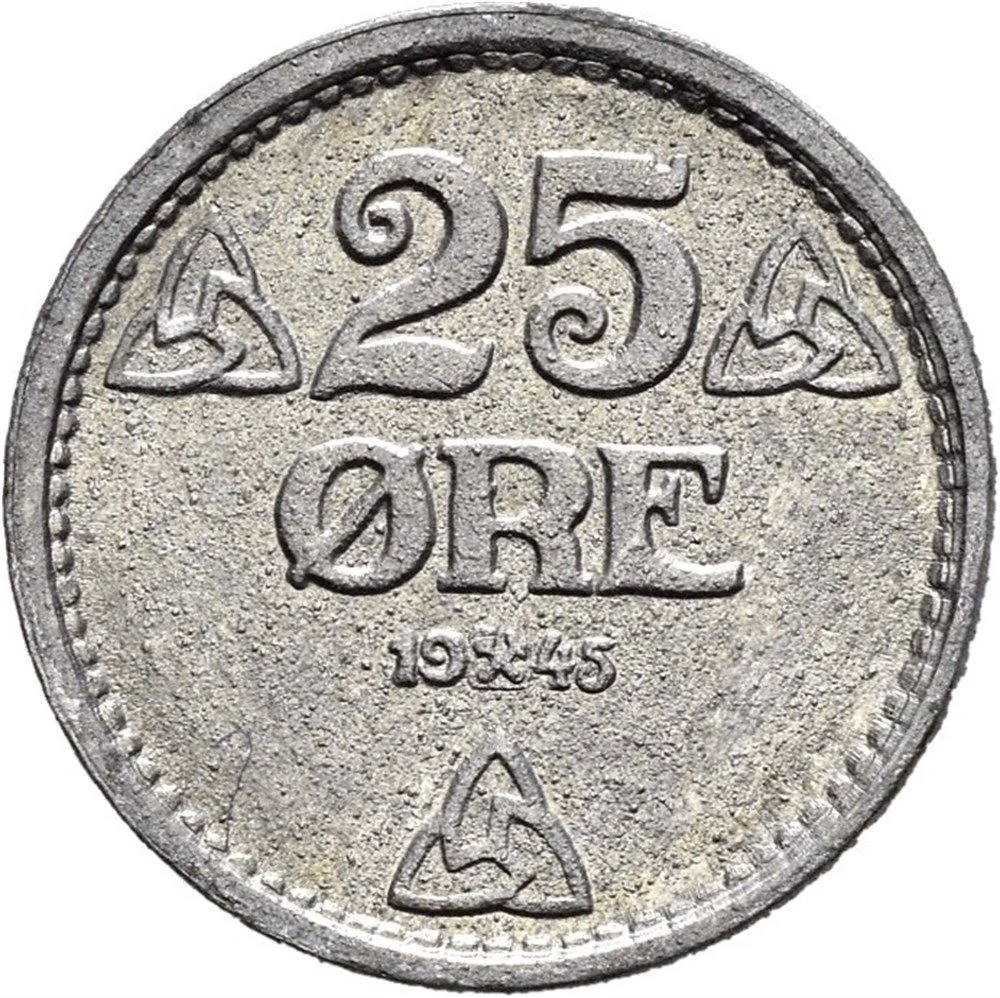
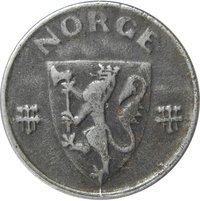
Obverse
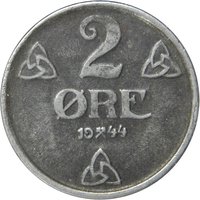
Reverse
Edge
Plain
Mints
| Name | Mark |
|---|---|
| Norwegian Mint | — |
Mintings
| Year | Mint Mark | Mintage | Quality | Collection |
|---|---|---|---|---|
| 1943 | — | 14,104,800 | ||
| 1944 | — | 3,030,500 | ||
| 1945 | — | 3,010,000 |
Historical background
During the German occupation of Norway from 1940 to 1945, the currency situation by 1943 had become severely destabilized and was a key instrument of Nazi economic exploitation. The occupying authorities, through the Reichskommissariat, forced the Norwegian central bank (Norges Bank) to cover the enormous costs of the occupation by printing vast amounts of Norwegian kroner. This was formalized through the so-called "clearing agreement," which created a massive, ever-growing debt owed by Germany to Norway—a debt that was, in reality, never intended to be repaid. The result was a classic case of occupation-funded inflation, as the money supply expanded dramatically without a corresponding increase in goods and services.
The inflationary pressure was acutely felt by the civilian population. Prices soared, and a pervasive black market emerged where goods could be obtained at many times their official prices, rendering controlled rations increasingly inadequate. While wages were also frozen for much of the occupation, the flood of currency eroded purchasing power and savings, leading to widespread economic hardship and inequality. The situation was further complicated by the circulation of German Reichskreditkassenscheine (military scrip) alongside Norwegian notes, and the fear that a sudden German collapse could render the currency worthless.
In response, the Norwegian government-in-exile in London and the domestic resistance movement took covert action to protect the nation's economic future. From 1943, plans were secretly developed for a post-liberation currency reform. The resistance, with assistance from the British, smuggled in new banknote plates and paper to Norway, hiding them until the war's end. This preparation allowed for the swift and decisive currency exchange carried out in 1945, which aimed to identify and invalidate illegally acquired occupation money, stabilize the economy, and sever the financial legacy of the occupation in one decisive stroke.
The inflationary pressure was acutely felt by the civilian population. Prices soared, and a pervasive black market emerged where goods could be obtained at many times their official prices, rendering controlled rations increasingly inadequate. While wages were also frozen for much of the occupation, the flood of currency eroded purchasing power and savings, leading to widespread economic hardship and inequality. The situation was further complicated by the circulation of German Reichskreditkassenscheine (military scrip) alongside Norwegian notes, and the fear that a sudden German collapse could render the currency worthless.
In response, the Norwegian government-in-exile in London and the domestic resistance movement took covert action to protect the nation's economic future. From 1943, plans were secretly developed for a post-liberation currency reform. The resistance, with assistance from the British, smuggled in new banknote plates and paper to Norway, hiding them until the war's end. This preparation allowed for the swift and decisive currency exchange carried out in 1945, which aimed to identify and invalidate illegally acquired occupation money, stabilize the economy, and sever the financial legacy of the occupation in one decisive stroke.
🌱 Common