

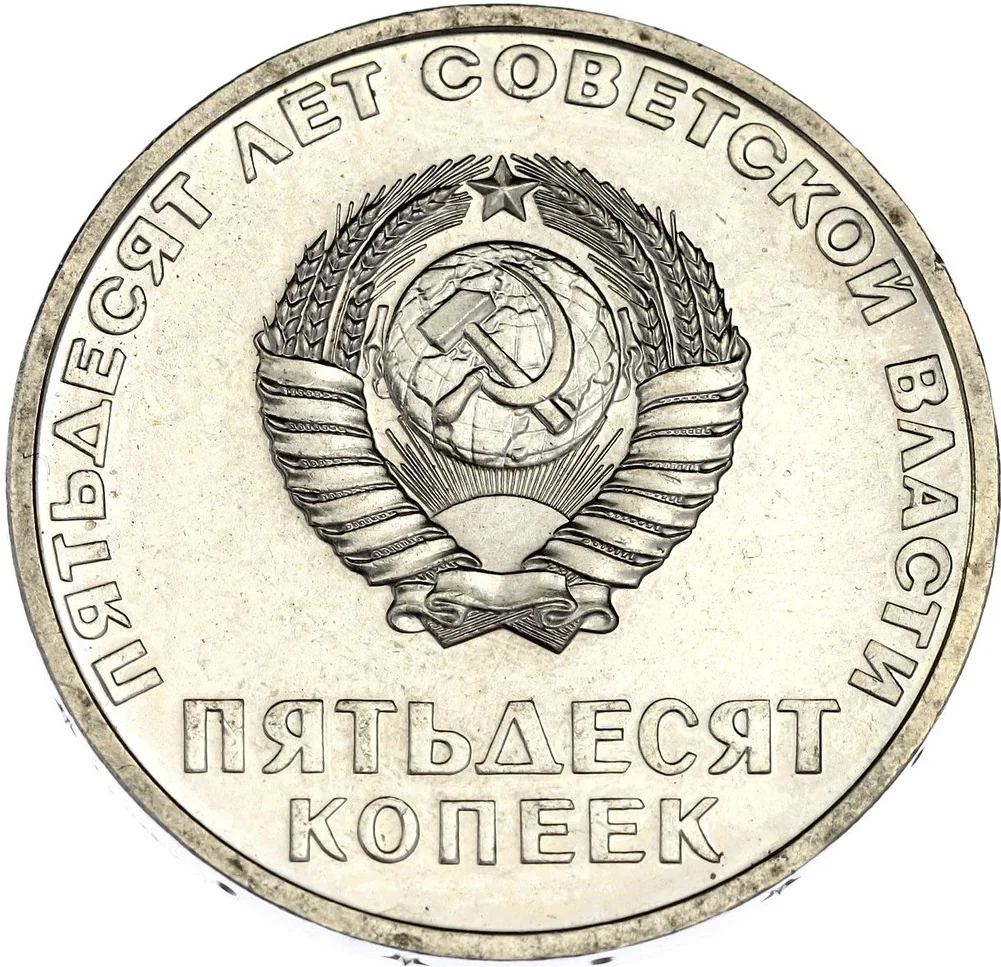
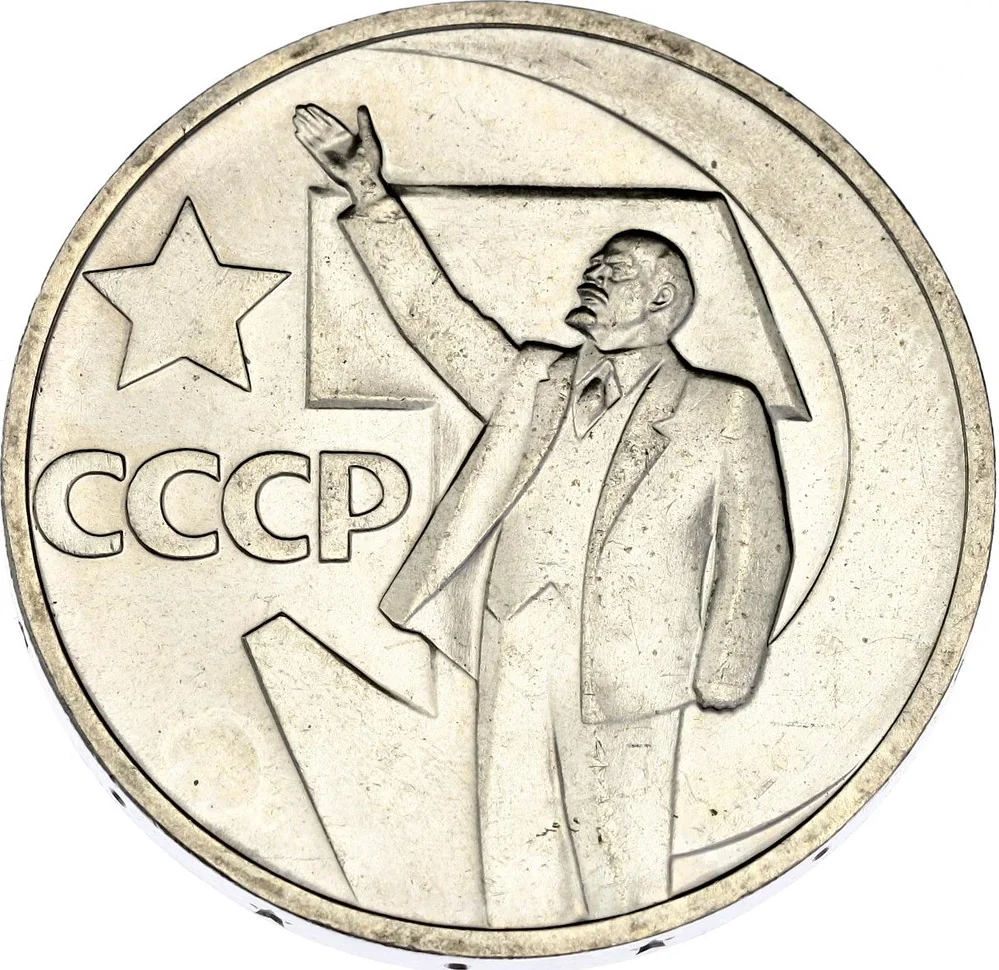
50 Kopecks (Great October Socialist Revolution) – Soviet Union
Circulating commemorative coins
Commemoration: 50th Anniversary of the Great October Socialist Revolution
Russia
Context
Year: 1967
Country: Russia 
Issuer: Soviet Union 
Period:
(1922—1991)
Currency:
(1961—1991)
Demonetization: 1991
Total mintage: 50,000,000
Material
Diameter: 25 mm
Weight: 6.45 g
Thickness: 2 mm
Shape: Round
Composition: Nickel brass
Magnetic: No
Technique: Milled
Alignment: Medal alignment
flip
References
Value
Exchange value: 0.50 SUR
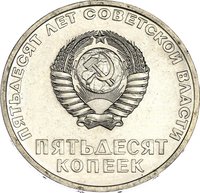
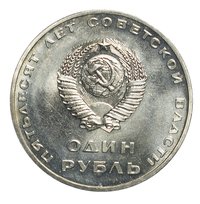
Obverse
Reverse
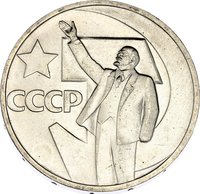
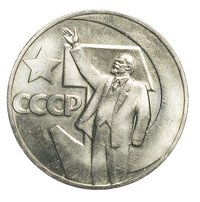
Description:
Lenin, right arm raised, facing left. Star at upper left.
Inscription:
СССР
Translation:
Union of Soviet Socialist Republics
Script: Cyrillic
Language: Russian
Engravers: N.N. Filippov, Igor Sergeevich Komshilov
Edge
Smooth with 8 stars and 8 points.
Legend:
★ • ★ • ★ • ★ • ★ • ★ • ★ • ★ •
Categories
| Person> Politician |
| Symbol> Hammer and sickle |
| Event> Revolution |
Mints
| Name | Mark |
|---|---|
| Saint Petersburg | — |
Mintings
| Year | Mint Mark | Mintage | Quality | Collection |
|---|---|---|---|---|
| 1967 | — | 49,789,000 | ||
| 1967 | — | 211,000 | Prooflike |
Historical background
By 1967, the Soviet Union's currency system was a study in contrasts, defined by strict internal controls and a complete separation from the global financial system. The domestic ruble was a non-convertible "soft currency," meaning it could not be legally exchanged for foreign currencies or taken out of the country. Its value was artificially set by the state and bore no relation to market forces. Within the USSR, it functioned as the sole legal tender for citizens, but its purchasing power was disconnected from the official exchange rate, which was used primarily for accounting in state-run foreign trade.
This system created a complex dual reality. For ordinary Soviet citizens, wages and daily transactions in rubles were stable but constrained by chronic shortages and a limited range of goods in state stores. Alongside this, a special parallel economy existed for foreigners and the Soviet elite through a separate currency known as the "cheque ruble" or "certificate ruble" (сертификационный рубль). This currency, used in hard-currency stores called Beryozka, could only be obtained with foreign cash and provided access to a world of high-quality imported and deficit goods entirely unavailable to the general public. It was a visible, resented symbol of privilege and the ruble's artificiality.
Internationally, the Soviet ruble was irrelevant. The state maintained an official, highly overvalued exchange rate (0.90 rubles to 1 USD in 1961, fixed until 1971) for propaganda purposes, to suggest the superiority of the planned economy. In practice, all foreign trade was conducted by state monopolies using world market prices and settled in hard currencies like US dollars. The 1960s saw no major monetary reforms like the 1947 or 1961 redenominations, but the inherent weaknesses of a non-convertible, artificially managed currency were becoming more apparent, foreshadowing the economic stagnation of the coming Brezhnev era.
This system created a complex dual reality. For ordinary Soviet citizens, wages and daily transactions in rubles were stable but constrained by chronic shortages and a limited range of goods in state stores. Alongside this, a special parallel economy existed for foreigners and the Soviet elite through a separate currency known as the "cheque ruble" or "certificate ruble" (сертификационный рубль). This currency, used in hard-currency stores called Beryozka, could only be obtained with foreign cash and provided access to a world of high-quality imported and deficit goods entirely unavailable to the general public. It was a visible, resented symbol of privilege and the ruble's artificiality.
Internationally, the Soviet ruble was irrelevant. The state maintained an official, highly overvalued exchange rate (0.90 rubles to 1 USD in 1961, fixed until 1971) for propaganda purposes, to suggest the superiority of the planned economy. In practice, all foreign trade was conducted by state monopolies using world market prices and settled in hard currencies like US dollars. The 1960s saw no major monetary reforms like the 1947 or 1961 redenominations, but the inherent weaknesses of a non-convertible, artificially managed currency were becoming more apparent, foreshadowing the economic stagnation of the coming Brezhnev era.
🌱 Very Common