

2½ pahlavī – Iran
Add to wishlist
Non-circulating coins
Commemoration: Pahlavi Marriage Celebration
Iran
Context
Year: 1959
Iranian - Persian Year:: 1338
Issuer: Iran
Issuing organization: Bank Melli Iran
Ruler: Mohammad Reza
Currency:
Demonetization: 1979
Material
References
KM: #
Numista: #60158
Value
Bullion value: $2808.45
Obverse
Description:
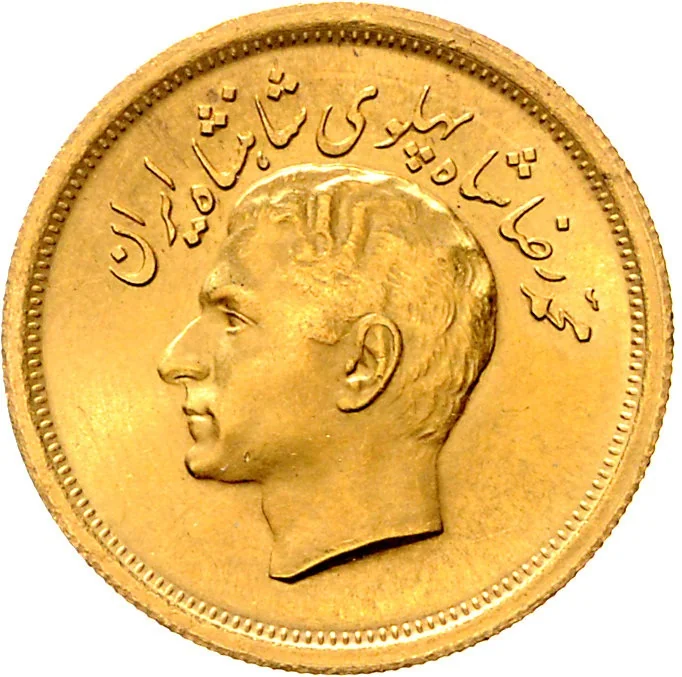
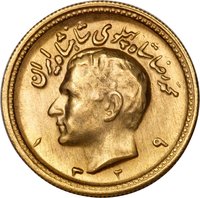
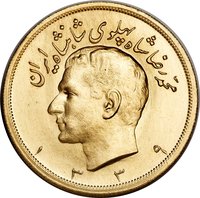
Pahlavi II's left-facing portrait.
Inscription:
محمّدرضا شاه پهلوی شاهنشاه ایران
Translation:
Mohammad Reza Shah Pahlavi, Shahanshah of Iran
Script: Persian (nastaliq)
Language: Persian
Reverse
Description:
Legend
Inscription:
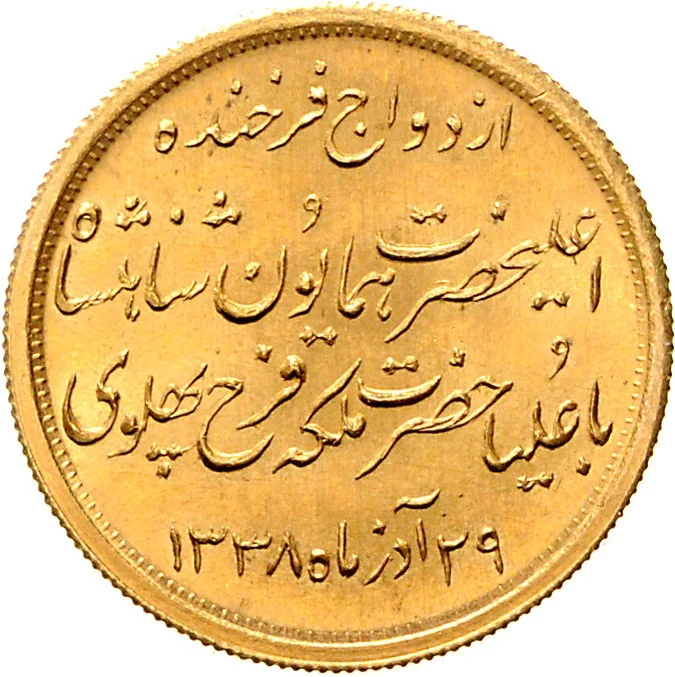
ازدواج فرخنده
اعلیحضرت همایُون شاهنشاه
با عُلیاحضرت ملکه فرح پهلوی
۱۳۳۸ آذرماه ۲۹
اعلیحضرت همایُون شاهنشاه
با عُلیاحضرت ملکه فرح پهلوی
۱۳۳۸ آذرماه ۲۹
Translation:
Auspicious Marriage
His Imperial Majesty the Shahanshah
with Her Imperial Majesty Queen Farah Pahlavi
1338 Azar 29
His Imperial Majesty the Shahanshah
with Her Imperial Majesty Queen Farah Pahlavi
1338 Azar 29
Script: Persian (nastaliq)
Language: Persian
Edge
Reeded
Categories
| Marriage |
Mints
| Name | Mark |
|---|---|
| Tehran | — |
Mintings
| Year | Mint Mark | Mintage | Quality | Collection |
|---|---|---|---|---|
| 1959 | — | — |
Historical background
In 1959, Iran's currency situation was characterized by relative stability under the monarchy of Mohammad Reza Pahlavi, but it existed within a framework of significant external influence and underlying economic pressures. The national currency, the rial, was effectively pegged to the U.S. dollar at a fixed rate of 75.75 rials per dollar, a regime established in 1955 with guidance from American financial advisors. This peg was managed by the Central Bank of Iran (Bank Markazi), which had been established just two years prior in 1957 to modernize monetary policy and assert greater national control over the currency.
This stability was largely artificial, underpinned by Iran's growing oil revenues and substantial U.S. economic and military aid, which provided crucial foreign exchange reserves. The country was in a period of economic expansion and modernization, known as the "White Revolution," which increased government spending on infrastructure and development projects. However, the economy remained heavily dependent on the volatile oil sector and agricultural exports, with a limited industrial base. The fixed exchange rate, while fostering predictability for international trade, also masked inflationary tendencies and made the rial potentially overvalued, which could hinder non-oil exports.
Furthermore, the currency regime reflected Iran's geopolitical alignment during the Cold War. The fixed peg to the dollar solidified Iran's financial integration with the Western bloc, facilitating trade and investment from the United States and Europe. This monetary policy was part of a broader strategy to position Iran as a regional economic power and a stable ally of the West. However, this external dependency and the state-led spending would later contribute to economic imbalances, setting the stage for the inflationary pressures and currency challenges that would emerge more forcefully in the following decades.
This stability was largely artificial, underpinned by Iran's growing oil revenues and substantial U.S. economic and military aid, which provided crucial foreign exchange reserves. The country was in a period of economic expansion and modernization, known as the "White Revolution," which increased government spending on infrastructure and development projects. However, the economy remained heavily dependent on the volatile oil sector and agricultural exports, with a limited industrial base. The fixed exchange rate, while fostering predictability for international trade, also masked inflationary tendencies and made the rial potentially overvalued, which could hinder non-oil exports.
Furthermore, the currency regime reflected Iran's geopolitical alignment during the Cold War. The fixed peg to the dollar solidified Iran's financial integration with the Western bloc, facilitating trade and investment from the United States and Europe. This monetary policy was part of a broader strategy to position Iran as a regional economic power and a stable ally of the West. However, this external dependency and the state-led spending would later contribute to economic imbalances, setting the stage for the inflationary pressures and currency challenges that would emerge more forcefully in the following decades.
✨ Legendary