

10 bolivars (Liberator) – Venezuela
Add to wishlist
Circulating commemorative coins
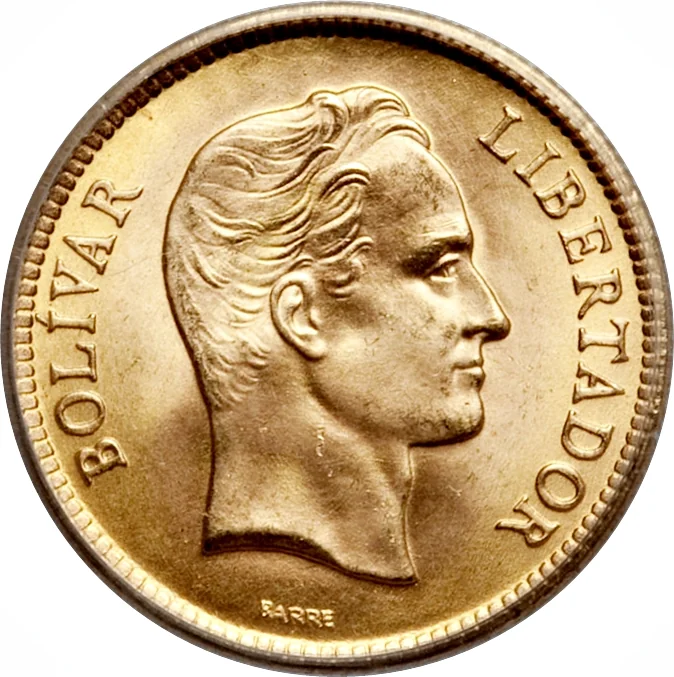
Commemoration: Centenary of the death of the Liberator.
Venezuela
Obverse
Description:
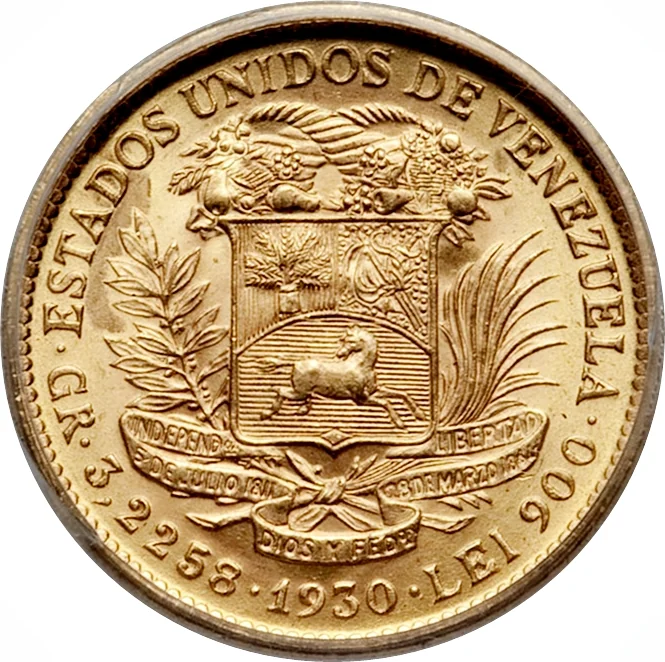
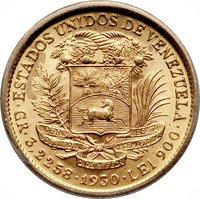
Coat of arms above, weight, date, and fineness below.
Inscription:
•ESTADOS UNIDOS DE VENEZUELA•
GR•3,2258 • 1930 • LEI 900
GR•3,2258 • 1930 • LEI 900
Translation:
UNITED STATES OF VENEZUELA
GR•3.2258 • 1930 • LAW 900
GR•3.2258 • 1930 • LAW 900
Script: Latin
Language: Spanish
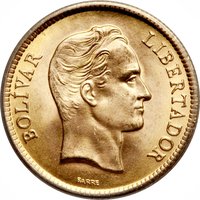
Engraver: Désiré-Albert Barre
Reverse
Edge
Reeded
Categories
| Symbol> Cornucopia |
| Animal> Horse |
| Person> Military leader |
| Person> Politician |
| Symbols> Coat of Arms |
Mints
| Name | Mark |
|---|---|
| United States Mint of Philadelphia | — |
Mintings
| Year | Mint Mark | Mintage | Quality | Collection |
|---|---|---|---|---|
| 1930 | — | 500,000 |
Historical background
In 1930, Venezuela’s currency system was defined by stability and was uniquely tied to the French franc, a legacy of the late 19th century. Following a period of monetary chaos, President Antonio Guzmán Blanco had reformed the system in the 1870s, introducing the silver Venezolano. However, in 1887, the government made a pivotal decision to peg the currency to the French franc on a gold standard, creating the Bolívar as the new unit (worth 5 francs). By 1930, this gold-standard link remained firmly intact, making the Bolívar one of the most stable and strong currencies in Latin America.
This monetary stability was almost entirely underwritten by Venezuela’s burgeoning oil industry. The discovery of massive petroleum reserves at the Maracaibo Basin in the 1920s had transformed the national economy from one dependent on coffee and cocoa to a leading global oil exporter. By the end of the decade, oil accounted for over 70% of government revenue and dominated export earnings. This influx of foreign exchange, primarily in US dollars and British pounds from international oil companies, provided the gold reserves needed to maintain the Bolívar's fixed parity, shielding the country from the balance of payments crises that afflicted many of its neighbors.
Consequently, while the Great Depression began ravaging global trade in 1929, Venezuela experienced a delayed and less severe initial economic impact compared to other commodity-driven nations. The sustained demand for oil and the government's conservative fiscal policies under General Juan Vicente Gómez provided a buffer. However, the depression would eventually expose the economy's profound vulnerability to a single commodity. The currency's strength in 1930 was real, but it masked a growing structural dependency on oil revenues that would define—and ultimately destabilize—Venezuela's monetary and economic fate in the decades to follow.
This monetary stability was almost entirely underwritten by Venezuela’s burgeoning oil industry. The discovery of massive petroleum reserves at the Maracaibo Basin in the 1920s had transformed the national economy from one dependent on coffee and cocoa to a leading global oil exporter. By the end of the decade, oil accounted for over 70% of government revenue and dominated export earnings. This influx of foreign exchange, primarily in US dollars and British pounds from international oil companies, provided the gold reserves needed to maintain the Bolívar's fixed parity, shielding the country from the balance of payments crises that afflicted many of its neighbors.
Consequently, while the Great Depression began ravaging global trade in 1929, Venezuela experienced a delayed and less severe initial economic impact compared to other commodity-driven nations. The sustained demand for oil and the government's conservative fiscal policies under General Juan Vicente Gómez provided a buffer. However, the depression would eventually expose the economy's profound vulnerability to a single commodity. The currency's strength in 1930 was real, but it masked a growing structural dependency on oil revenues that would define—and ultimately destabilize—Venezuela's monetary and economic fate in the decades to follow.
💎 Very Rare