

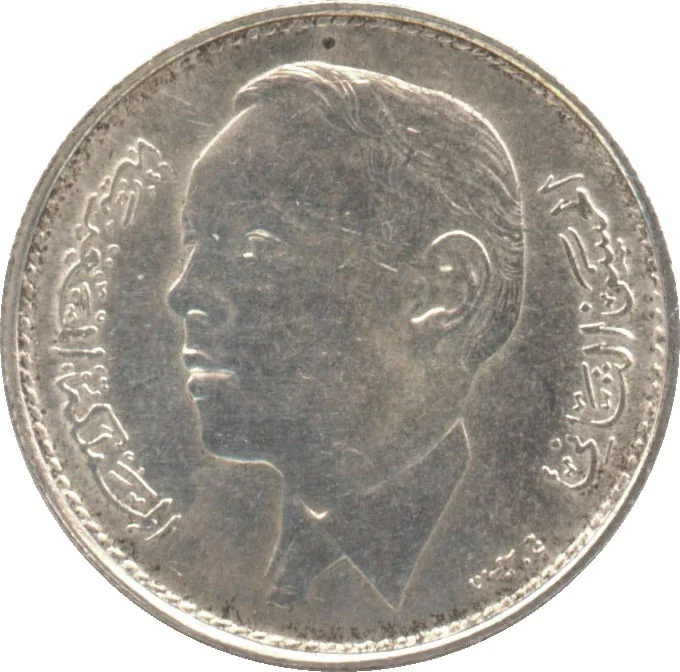
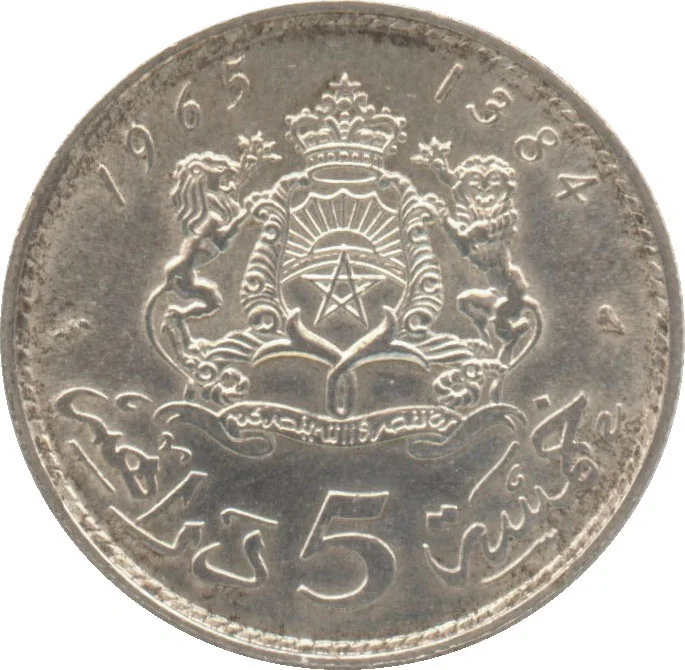
5 dirhams – Morocco
Add to wishlist
Morocco
Context
Year: 1965
Islamic (Hijri) Year:: 1384
Issuer: Morocco
Ruler: Hassan II
Currency:
(since 1960)
Demonetization: 30 March 1965
Total mintage: 2,000,200
Material
References
Y: #
Numista: #5977
Value
Exchange value: 5 MAD
Bullion value: $20.75
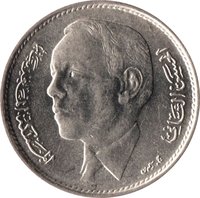
Obverse
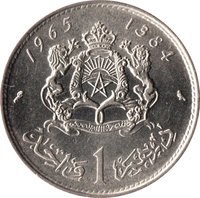
Reverse
Edge
Reeded
Mints
| Name | Mark |
|---|---|
| Monnaie de Paris | — |
Mintings
| Year | Mint Mark | Mintage | Quality | Collection |
|---|---|---|---|---|
| 1965 | — | 2,000,000 | ||
| 1965 | — | 200 | Proof | |
| 1965 | — | — | Prooflike |
Historical background
In 1965, Morocco's currency situation was characterized by the continued use of the Moroccan franc, which was pegged to the French franc as a legacy of the French protectorate (1912-1956). This arrangement, formalized in the 1958 Monetary Accord, tied Morocco's economy closely to France's, ensuring stability but limiting independent monetary policy. The Moroccan franc circulated alongside the dirham, a unit of account introduced at independence, creating a somewhat dual system where 1 dirham was equal to 100 francs. This period was one of transition, with the government and King Hassan II laying the groundwork for a full national currency.
Economically, the mid-1960s were a time of significant strain, which pressured the currency framework. The country faced a large budget deficit, high inflation, and a burdensome external debt following ambitious post-independence development plans. These factors led to a balance of payments crisis, drawing down foreign currency reserves and testing the peg's sustainability. The government responded with an austerity program in 1964-1965, including credit restrictions and import controls, to stabilize the franc and correct macroeconomic imbalances.
The situation in 1965 proved to be a pivotal prelude to major monetary reform. The pressures of maintaining the peg during economic difficulty highlighted the need for greater monetary sovereignty. Consequently, just two years later, in 1967, the dirham would be introduced as Morocco's full-fledged physical currency, replacing the Moroccan franc entirely. This move decisively severed the direct peg to the French franc, allowing the Bank al-Maghrib greater control over monetary policy and marking a definitive step in Morocco's post-colonial economic independence.
Economically, the mid-1960s were a time of significant strain, which pressured the currency framework. The country faced a large budget deficit, high inflation, and a burdensome external debt following ambitious post-independence development plans. These factors led to a balance of payments crisis, drawing down foreign currency reserves and testing the peg's sustainability. The government responded with an austerity program in 1964-1965, including credit restrictions and import controls, to stabilize the franc and correct macroeconomic imbalances.
The situation in 1965 proved to be a pivotal prelude to major monetary reform. The pressures of maintaining the peg during economic difficulty highlighted the need for greater monetary sovereignty. Consequently, just two years later, in 1967, the dirham would be introduced as Morocco's full-fledged physical currency, replacing the Moroccan franc entirely. This move decisively severed the direct peg to the French franc, allowing the Bank al-Maghrib greater control over monetary policy and marking a definitive step in Morocco's post-colonial economic independence.
🌱 Common