

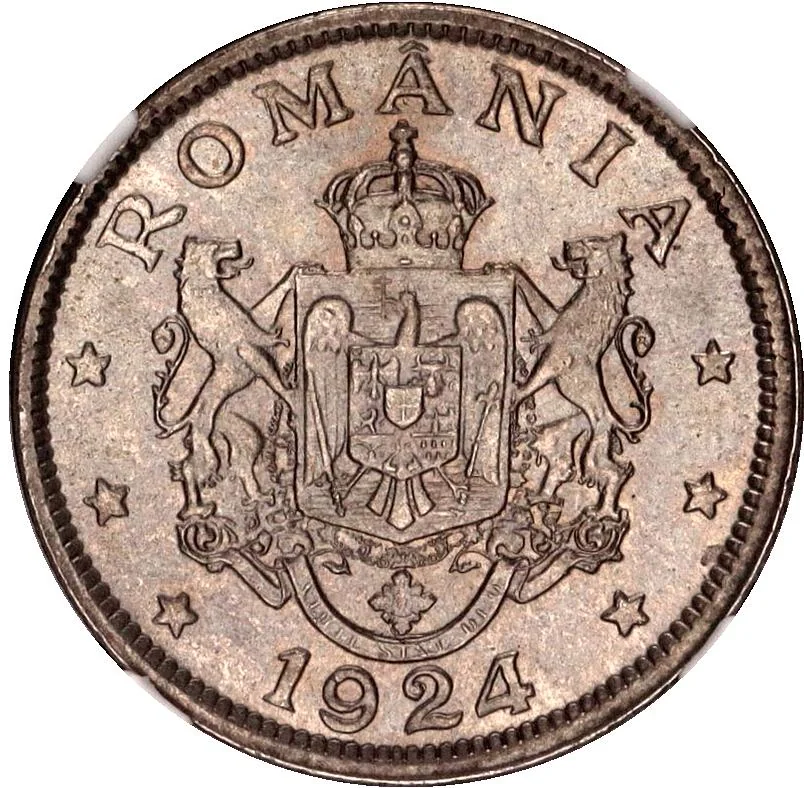
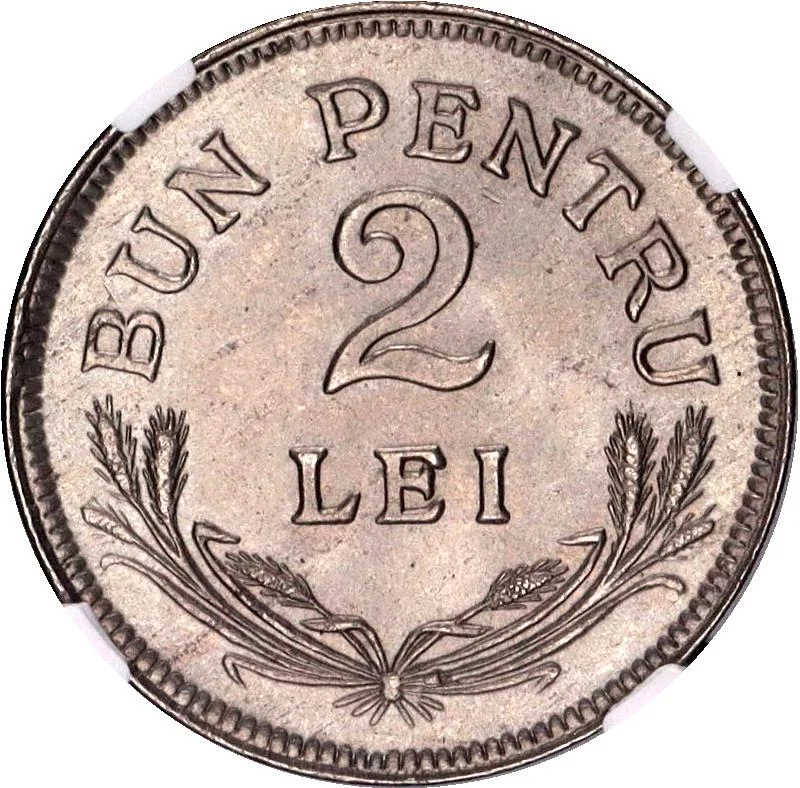
2 lei – Romania
Add to wishlist
Romania
Context
Year: 1924
Issuer: Romania
Ruler: Ferdinand I
Currency:
(1867—1947)
Demonetized: Yes
Total mintage: 50,008,000
Material
Diameter: 25 mm
Weight: 7 g
Thickness: 1.8 mm
Shape: Round
Composition: Copper-nickel
Technique: Milled
Alignment: Coin alignment
flip
References
KM: #
Numista: #5973
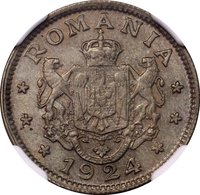
Obverse
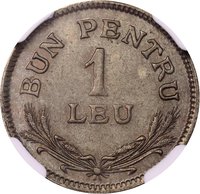
Reverse
Edge
Reeded
Categories
| Symbols> Coat of Arms |
Mints
| Name | Mark |
|---|---|
| Royal Mint of Belgium | — |
| Société Française de Monnayage | — |
Mintings
| Year | Mint Mark | Mintage | Quality | Collection |
|---|---|---|---|---|
| 1924 | — | 50,008,000 |
Historical background
In 1924, Romania’s currency situation was defined by the aftermath of World War I and the subsequent Great Union of 1918, which had significantly expanded the nation's territory. The Romanian Leu (ROL) was the official currency, but the country operated under a complex and unstable monetary regime. The pre-war gold standard had been abandoned during the conflict, and the government had resorted to extensive printing of paper money to finance the war effort and integrate the new provinces, which each came with their own former currencies (like the Austro-Hungarian Krone). This led to severe inflation and a sharp decline in the leu's value, creating economic hardship and complicating trade.
The government, led by the National Liberal Party, recognized that monetary stabilization was essential for attracting foreign investment and achieving long-term economic growth. Consequently, 1924 was a year of preparation for a major monetary reform. The key legislative step was the passage of the Law for the Stabilization of the Leu in 1924, which laid the legal groundwork for pegging the currency to gold at a fixed rate. This law aimed to halt inflationary financing and restore confidence by establishing strict rules for the future central bank, the Banca Națională a României, which would hold a gold reserve to back the currency.
Therefore, while 1924 itself was not a year of stable currency, it was a critical turning point. The hyperinflation of the immediate post-war years persisted, but the legal and technical foundations were being actively laid. The actual stabilization would come to fruition in 1929, when the leu was finally officially pegged to gold, but the decisive plans and laws set in motion in 1924 marked the beginning of Romania's journey toward monetary normalization and integration into the international financial system of the interwar period.
The government, led by the National Liberal Party, recognized that monetary stabilization was essential for attracting foreign investment and achieving long-term economic growth. Consequently, 1924 was a year of preparation for a major monetary reform. The key legislative step was the passage of the Law for the Stabilization of the Leu in 1924, which laid the legal groundwork for pegging the currency to gold at a fixed rate. This law aimed to halt inflationary financing and restore confidence by establishing strict rules for the future central bank, the Banca Națională a României, which would hold a gold reserve to back the currency.
Therefore, while 1924 itself was not a year of stable currency, it was a critical turning point. The hyperinflation of the immediate post-war years persisted, but the legal and technical foundations were being actively laid. The actual stabilization would come to fruition in 1929, when the leu was finally officially pegged to gold, but the decisive plans and laws set in motion in 1924 marked the beginning of Romania's journey toward monetary normalization and integration into the international financial system of the interwar period.
🌱 Very Common