

Obverse
Description:
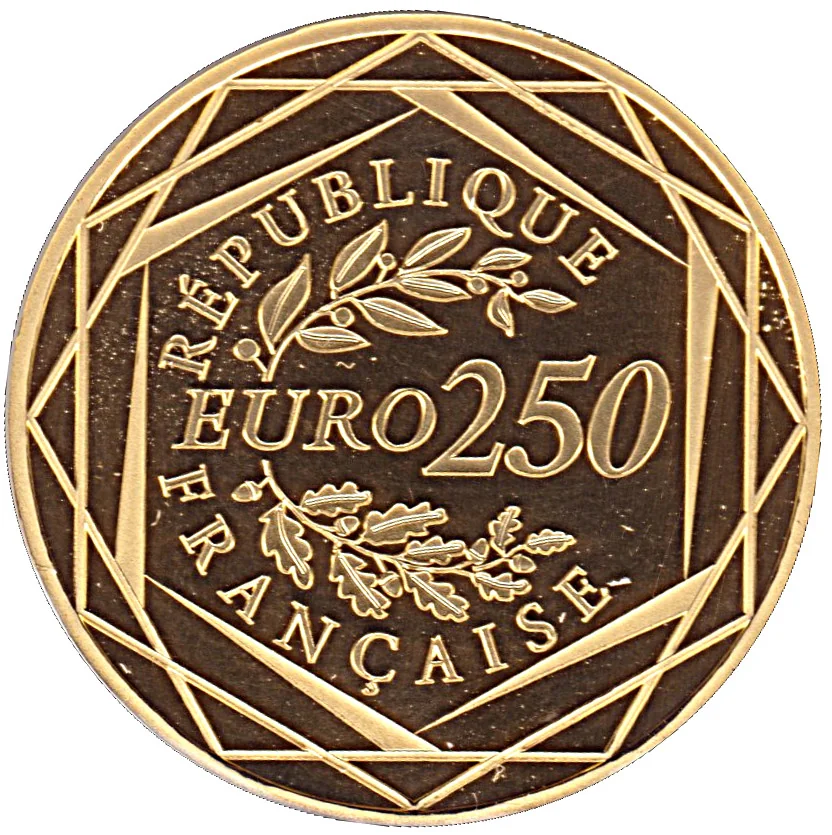
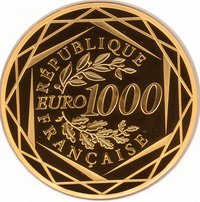
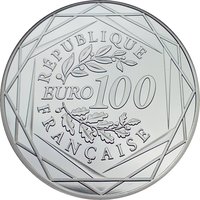
The face value, flanked by oak and laurel branches, is framed by lines forming the Hexagon.
Inscription:
RÉPUBLIQUE
EURO 250
FRANÇAISE
EURO 250
FRANÇAISE
Translation:
FRENCH REPUBLIC
EURO 250
EURO 250
Script: Latin
Language: French
Engraver: Joaquin Jimenez
Reverse
Description:
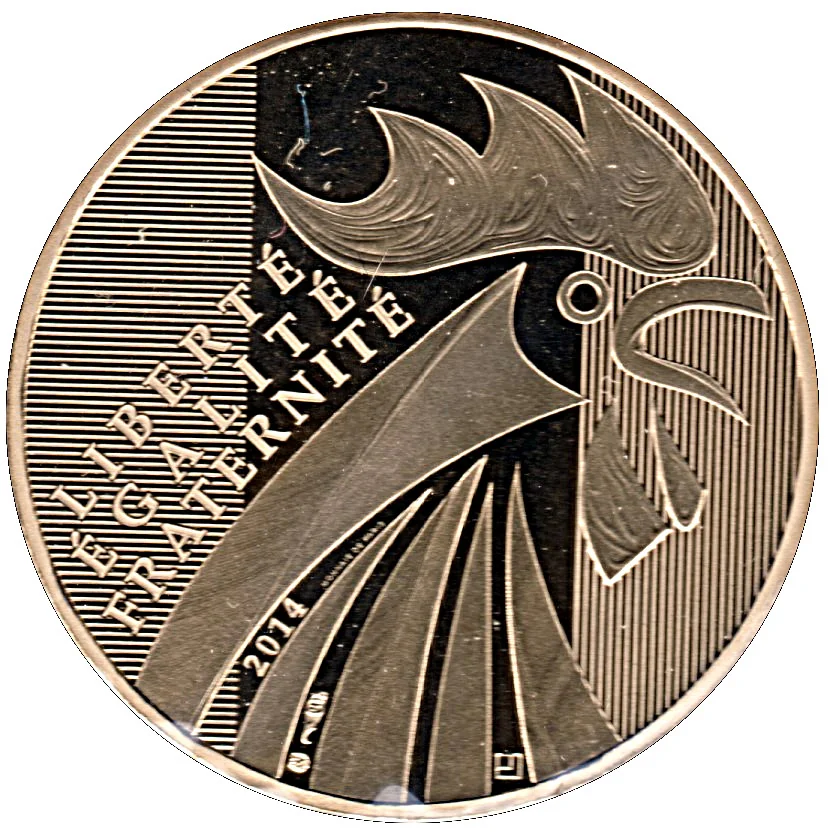
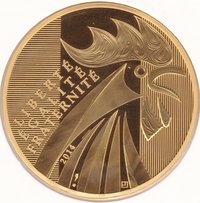
A contemporary cockerel bust with stylized crest and feathers, bearing the motto "Liberté, Égalité, Fraternité". The French flag in the background uses the heraldic patterns from euro coins: horizontal lines (blue), flat (white), and vertical lines (red).
Inscription:
LIBERTÉ
ÉGALITÉ
FRATERNITÉ
2014
ÉGALITÉ
FRATERNITÉ
2014
Translation:
LIBERTY
EQUALITY
FRATERNITY
2014
EQUALITY
FRATERNITY
2014
Script: Latin
Language: French
Engraver: Joaquin Jimenez
Edge
Plain.
Mints
| Name | Mark |
|---|---|
| Monnaie de Paris | — |
Mintings
| Year | Mint Mark | Mintage | Quality | Collection |
|---|---|---|---|---|
| 2014 | — | 25,000 |
Historical background
In 2014, France's currency situation was defined by its entrenched membership in the Eurozone, using the euro (€) as its sole legal tender. The period was marked by ongoing challenges stemming from the aftermath of the European sovereign debt crisis, with France experiencing sluggish economic growth, persistently high unemployment (hovering around 10%), and rising public debt. These factors placed the country under significant scrutiny from European institutions, particularly regarding its adherence to the EU's Stability and Growth Pact, which mandated a budget deficit below 3% of GDP—a target France repeatedly failed to meet, leading to warnings from the European Commission.
Domestically, the economic climate fueled political debates about economic sovereignty and the constraints of the single currency. While there was no serious political movement to abandon the euro, there was growing criticism, particularly from the political fringes, that the strict austerity-focused rules of the Eurozone were hampering France's ability to stimulate its economy. The government of President François Hollande, elected in 2012, initially advocated for a more "growth-friendly" European policy but ultimately pursued a moderate fiscal consolidation path, attempting to balance EU demands with domestic social spending.
Consequently, the currency situation was one of stability in terms of the monetary unit but underlying tension regarding its governance. The euro's exchange rate saw a depreciation against the US dollar in 2014, which provided a modest boost to export competitiveness. However, the core narrative was France's struggle to reconcile its economic policy within the euro's framework, navigating between European fiscal obligations and domestic pressures for recovery, all while deflecting Germany-led calls for deeper structural reforms. This set the stage for the continued economic debates that would shape the following years.
Domestically, the economic climate fueled political debates about economic sovereignty and the constraints of the single currency. While there was no serious political movement to abandon the euro, there was growing criticism, particularly from the political fringes, that the strict austerity-focused rules of the Eurozone were hampering France's ability to stimulate its economy. The government of President François Hollande, elected in 2012, initially advocated for a more "growth-friendly" European policy but ultimately pursued a moderate fiscal consolidation path, attempting to balance EU demands with domestic social spending.
Consequently, the currency situation was one of stability in terms of the monetary unit but underlying tension regarding its governance. The euro's exchange rate saw a depreciation against the US dollar in 2014, which provided a modest boost to export competitiveness. However, the core narrative was France's struggle to reconcile its economic policy within the euro's framework, navigating between European fiscal obligations and domestic pressures for recovery, all while deflecting Germany-led calls for deeper structural reforms. This set the stage for the continued economic debates that would shape the following years.

⭐ Rare