

100000 lire (Basilica of San Nicola of Bari) – Italy
Add to wishlist
Non-circulating coins
Commemoration: 800th Anniversary of the Dedication of the Basilica of San Nicola of Bari
Italy
Context
Material
References
KM: #
Numista: #59457
Value
Exchange value: 100000 ITL
Bullion value: $2070.91
Inflation-adjusted value: 174305.00 ITL
Obverse
Description:
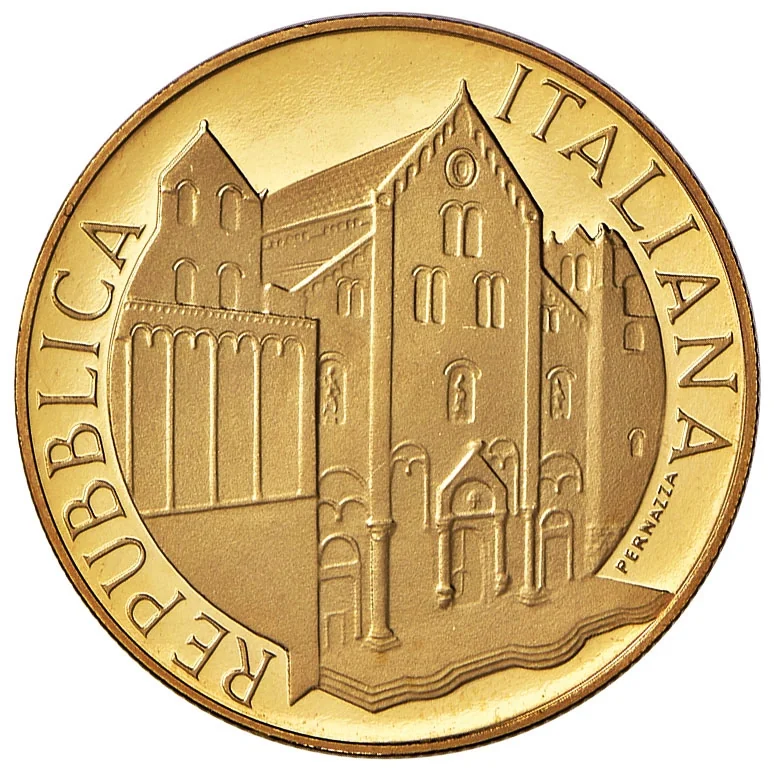
Circular depiction of the Basilica of San Nicola in Bari, with author's name at lower right and lettering near the rim.
Inscription:
REPUBBLICA ITALIANA
PERNAZZA
PERNAZZA
Translation:
Italian Republic
Pernazza
Pernazza
Script: Latin
Language: Italian
Engraver: Uliana Pernazza
Reverse
Description:
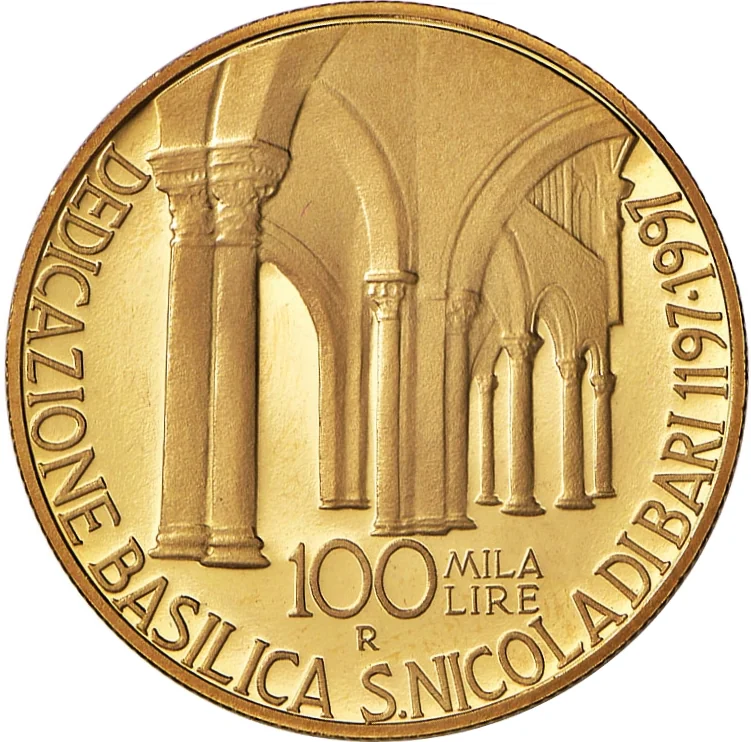
Colonnade detail of the Basilica Superiore, with value and mintmark.
Inscription:
DEDICAZIONE BASILICA S. NICOLA DI BARI 1197.1997
100 MILA LIRE
R
100 MILA LIRE
R
Translation:
Dedication of the Basilica of St. Nicholas of Bari 1197-1997
One Hundred Thousand Lire
One Hundred Thousand Lire
Script: Latin
Language: Italian
Engraver: Uliana Pernazza
Edge
Reeded
Categories
| Building> Religious building |
Mints
| Name | Mark |
|---|---|
| Rome | R |
Mintings
| Year | Mint Mark | Mintage | Quality | Collection |
|---|---|---|---|---|
| 1997 | R | 5,400 | Proof |
Historical background
In 1997, Italy's currency situation was defined by its intense and final preparations to join the European single currency, the euro. The country was operating under the European Exchange Rate Mechanism (ERM), which required the lira to remain within strict fluctuation bands against other European currencies. This period followed the severe lira crisis of 1992, which had forced a devaluation and temporary exit from the ERM. By 1996, Italy had re-entered the mechanism, and in 1997, the government of Prime Minister Romano Prodi was engaged in a stringent austerity drive to meet the Maastricht Treaty's convergence criteria on budget deficits, inflation, interest rates, and public debt.
The primary challenge was fiscal consolidation. Italy's public debt-to-GDP ratio, at over 120%, was by far the highest among prospective eurozone members and posed a significant hurdle. The Prodi government implemented substantial budget cuts and a one-off "Eurotax" to reduce the deficit to the required 3% of GDP threshold, a target it successfully achieved that year. This fiscal tightening, while politically difficult, was crucial for convincing European partners and financial markets of Italy's commitment to monetary union, as the decision on founding members was to be made in early 1998 based on 1997 data.
Consequently, 1997 was a year of stabilized financial markets and growing confidence. The lira remained stable within the ERM, and inflation and long-term interest rates converged toward German levels. This marked a dramatic turnaround from the early 1990s, transforming Italy from a perennial weak link in the European monetary system into a likely founding member of the euro. The year thus represented the culmination of a politically arduous convergence process, setting the stage for Italy's formal adoption of the euro on January 1, 1999, with lira notes and coins to be replaced three years later.
The primary challenge was fiscal consolidation. Italy's public debt-to-GDP ratio, at over 120%, was by far the highest among prospective eurozone members and posed a significant hurdle. The Prodi government implemented substantial budget cuts and a one-off "Eurotax" to reduce the deficit to the required 3% of GDP threshold, a target it successfully achieved that year. This fiscal tightening, while politically difficult, was crucial for convincing European partners and financial markets of Italy's commitment to monetary union, as the decision on founding members was to be made in early 1998 based on 1997 data.
Consequently, 1997 was a year of stabilized financial markets and growing confidence. The lira remained stable within the ERM, and inflation and long-term interest rates converged toward German levels. This marked a dramatic turnaround from the early 1990s, transforming Italy from a perennial weak link in the European monetary system into a likely founding member of the euro. The year thus represented the culmination of a politically arduous convergence process, setting the stage for Italy's formal adoption of the euro on January 1, 1999, with lira notes and coins to be replaced three years later.
✨ Legendary