

1 leu (The Court of Accounts) – Romania
Add to wishlist
Non-circulating coins
Commemoration: 150 years since the establishment of The Court of Accounts
Romania
Context
Year: 2014
Issuer: Romania
Issuing organization: National Bank of Romania
Period:
(since 1989)
Currency:
(since 2005)
Total mintage: 150
Material
References
KM: #
Numista: #59424
Value
Exchange value: 1 RON
Inflation-adjusted value: 1.55 RON
Obverse
Description:
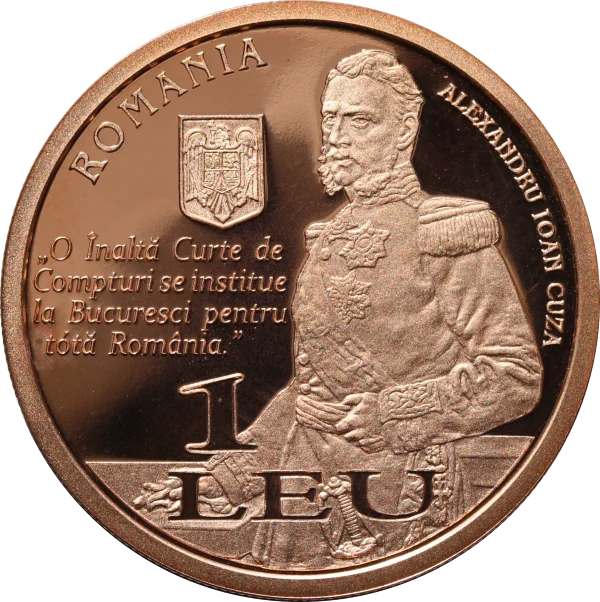
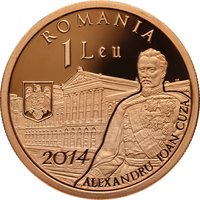
A portrait of Alexandru Ioan Cuza, the quote "O Înaltă Curte de Compturi se institue la Bucuresci pentru tótă România", the Romanian coat of arms, the value "1 LEU", and the inscriptions "ROMANIA" and "ALEXANDRU IOAN CUZA".
Inscription:
O Înaltă Curte de Compturi se institue la Bucuresci pentru tótă România
1 LEU
ROMANIA
ALEXANDRU IOAN CUZA
1 LEU
ROMANIA
ALEXANDRU IOAN CUZA
Translation:
The High Court of Accounts is instituted at Bucharest for all Romania
1 LEU
ROMANIA
ALEXANDRU IOAN CUZA
1 LEU
ROMANIA
ALEXANDRU IOAN CUZA
Script: Latin
Language: Romanian
Reverse
Description:
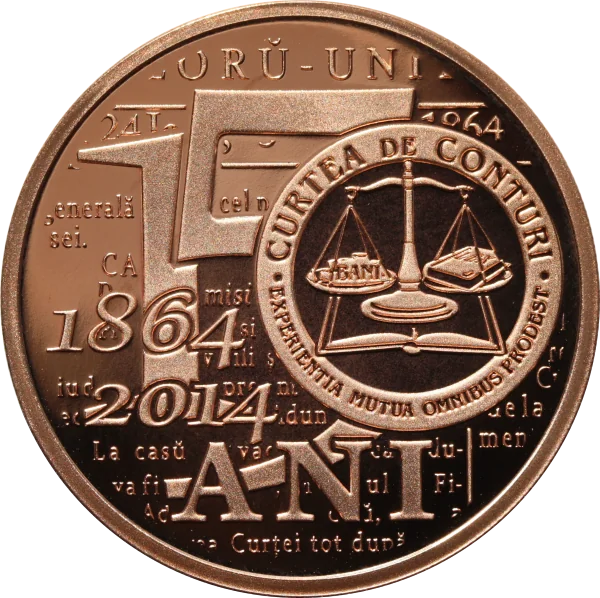
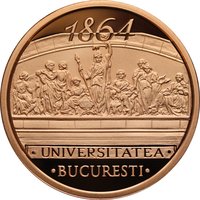
A design marking 150 years since the Court of Accounts' founding, featuring the inscription "150 ANI" overlaid on the 24 January 1864 Official Gazette announcing its establishment, along with the institution's symbol and the years "1864" and "2014".
Inscription:
150 ANI
1864
2014
1864
2014
Script: Latin
Edge
Reeded
Mints
| Name | Mark |
|---|---|
| State Mint | — |
Mintings
| Year | Mint Mark | Mintage | Quality | Collection |
|---|---|---|---|---|
| 2014 | — | 150 |
Historical background
In 2014, Romania's currency situation was characterized by a period of relative stability and cautious optimism for the Romanian Leu (RON), but within a context of significant political and monetary policy tension. The year began with the RON trading at approximately 4.4 to the Euro, a level it managed to maintain with moderate volatility. This stability was largely underpinned by a robust economic recovery, with Romania posting one of the highest GDP growth rates in the European Union (over 3%), driven by strong industrial output and exports. Furthermore, the National Bank of Romania (NBR) maintained a high benchmark interest rate of 3.5% for most of the year, which helped attract foreign capital and support the currency.
However, this stability was consistently tested by domestic and external pressures. A major source of uncertainty was the persistent political instability, including a contentious presidential election in November and frequent clashes between the government and the presidency, which rattled investor confidence. Externally, the escalating crisis in Ukraine and the resulting geopolitical tensions in Eastern Europe posed a risk to regional currencies. Most significantly, the NBR was engaged in a delicate and visible struggle to manage inflation, which had fallen to historic lows (entering deflationary territory by the end of the year), while simultaneously intervening in the foreign exchange market to prevent excessive appreciation of the Leu that could hurt exporters.
The year concluded with a notable policy shift that defined the currency's trajectory. In August, the NBR began a gradual cycle of cutting interest rates to stimulate the economy, a move that typically exerts downward pressure on a currency. Despite this, the Leu remained resilient, ending the year only slightly weaker at around 4.5 to the Euro. This was largely due to the NBR's active intervention, selling Lei and buying foreign reserves to curb strength, and the overall positive macroeconomic fundamentals. Thus, 2014 was a year where the RON demonstrated resilience amid growth, but its path was carefully orchestrated by a central bank balancing growth, inflation, and external competitiveness concerns.
However, this stability was consistently tested by domestic and external pressures. A major source of uncertainty was the persistent political instability, including a contentious presidential election in November and frequent clashes between the government and the presidency, which rattled investor confidence. Externally, the escalating crisis in Ukraine and the resulting geopolitical tensions in Eastern Europe posed a risk to regional currencies. Most significantly, the NBR was engaged in a delicate and visible struggle to manage inflation, which had fallen to historic lows (entering deflationary territory by the end of the year), while simultaneously intervening in the foreign exchange market to prevent excessive appreciation of the Leu that could hurt exporters.
The year concluded with a notable policy shift that defined the currency's trajectory. In August, the NBR began a gradual cycle of cutting interest rates to stimulate the economy, a move that typically exerts downward pressure on a currency. Despite this, the Leu remained resilient, ending the year only slightly weaker at around 4.5 to the Euro. This was largely due to the NBR's active intervention, selling Lei and buying foreign reserves to curb strength, and the overall positive macroeconomic fundamentals. Thus, 2014 was a year where the RON demonstrated resilience amid growth, but its path was carefully orchestrated by a central bank balancing growth, inflation, and external competitiveness concerns.
✨ Legendary