

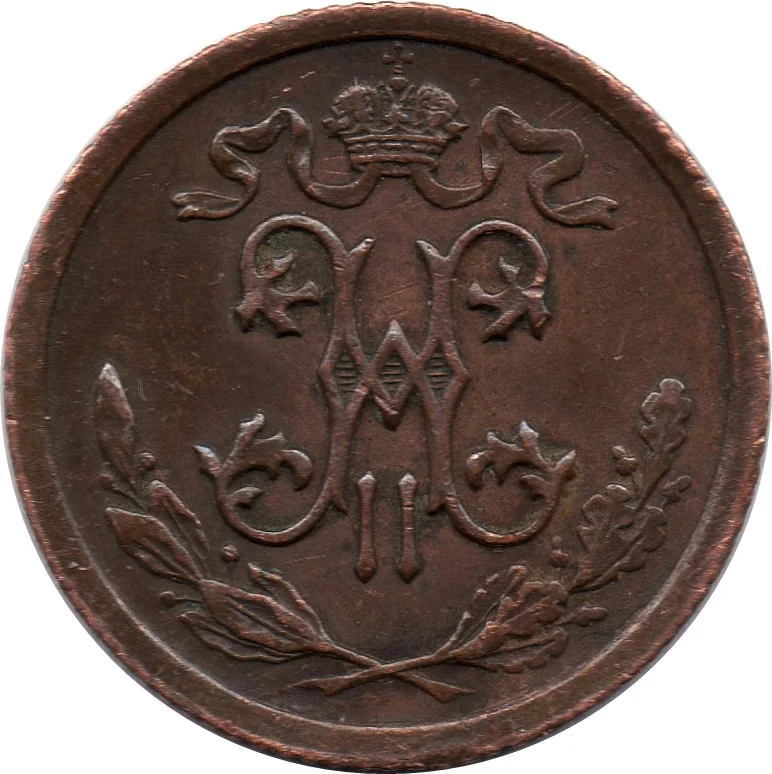
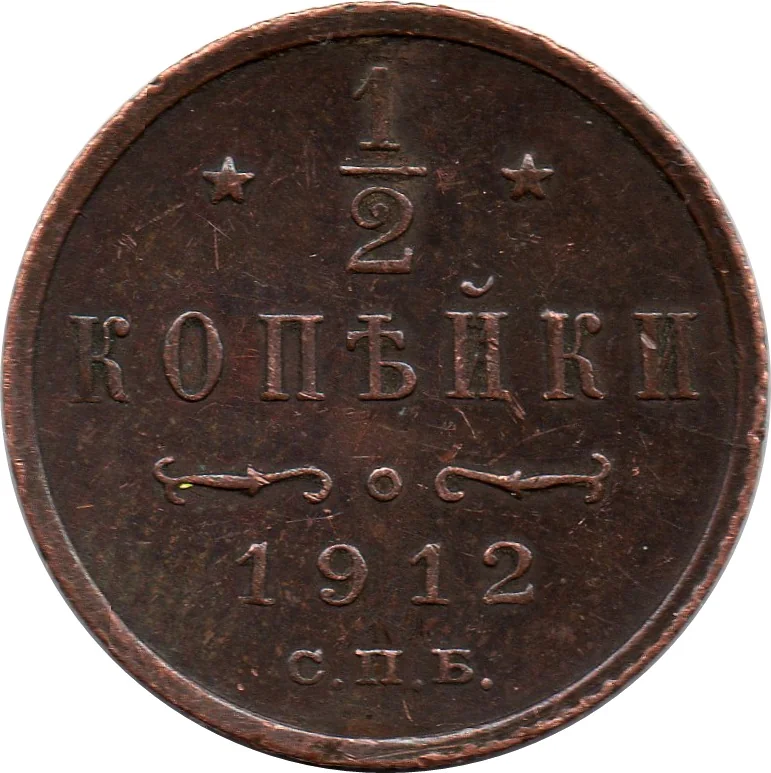
½ kopeck – Russian Empire
Add to wishlist
Russia
Context
Years: 1894–1914
Country: Russia
Issuer: Russian Empire
Ruler: Nicholas II
Currency:
(1700—1917)
Demonetized: Yes
Total mintage: 461,632,000
Material
References
Y: #
Numista: #5933
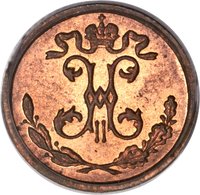
Obverse
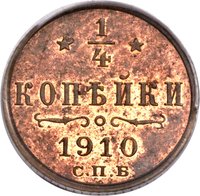
Reverse
Edge
Reeded
Mints
| Name | Mark |
|---|---|
| Heaton and Sons / The Mint Birmingham | С. П. Б. |
| Rosenkranz Works | С. П. Б. |
| Saint Petersburg | С. П. Б. |
Mintings
| Year | Mint Mark | Mintage | Quality | Collection |
|---|---|---|---|---|
| 1894 | С.П.Б. | — | ||
| 1895 | С.П.Б. | 2,992,000 | ||
| 1896 | С.П.Б. | 1,340,000 | ||
| 1897 | С.П.Б. | 60,000,000 | ||
| 1898 | С.П.Б. | 76,000,000 | ||
| 1899 | С.П.Б. | 76,000,000 | BU | |
| 1900 | С.П.Б. | 36,000,000 | BU | |
| 1908 | С.П.Б. | 8,000,000 | ||
| 1909 | С.П.Б. | 49,500,000 | ||
| 1910 | С.П.Б. | 24,000,000 | ||
| 1911 | С.П.Б. | 35,800,000 | ||
| 1912 | С.П.Б. | 28,000,000 | ||
| 1913 | С.П.Б. | 50,000,000 | ||
| 1914 | С.П.Б. | 14,000,000 |
Historical background
In 1894, the Russian Empire operated under a monetary system defined by the state-backed paper ruble assignat and the precious metal silver ruble, a legacy of earlier financial instability. Since the reign of Nicholas I, the country had struggled with a chronic budget deficit, often financed by printing more paper assignats, which led to a significant and persistent gap between their face value and their much lower market value in silver. This created a de facto dual-currency system where transactions, especially in international trade and state finance, were often calculated in hard silver rubles, while the depreciated paper assignats circulated widely in the domestic economy, causing complexity and inefficiency.
The foundation for future reform had been laid by Tsar Alexander III's Finance Minister, Ivan Vyshnegradsky, and was being aggressively continued by his successor, Sergei Witte. Their policy aimed at accumulating a massive gold reserve through heavy grain exports and foreign loans, with the ultimate goal of moving Russia onto the gold standard. This was seen as essential for attracting vital foreign investment for industrialization, stabilizing the exchange rate, and integrating Russia into the global financial system. By 1894, Witte's policies were in full swing, though the formal transition to gold would not be decreed until 1897.
Thus, the currency situation in 1894 was one of transition and preparation. The economy still bore the burdens of a weak, inflationary paper currency, but the state was actively amassing the gold needed for a profound monetary transformation. The accession of Tsar Nicholas II that year would see Witte continue this critical project, which would soon replace the unstable paper and silver system with a new gold-backed ruble, marking a pivotal shift in Imperial Russia's financial history.
The foundation for future reform had been laid by Tsar Alexander III's Finance Minister, Ivan Vyshnegradsky, and was being aggressively continued by his successor, Sergei Witte. Their policy aimed at accumulating a massive gold reserve through heavy grain exports and foreign loans, with the ultimate goal of moving Russia onto the gold standard. This was seen as essential for attracting vital foreign investment for industrialization, stabilizing the exchange rate, and integrating Russia into the global financial system. By 1894, Witte's policies were in full swing, though the formal transition to gold would not be decreed until 1897.
Thus, the currency situation in 1894 was one of transition and preparation. The economy still bore the burdens of a weak, inflationary paper currency, but the state was actively amassing the gold needed for a profound monetary transformation. The accession of Tsar Nicholas II that year would see Witte continue this critical project, which would soon replace the unstable paper and silver system with a new gold-backed ruble, marking a pivotal shift in Imperial Russia's financial history.
🌱 Very Common