

20 New Pesos – Mexico
Mexico
Context
Years: 1993–1995
Issuer: Mexico 
Period:
(since 1823)
Currency:
(since 1992)
Total mintage: 35,000,000
Material
References
KM: #Click to copy to clipboard561
Numista: #593
Value
Exchange value: 20 MXN = $1.16
Inflation-adjusted value: 220.34 MXN
Obverse
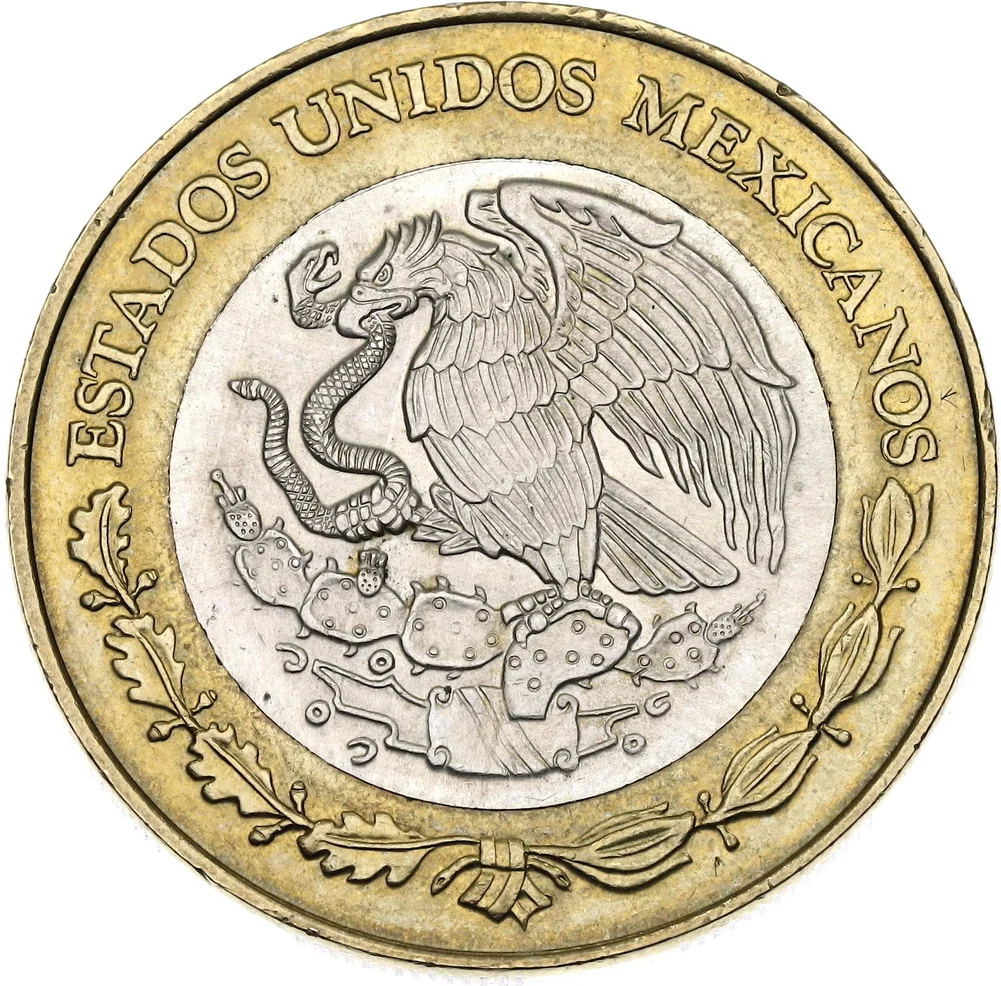
Reverse
Description:
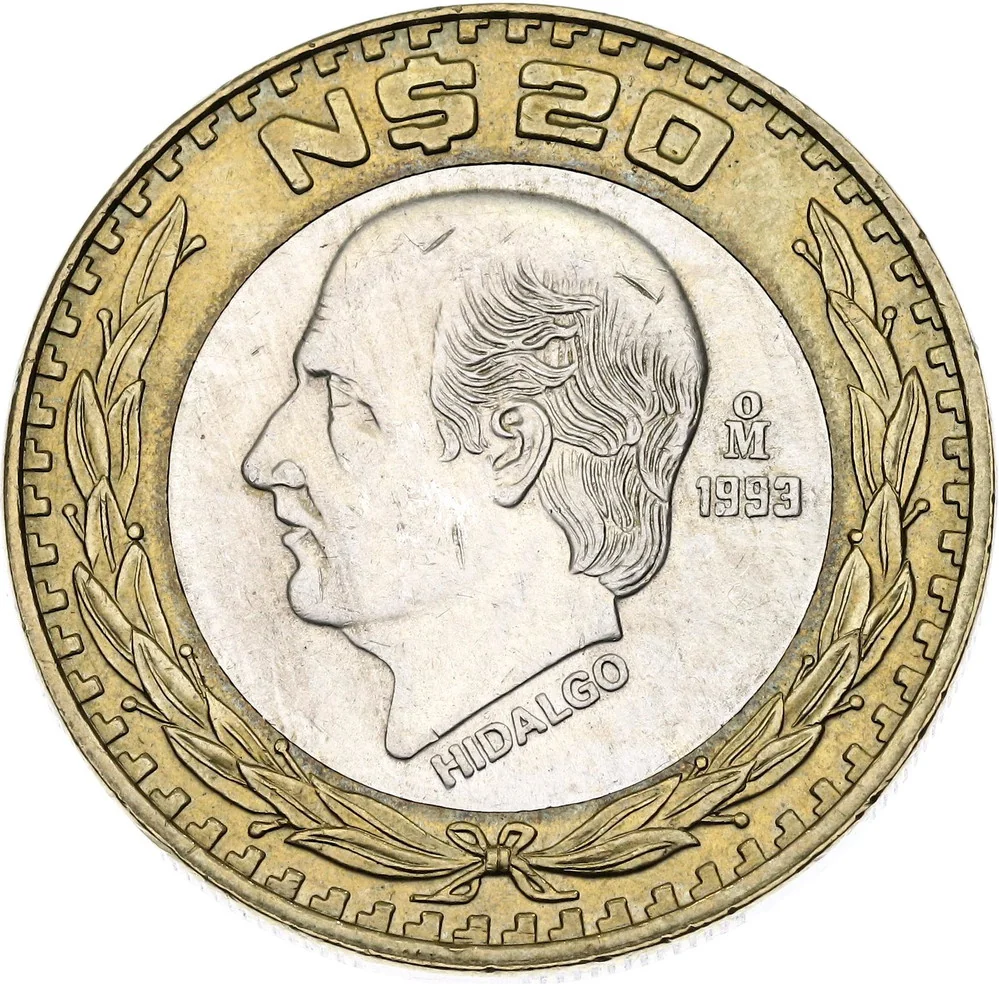
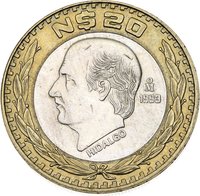
A left-profile portrait of Miguel Hidalgo (1753–1811), leader of Mexico’s independence, is encircled by a vegetable crown with the legend “HIDALGO” and the face value.
Inscription:
N$20 HIDALGO 1993 M
Script: Latin
Edge
Segmented reeding.
Categories
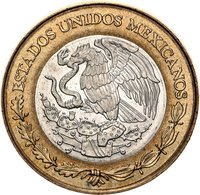
| Animal> Bird> Eagle |
| Person> Military leader |
| Symbols> Coat of Arms |
| Symbol> Wreath |
Mints
| Name | Mark |
|---|---|
| Mexican Mint | (Mo) |
Mintings
| Year | Mint Mark | Mintage | Quality | Collection |
|---|---|---|---|---|
| 1993 | Mo | 25,000,000 | ||
| 1994 | Mo | 5,000,000 | ||
| 1995 | Mo | 5,000,000 |
Historical background
In 1993, Mexico was in the final stages of a profound economic transformation, centered on the introduction of a new currency: the Nuevo Peso (New Peso). This change, enacted by President Carlos Salinas de Gortari, was a technical measure to address decades of high inflation and simplify financial transactions. The old peso (MXP) was redenominated at a rate of 1,000 old pesos for 1 nuevo peso (MXN), effectively removing three zeros from the currency. This was not a devaluation but a recalibration, aimed at restoring public confidence, streamlining accounting, and signaling a break from the country's unstable monetary past.
This monetary reform was a cornerstone of the broader "Solidarity Pact" economic stabilization program, which combined fiscal discipline, wage and price controls, and a fixed exchange rate policy. Since 1988, the government had maintained a crawling peg, allowing the peso to depreciate against the U.S. dollar at a predetermined, controlled rate to maintain competitiveness. By 1993, this policy had successfully reduced inflation from triple-digit levels to single digits, creating an environment of apparent stability that attracted significant foreign investment, particularly into the Mexican stock market.
However, this stability was increasingly fragile. The fixed exchange rate, while taming inflation, had led to a significant overvaluation of the peso, making Mexican exports more expensive and imports cheaper. This resulted in a growing and unsustainable current account deficit, financed by volatile short-term capital inflows. While the public focus in 1993 was on the logistical rollout of the new banknotes and coins and the impending start of the North American Free Trade Agreement (NAFTA), underlying imbalances were mounting. These tensions would culminate just over a year later in the severe December 1994 currency crisis, known as the "Tequila Crisis," forcing a dramatic peso devaluation.
This monetary reform was a cornerstone of the broader "Solidarity Pact" economic stabilization program, which combined fiscal discipline, wage and price controls, and a fixed exchange rate policy. Since 1988, the government had maintained a crawling peg, allowing the peso to depreciate against the U.S. dollar at a predetermined, controlled rate to maintain competitiveness. By 1993, this policy had successfully reduced inflation from triple-digit levels to single digits, creating an environment of apparent stability that attracted significant foreign investment, particularly into the Mexican stock market.
However, this stability was increasingly fragile. The fixed exchange rate, while taming inflation, had led to a significant overvaluation of the peso, making Mexican exports more expensive and imports cheaper. This resulted in a growing and unsustainable current account deficit, financed by volatile short-term capital inflows. While the public focus in 1993 was on the logistical rollout of the new banknotes and coins and the impending start of the North American Free Trade Agreement (NAFTA), underlying imbalances were mounting. These tensions would culminate just over a year later in the severe December 1994 currency crisis, known as the "Tequila Crisis," forcing a dramatic peso devaluation.
🌱 Common