

100 Kwanzas – Angola
Non-circulating coins
Commemoration: Prince Henry the Navigator
Angola
Obverse
Description:
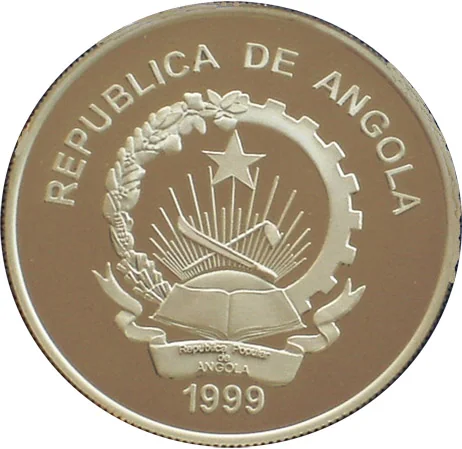
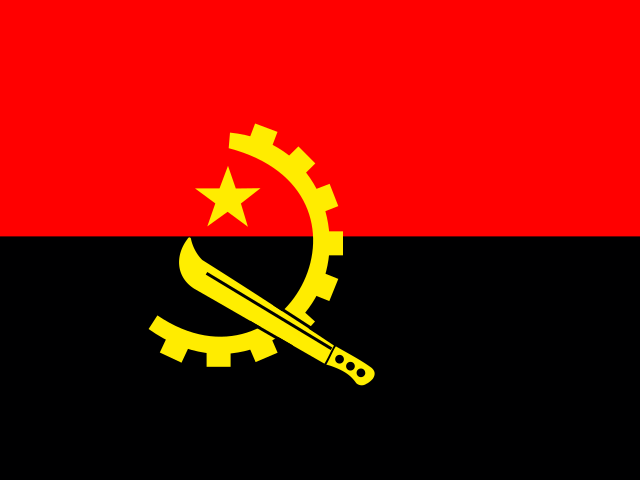
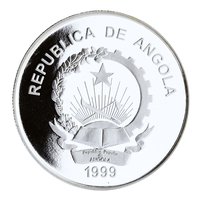
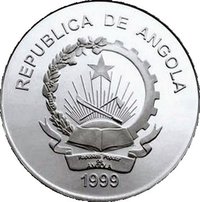
Angolan coat of arms, legend above, year below.
Inscription:
REPUBLICA DE ANGOLA
1999
1999
Translation:
REPUBLIC OF ANGOLA
1999
1999
Script: Latin
Language: Portuguese
Reverse
Description:
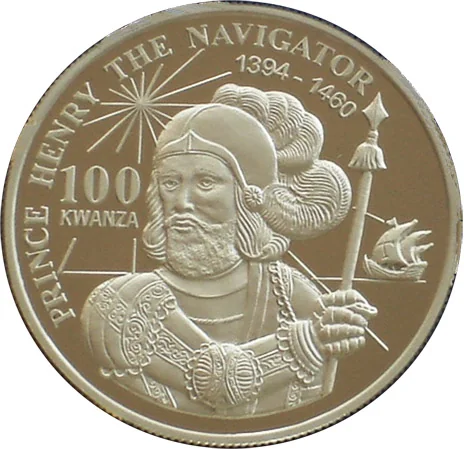
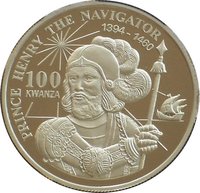
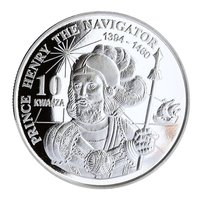
Prince Henry the Navigator, spear in hand, with a boat and sun behind him.
Inscription:
PRINCE HENRY THE NAVIGATOR
1394-1460
100 KWANZA
1394-1460
100 KWANZA
Script: Latin
Edge
Reeded
Mintings
| Year | Mint Mark | Mintage | Quality | Collection |
|---|---|---|---|---|
| 1999 | — | 10,000 | Proof |
Historical background
In 1999, Angola was in the throes of a profound economic and currency crisis, a direct consequence of the protracted civil war and severe macroeconomic mismanagement. The national currency, the kwanza (AOK), was in a state of hyperinflation, with annual rates estimated to have exceeded 300%. This erosion of value was driven by the government's heavy reliance on money creation to finance massive fiscal deficits, primarily directed toward the war effort against UNITA rebels. The parallel "black market" for foreign exchange, especially US dollars, flourished as the official exchange rate set by the Banco Nacional de Angola became increasingly divorced from reality, creating a vast disparity that crippled formal trade and encouraged rampant corruption.
The currency situation was further destabilized by the collapse of the country's productive capacity and its overwhelming dependence on oil revenues, which accounted for over 90% of export earnings. Fluctuating global oil prices and the destruction of non-oil sectors, particularly agriculture, led to severe shortages of basic goods. With little confidence in the kwanza, dollarization became widespread for major transactions and savings, further undermining monetary policy. The government attempted to maintain an overvalued official exchange rate, but this only served to drain foreign reserves and create a multi-tiered system that benefited a small elite with access to cheap dollars.
Ultimately, the 1999 currency environment was a symptom of a state in survival mode, where monetary policy was subordinated to military and political objectives. The economic distortions caused by the dysfunctional kwanza stifled investment, impoverished the population, and entrenched a system of patronage. This crisis set the stage for the major monetary reforms that would follow the end of the civil war in 2002, including the introduction of a new, revalued kwanza (AOA) in an attempt to restore stability and confidence in the financial system.
The currency situation was further destabilized by the collapse of the country's productive capacity and its overwhelming dependence on oil revenues, which accounted for over 90% of export earnings. Fluctuating global oil prices and the destruction of non-oil sectors, particularly agriculture, led to severe shortages of basic goods. With little confidence in the kwanza, dollarization became widespread for major transactions and savings, further undermining monetary policy. The government attempted to maintain an overvalued official exchange rate, but this only served to drain foreign reserves and create a multi-tiered system that benefited a small elite with access to cheap dollars.
Ultimately, the 1999 currency environment was a symptom of a state in survival mode, where monetary policy was subordinated to military and political objectives. The economic distortions caused by the dysfunctional kwanza stifled investment, impoverished the population, and entrenched a system of patronage. This crisis set the stage for the major monetary reforms that would follow the end of the civil war in 2002, including the introduction of a new, revalued kwanza (AOA) in an attempt to restore stability and confidence in the financial system.
✨ Legendary