



Obverse
Description:
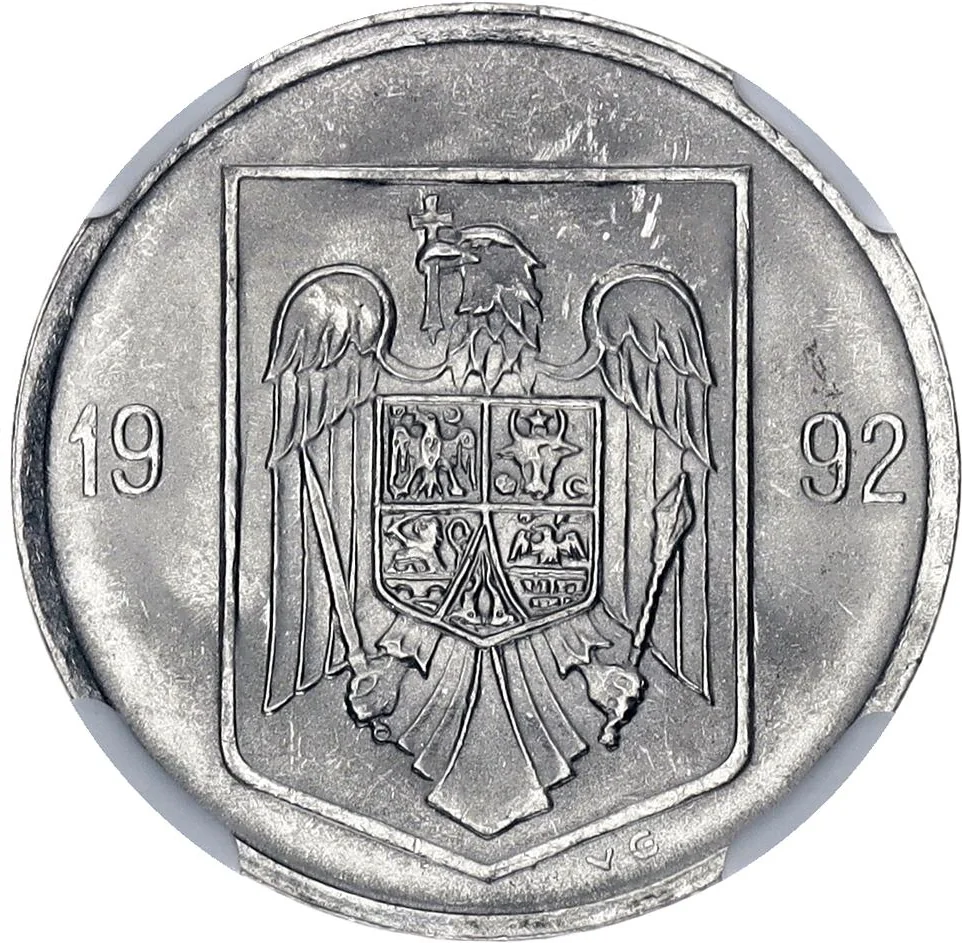
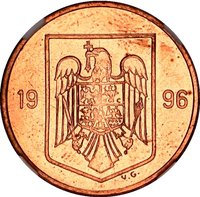
Romania's 1992 coat of arms features an eagle holding a shield divided into five sections, representing its historic provinces: Wallachia (golden eagle), Moldavia (aurochs), Oltenia and Banat (lion and bridge), Dobrogea (dolphins), and Transylvania (black eagle, seven castles, sun, and moon).
Inscription:
19 95
V.G.
V.G.
Script: Latin
Reverse
Description:
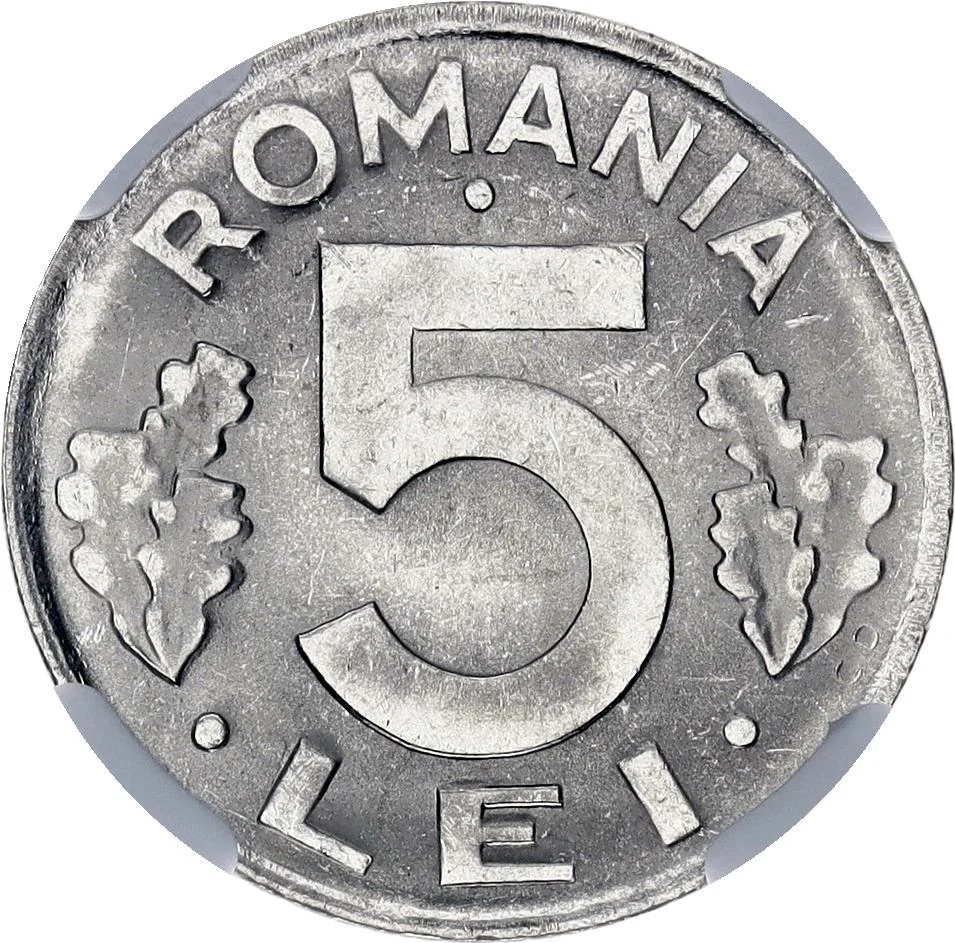
5 LEI face value, ROMANIA between oak branches.
Inscription:
ROMANIA
•
5
• LEI •
CD
•
5
• LEI •
CD
Script: Latin
Edge
Plain
Categories
| Symbols> Coat of Arms |
Mints
| Name | Mark |
|---|---|
| State Mint | — |
Mintings
| Year | Mint Mark | Mintage | Quality | Collection |
|---|---|---|---|---|
| 1992 | — | 30,000,000 | ||
| 1993 | — | 70,000,000 | ||
| 1994 | — | 10,000,000 | ||
| 1995 | — | 25,000,000 | ||
| 2000 | — | 4,500 | Proof | |
| 2002 | — | 1,500 | Proof | |
| 2003 | — | 2,000 | Proof | |
| 2005 | — | — | Proof |
Historical background
In 1992, Romania was navigating the turbulent early years of its post-communist transition, with its currency situation characterized by instability, scarcity, and inflationary pressures. The national currency, the leu, was severely weakened after decades of Ceaușescu's centralized economic mismanagement and the sudden shock of moving toward a market economy. While a limited currency reform in 1991 had introduced new banknotes and attempted to curb the black market, the economy remained largely cash-based and under-monetized. Acute shortages of physical cash were a daily reality, crippling transactions and forcing many enterprises to resort to barter.
The core of the monetary crisis was rooted in the National Bank of Romania's (BNR) practice of providing automatic, subsidized credits to still-state-owned enterprises. This direct financing of loss-making industries, often to maintain employment, led to rampant money creation disconnected from economic output. Consequently, inflation soared, reaching an annual rate of over 200% in 1992, which rapidly eroded the leu's purchasing power. The official exchange rate was artificially maintained, creating a vast disparity with the black market rate where the leu traded for significantly less against hard currencies like the US dollar.
This unsustainable environment set the stage for critical reforms later in the decade. The experiences of 1992 highlighted the urgent need for macroeconomic stabilization, which would eventually lead to the implementation of a stringent stabilization plan in the mid-1990s. The period solidified the understanding that true currency stability was impossible without addressing the fundamental issues of fiscal discipline, restructuring of state enterprises, and the establishment of an independent central bank committed to controlling inflation.
The core of the monetary crisis was rooted in the National Bank of Romania's (BNR) practice of providing automatic, subsidized credits to still-state-owned enterprises. This direct financing of loss-making industries, often to maintain employment, led to rampant money creation disconnected from economic output. Consequently, inflation soared, reaching an annual rate of over 200% in 1992, which rapidly eroded the leu's purchasing power. The official exchange rate was artificially maintained, creating a vast disparity with the black market rate where the leu traded for significantly less against hard currencies like the US dollar.
This unsustainable environment set the stage for critical reforms later in the decade. The experiences of 1992 highlighted the urgent need for macroeconomic stabilization, which would eventually lead to the implementation of a stringent stabilization plan in the mid-1990s. The period solidified the understanding that true currency stability was impossible without addressing the fundamental issues of fiscal discipline, restructuring of state enterprises, and the establishment of an independent central bank committed to controlling inflation.

🌱 Very Common