

10 pesos – Mexico
Add to wishlist
Mexico
Context
Years: 1997–2025
Issuer: Mexico
Period:
(since 1823)
Currency:
(since 1992)
Total mintage: 3,064,383,474
Material
References
KM: #
Numista: #591
Value
Exchange value: 10 MXN
Inflation-adjusted value: 51.73 MXN
Obverse
Reverse
Description:
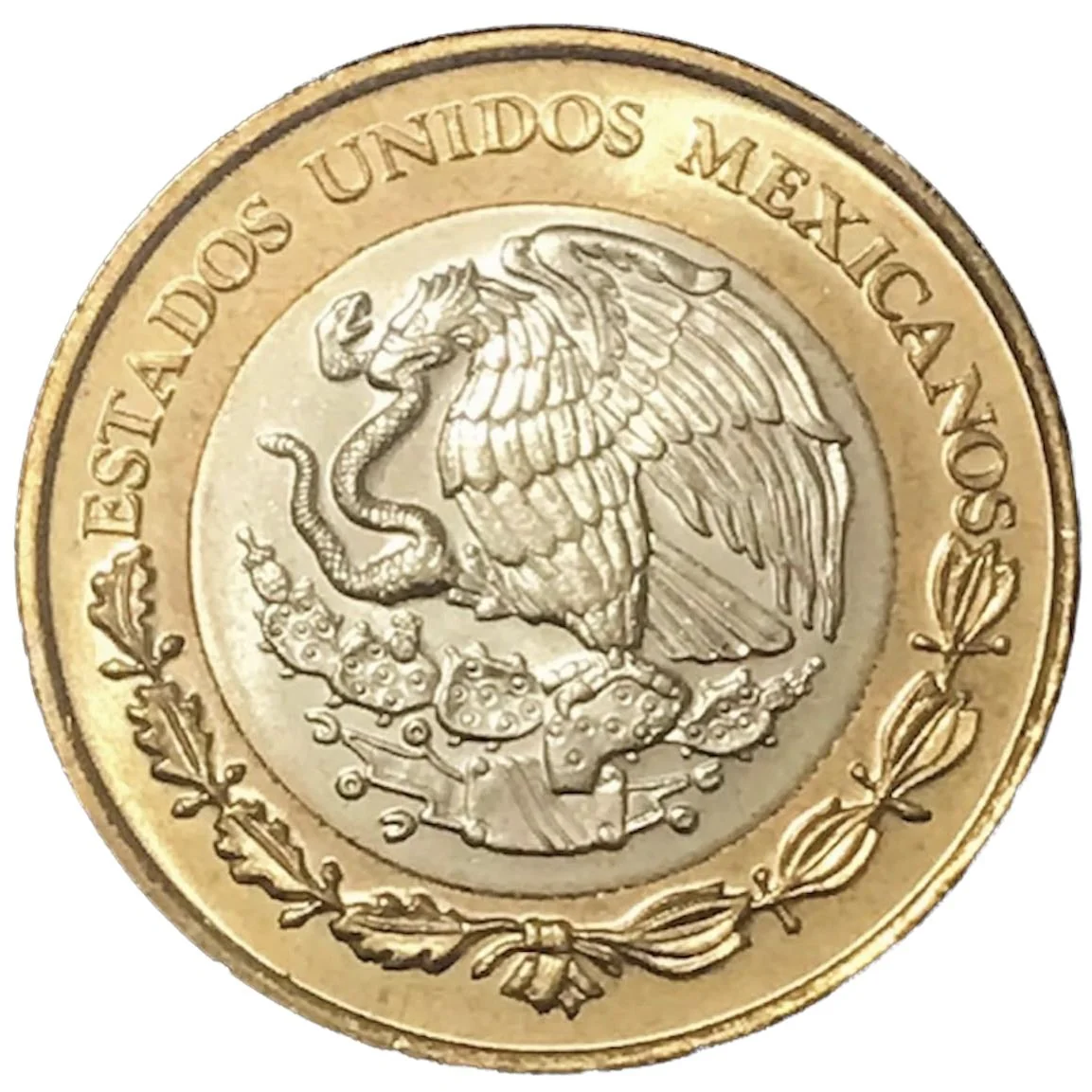
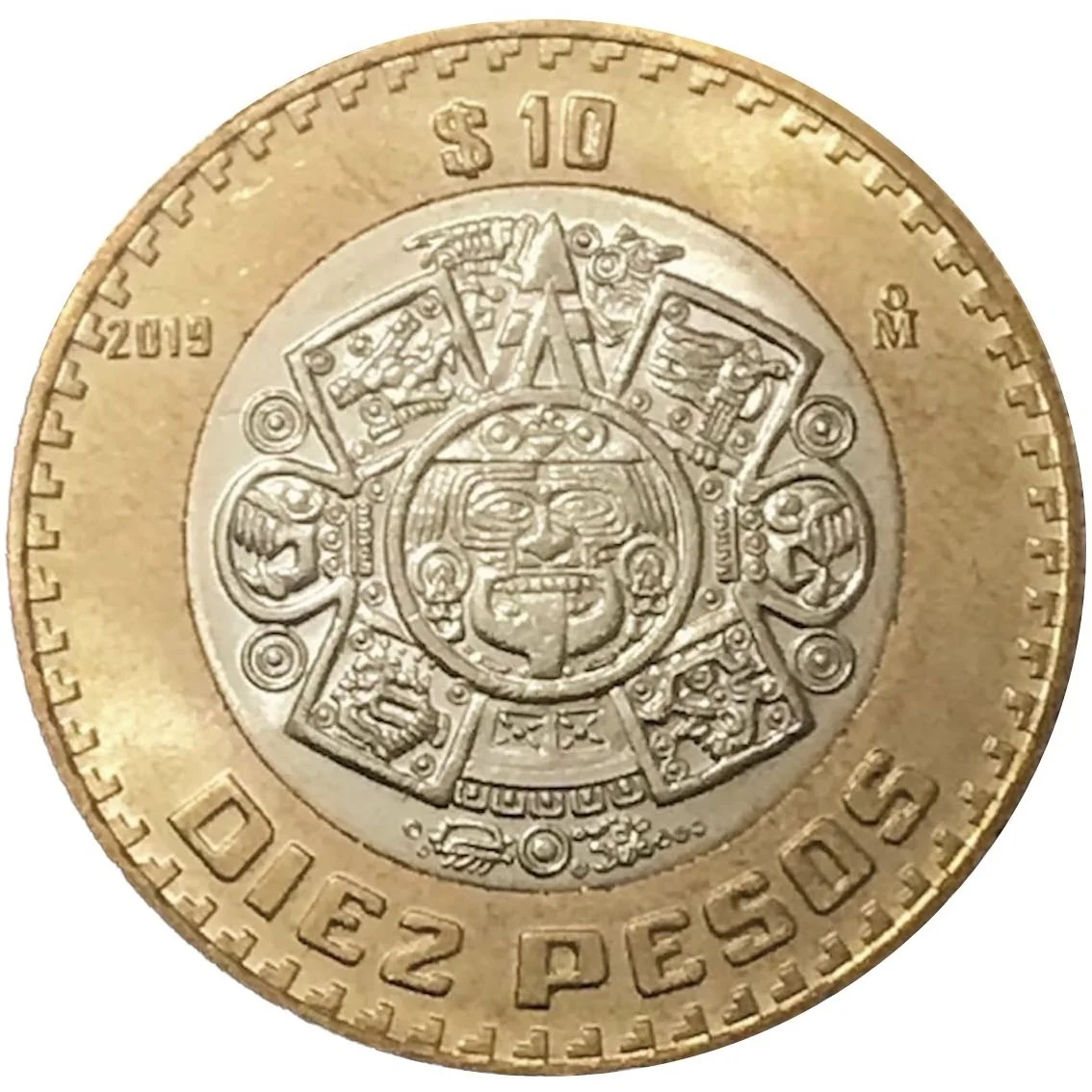
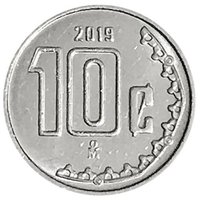
Central Aztec sun stone circle depicts Tonatiuh with a fire mask. Peripheral ring: top has value, left has mint year, right has Mexico Mint mark "Mo", bottom has face value in words. Most coins feature an inverted "L" ornament along the rim.
Inscription:
$10
2019 Mo
DIEZ PESOS
2019 Mo
DIEZ PESOS
Translation:
TEN PESOS
2019 Mo
2019 Mo
Script: Latin
Language: Spanish
Edge
Reeded
Mints
| Name | Mark |
|---|---|
| Mexican Mint | (Mo) |
Mintings
| Year | Mint Mark | Mintage | Quality | Collection |
|---|---|---|---|---|
| 1997 | Mo | 44,837,000 | ||
| 1998 | Mo | 203,735,000 | ||
| 1999 | Mo | 29,842,000 | ||
| 2002 | Mo | 44,721,000 | ||
| 2004 | Mo | 74,739,000 | ||
| 2005 | Mo | 64,635,000 | ||
| 2006 | Mo | 84,575,000 | ||
| 2007 | Mo | — | ||
| 2008 | Mo | 64,744,000 | ||
| 2009 | Mo | 54,812,000 | ||
| 2010 | Mo | 54,822,000 | ||
| 2011 | Mo | 69,731,000 | ||
| 2012 | Mo | 89,732,000 | ||
| 2013 | Mo | 44,769,000 | ||
| 2014 | Mo | 99,962,000 | ||
| 2015 | Mo | 157,406,000 | ||
| 2016 | Mo | 219,454,772 | ||
| 2017 | Mo | 282,560,519 | ||
| 2018 | Mo | 432,081,418 | ||
| 2019 | Mo | — | ||
| 2021 | Mo | — | ||
| 2022 | Mo | 279,278,612 | ||
| 2023 | Mo | 317,454,995 | ||
| 2024 | Mo | 350,491,158 | ||
| 2025 | Mo | — |
Historical background
In 1997, Mexico's currency, the peso, was in a period of relative stability, a notable achievement following the profound Tequila Crisis of 1994-1995. That earlier crisis had forced a sudden devaluation, led to a deep recession, and required a massive $50 billion international bailout. By 1997, the economy was recovering, with growth returning and inflation beginning to decline from its crisis peak. This stability was underpinned by a floating exchange rate regime, adopted in late 1994, which allowed the peso's value to be set by the market, and a new monetary policy framework focused on inflation targeting, established by an increasingly autonomous Bank of Mexico.
However, this stability remained fragile and was tested by external shocks. The Asian Financial Crisis, which erupted in mid-1997, triggered volatility in emerging markets worldwide. While Mexico was not as directly exposed as Asian economies, investor nervousness led to capital outflows and pressure on the peso. The government and central bank were forced to defend the currency through interest rate hikes, which raised borrowing costs and threatened to slow the ongoing economic recovery. This period highlighted Mexico's continued vulnerability to global capital flow reversals despite its improved fundamentals.
Ultimately, the policies established after the 1994 crisis proved resilient. The floating peso acted as a shock absorber, adjusting to market pressures without exhausting foreign reserves in a futile defense of a fixed rate. The commitment to fiscal discipline and transparent monetary policy, communicated by the newly independent central bank, helped maintain investor confidence. Consequently, while experiencing volatility, Mexico avoided a repeat of the catastrophic devaluation of 1994, navigating the 1997 turbulence and setting a foundation for the inflation-targeting regime that would define its monetary policy in the coming decades.
However, this stability remained fragile and was tested by external shocks. The Asian Financial Crisis, which erupted in mid-1997, triggered volatility in emerging markets worldwide. While Mexico was not as directly exposed as Asian economies, investor nervousness led to capital outflows and pressure on the peso. The government and central bank were forced to defend the currency through interest rate hikes, which raised borrowing costs and threatened to slow the ongoing economic recovery. This period highlighted Mexico's continued vulnerability to global capital flow reversals despite its improved fundamentals.
Ultimately, the policies established after the 1994 crisis proved resilient. The floating peso acted as a shock absorber, adjusting to market pressures without exhausting foreign reserves in a futile defense of a fixed rate. The commitment to fiscal discipline and transparent monetary policy, communicated by the newly independent central bank, helped maintain investor confidence. Consequently, while experiencing volatility, Mexico avoided a repeat of the catastrophic devaluation of 1994, navigating the 1997 turbulence and setting a foundation for the inflation-targeting regime that would define its monetary policy in the coming decades.
🌱 Very Common