


Obverse
Description:
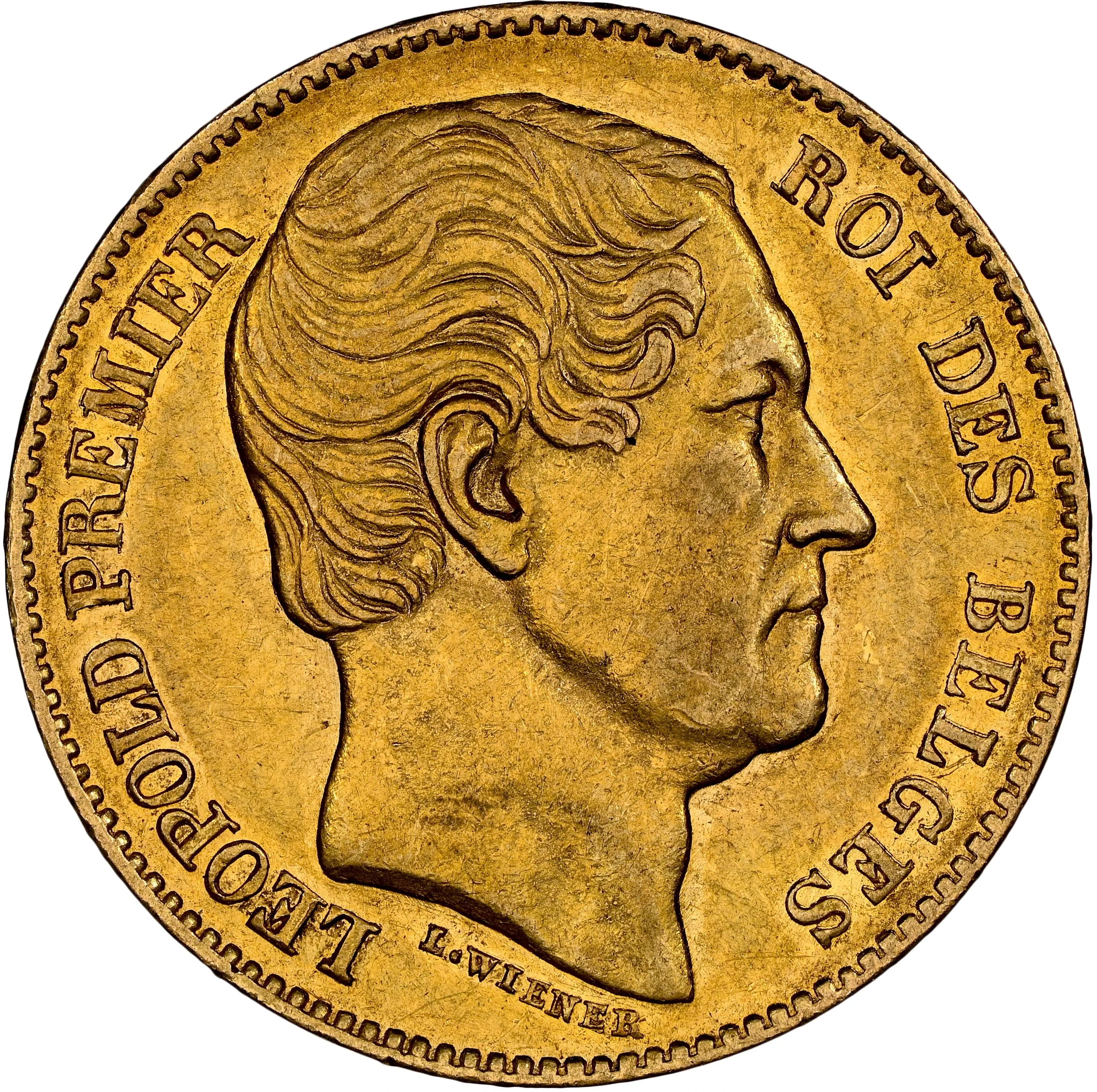
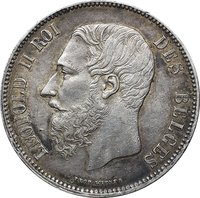
King Leopold I facing right, designer below neck, French text surrounding.
Inscription:
LEOPOLD PREMIER ROI DES BELGES
L.WIENER
L.WIENER
Translation:
Leopold the First King of the Belgians
L. Wiener
L. Wiener
Script: Latin
Language: French
Engraver: Léopold Wiener
Reverse
Description:
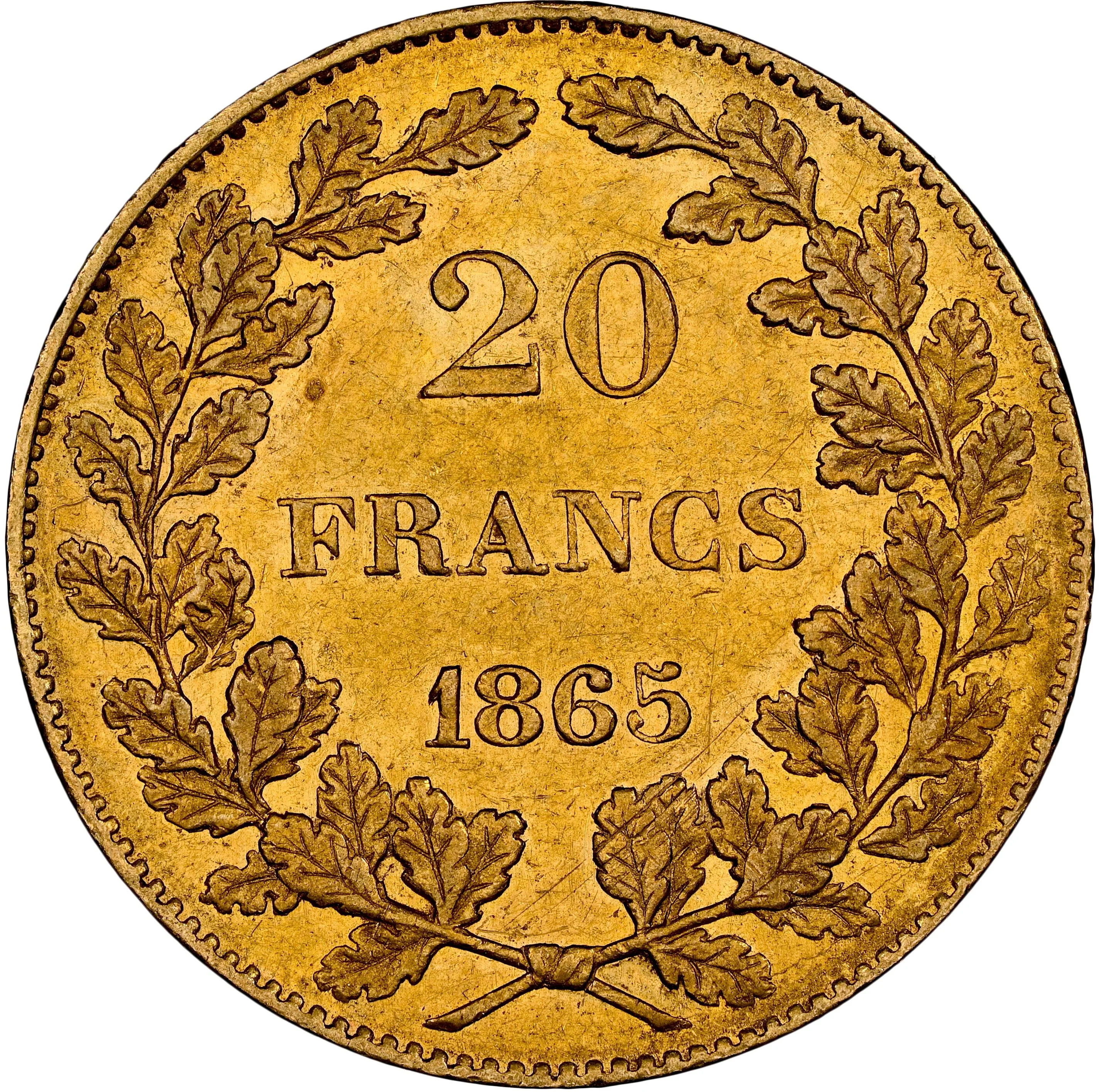
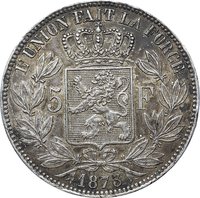
Value and date encircled by oak branches.
Inscription:
20
FRANCS
1865
FRANCS
1865
Script: Latin
Engraver: Léopold Wiener
Edge
Plain with incused lettering
Legend:
DIEU * PROTÈGE * LA * BELGIQUE *
Translation:
GOD * PROTECTS * BELGIQUE *
Language: French
Mints
| Name | Mark |
|---|---|
| Royal Mint of Belgium | — |
Mintings
| Year | Mint Mark | Mintage | Quality | Collection |
|---|---|---|---|---|
| 1864 | — | — | ||
| 1865 | — | 1,016,103 | ||
| 1866 | — | 531,963 |
Historical background
In 1864, Belgium was operating under a complex and fragmented monetary system, a common legacy of the Napoleonic era and the nation's own recent independence (1830). The official currency was the Belgian franc, which was part of the Latin Monetary Union (LMU), a pioneering attempt at European monetary standardization established in 1865. However, in 1864, the Union was still in its final negotiation stages, meaning Belgium's system was in a state of transition, awaiting the formalization of common standards for gold and silver coinage with France, Italy, and Switzerland.
The domestic situation was characterized by the circulation of not only Belgian coins but also a significant amount of foreign currency, particularly French francs, which were legally accepted. This created practical challenges for commerce. Furthermore, the system was bimetallic, meaning both gold and silver coins were legal tender at a fixed ratio. This was increasingly problematic as the global market value of silver began to decline relative to gold, leading to the hoarding and export of gold coins (Gresham's Law) and threatening the stability of the currency's metallic base.
Therefore, the backdrop of 1864 was one of anticipation and preparation for the LMU. Belgian authorities were aligning their coinage laws with the impending treaty, aiming to stabilize the currency, reduce transaction costs for international trade, and solidify the franc's place within a broader European economic bloc. The move represented a crucial step toward modernizing the national economy and integrating it more closely with its continental neighbours, setting the stage for the unified system that would officially commence the following year.
The domestic situation was characterized by the circulation of not only Belgian coins but also a significant amount of foreign currency, particularly French francs, which were legally accepted. This created practical challenges for commerce. Furthermore, the system was bimetallic, meaning both gold and silver coins were legal tender at a fixed ratio. This was increasingly problematic as the global market value of silver began to decline relative to gold, leading to the hoarding and export of gold coins (Gresham's Law) and threatening the stability of the currency's metallic base.
Therefore, the backdrop of 1864 was one of anticipation and preparation for the LMU. Belgian authorities were aligning their coinage laws with the impending treaty, aiming to stabilize the currency, reduce transaction costs for international trade, and solidify the franc's place within a broader European economic bloc. The move represented a crucial step toward modernizing the national economy and integrating it more closely with its continental neighbours, setting the stage for the unified system that would officially commence the following year.
🌟 Uncommon