

10 Mark (German Democratic Republic) – German Democratic Republic
Circulating commemorative coins
Commemoration: 25th Anniversary of the German Democratic Republic
Germany
Context
Year: 1974
Country: Germany 
Issuer: German Democratic Republic 
Period:
(1949—1990)
Currency:
(1948—1990)
Demonetization: 30 June 1990
Total mintage: 2,290,000
Material
Diameter: 31 mm
Weight: 12 g
Thickness: 2.15 mm
Shape: Round
Composition: Copper-nickel
Technique: Milled
Alignment: Medal alignment
flip
References
KM: #Click to copy to clipboard50
Numista: #5879
Value
Exchange value: 10 DDM
Inflation-adjusted value: 36.41 DDM
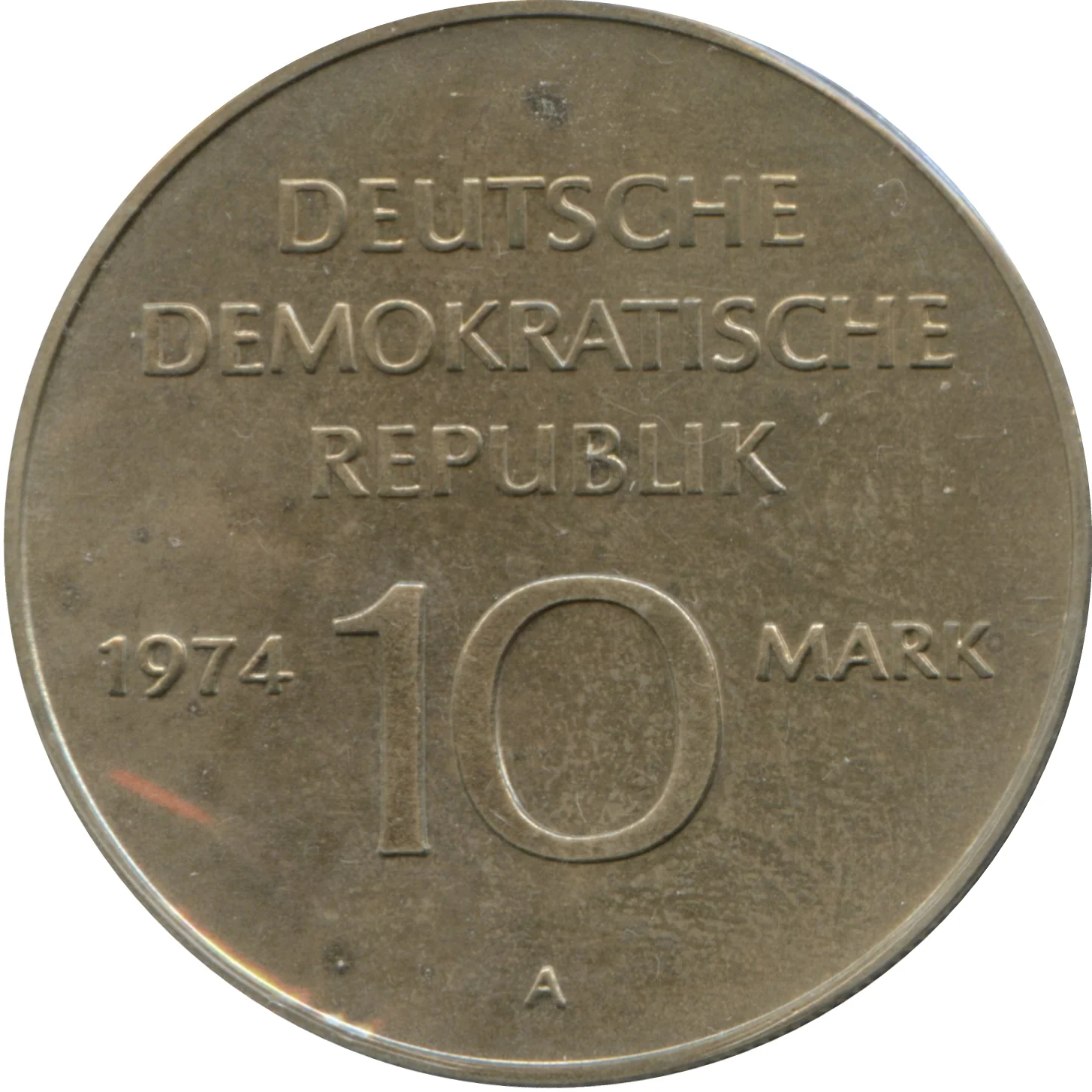
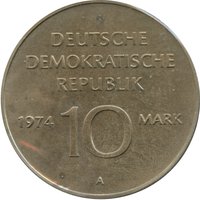
Obverse
Description:
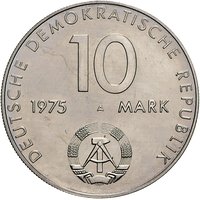
Denomination and date below lettering.
Inscription:
DEUTSCHE DEMOKRATISCHE REPUBLIK
1974 10 MARK
A
1974 10 MARK
A
Translation:
German Democratic Republic
1974 10 Mark
1974 10 Mark
Script: Latin
Language: German
Designer: Günter Junge
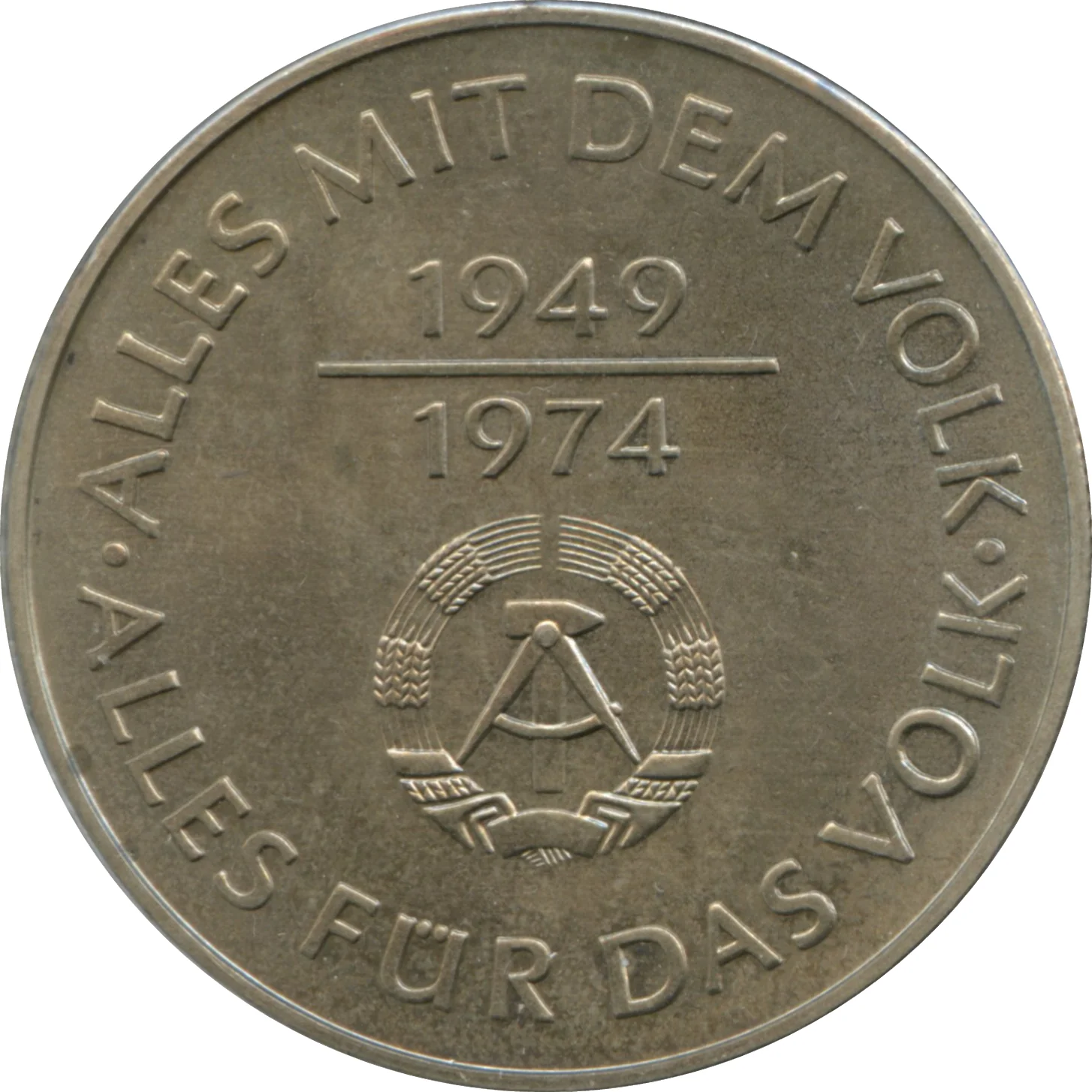
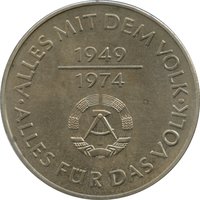
Reverse
Description:
National emblem below spelled-out year, surrounded by edge lettering.
Inscription:
ALLES MIT DEM VOLK
1949-1974
ALLES FÜR DAS VOLK
1949-1974
ALLES FÜR DAS VOLK
Translation:
Everything with the people
1949-1974
Everything for the people
1949-1974
Everything for the people
Script: Latin
Language: German
Designer: Günter Junge
Edge
Milled
Mints
| Name | Mark |
|---|---|
| Berlin | A |
Historical background
In 1974, the German Democratic Republic (GDR) operated under a strict dual-currency system that was a fundamental feature of its planned economy and a tool for political control. The official currency was the East German Mark (Mark der DDR, or M), which was non-convertible and isolated from international financial markets. Its value was artificially set by the state and bore no relation to its actual purchasing power or exchange rate with Western currencies. For ordinary citizens, the M was used for all domestic transactions, but its utility was constrained by chronic shortages of desirable consumer goods, leading to a situation where money often could not buy what was not available.
The critical second pillar of this system was the privileged role of the Deutsche Mark (DM) from the Federal Republic of Germany (FRG). While possession of West German currency by GDR citizens was technically illegal, it was widely circulated on a thriving black market and was essential for accessing high-quality or scarce goods in Intershop stores. These state-run shops, which proliferated in the 1970s, sold imported Western products exclusively for hard currency, creating a two-tiered consumer society. This arrangement allowed the SED regime to capture valuable foreign exchange from its own population, often remitted from West German relatives, to bolster the struggling economy and import critical technology.
The currency situation in 1974 thus reflected the broader contradictions of the GDR. Economically, it highlighted the state's failure to create a productive economy capable of satisfying consumer demand, forcing it to rely on the very capitalist system it ideologically opposed. Socially, it created deep inequalities between those with access to hard currency and those without, undermining the official doctrine of socialist equality. Politically, it was a humbling concession that the legitimacy of the state depended, in part, on the economic strength of its Western rival, as the DM became a symbol of a higher standard of living and greater personal freedom.
The critical second pillar of this system was the privileged role of the Deutsche Mark (DM) from the Federal Republic of Germany (FRG). While possession of West German currency by GDR citizens was technically illegal, it was widely circulated on a thriving black market and was essential for accessing high-quality or scarce goods in Intershop stores. These state-run shops, which proliferated in the 1970s, sold imported Western products exclusively for hard currency, creating a two-tiered consumer society. This arrangement allowed the SED regime to capture valuable foreign exchange from its own population, often remitted from West German relatives, to bolster the struggling economy and import critical technology.
The currency situation in 1974 thus reflected the broader contradictions of the GDR. Economically, it highlighted the state's failure to create a productive economy capable of satisfying consumer demand, forcing it to rely on the very capitalist system it ideologically opposed. Socially, it created deep inequalities between those with access to hard currency and those without, undermining the official doctrine of socialist equality. Politically, it was a humbling concession that the legitimacy of the state depended, in part, on the economic strength of its Western rival, as the DM became a symbol of a higher standard of living and greater personal freedom.
🌱 Common