

10 kroner – Norway
Add to wishlist
Norway
Context
Year: 1910
Issuer: Norway
Ruler: Haakon VII
Currency:
(since 1875)
Demonetized: Yes
Total mintage: 52,600
Material
References
KM: #
Numista: #58612
Value
Exchange value: 10 NOK
Bullion value: $620.68
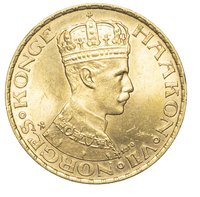
Obverse
Description:
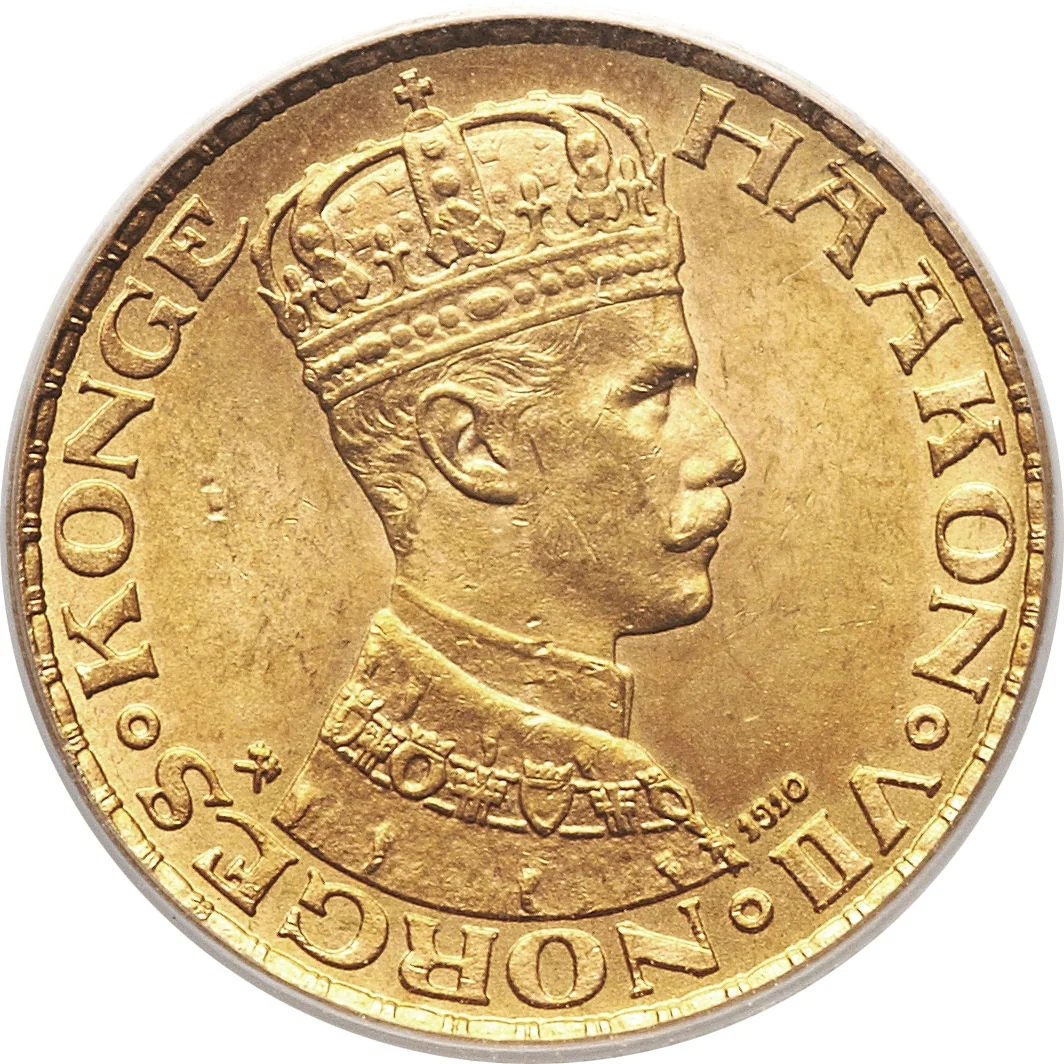
King Haakon VII's right-facing bust, encircled by an inscription. Mintmark at lower left, date at lower right. Wreathed ring on the rim.
Inscription:
HAAKON⸰VII⸰NORGES⸰KONGE
⚒ | 1910
⚒ | 1910
Translation:
Haakon VII Norway's King
Hammer | 1910
Hammer | 1910
Script: Latin
Language: Norwegian
Engraver: Lars Utne
Designer: Henrik Bull
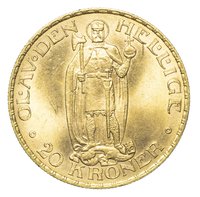
Reverse
Description:
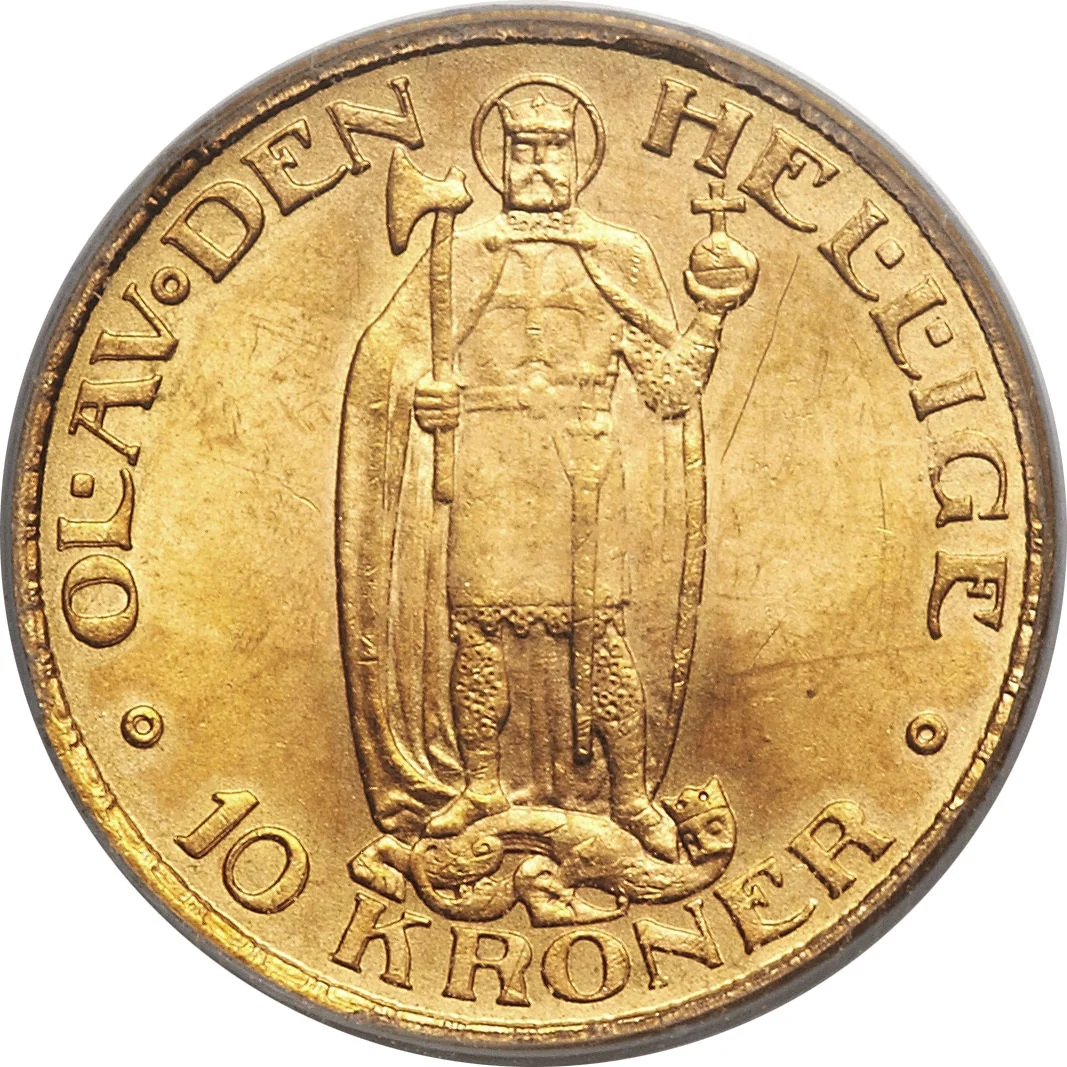
Saint Olaf with halo, axe, and globe, standing on a human-headed dragon. Inscription around, value below, wreathed rim.
Inscription:
OL·AV⸰DEN | HEL·L·IGE
⸰ 10 KRONER ⸰
⸰ 10 KRONER ⸰
Translation:
Olav the Holy
10 Kroner
10 Kroner
Script: Latin
Language: Norwegian
Engraver: Lars Utne
Designer: Henrik Bull
Edge
Reeded
Mints
| Name | Mark |
|---|---|
| Norwegian Mint | — |
Mintings
| Year | Mint Mark | Mintage | Quality | Collection |
|---|---|---|---|---|
| 1910 | — | 52,600 |
Historical background
By 1910, Norway's currency situation was defined by its membership in the Scandinavian Monetary Union (SMU), established with Denmark in 1873 and joined by Sweden in 1875. This union created a fixed exchange rate and free circulation of gold-backed coins between the member countries, meaning Danish and Swedish kroner were legal tender in Norway and vice-versa. The Norwegian krone, divided into 100 øre, was pegged to gold at a rate of 2,480 kroner per kilogram, ensuring monetary stability and facilitating trade within Scandinavia and with the wider world.
However, the system's foundation on a pure gold standard was beginning to show strains. While coins were gold-backed, the member countries had issued their own banknotes, which were not automatically accepted across borders. Furthermore, the outbreak of World War I in 1914 would soon precipitate the Union's de facto end, as countries suspended gold convertibility to conserve reserves. Thus, in 1910, Norway enjoyed the benefits of a stable, internationally credible currency system, but stood on the precipice of a fundamental change.
Domestically, the currency was managed by Norges Bank, which held the nation's gold reserves. The period was one of significant economic growth, driven by shipping, hydropower development, and early industrialization, all supported by this stable monetary framework. The krone's reliability was crucial for attracting foreign investment and financing Norway's infrastructure projects. Consequently, the monetary situation in 1910 represented the peak of a classical gold standard era, providing a solid foundation for the economy just before the global upheavals of the 20th century would force its abandonment.
However, the system's foundation on a pure gold standard was beginning to show strains. While coins were gold-backed, the member countries had issued their own banknotes, which were not automatically accepted across borders. Furthermore, the outbreak of World War I in 1914 would soon precipitate the Union's de facto end, as countries suspended gold convertibility to conserve reserves. Thus, in 1910, Norway enjoyed the benefits of a stable, internationally credible currency system, but stood on the precipice of a fundamental change.
Domestically, the currency was managed by Norges Bank, which held the nation's gold reserves. The period was one of significant economic growth, driven by shipping, hydropower development, and early industrialization, all supported by this stable monetary framework. The krone's reliability was crucial for attracting foreign investment and financing Norway's infrastructure projects. Consequently, the monetary situation in 1910 represented the peak of a classical gold standard era, providing a solid foundation for the economy just before the global upheavals of the 20th century would force its abandonment.
💎 Extremely Rare