

1 Peso (Dominican Republic) – Dominican Republic
Circulating commemorative coins
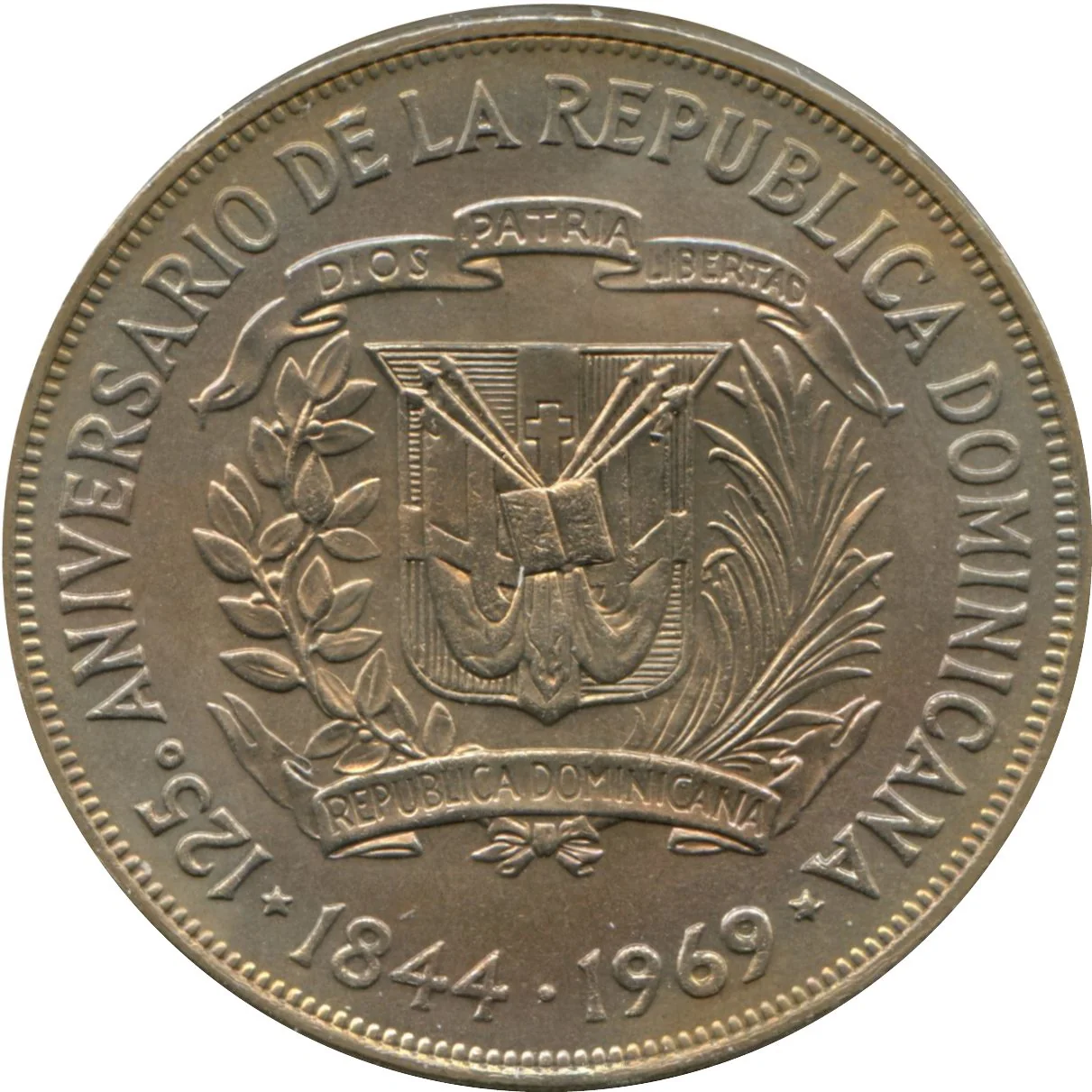
Commemoration: 125th Anniversary of the Dominican Republic
Dominican Republic
Context
Year: 1969
Issuer: Dominican Republic 
Period:
(since 1966)
Currency:
(since 1937)
Total mintage: 30,000
Material
Diameter: 38.1 mm
Weight: 27.3 g
Thickness: 2.9 mm
Shape: Round
Composition: Copper-nickel
Technique: Milled
Alignment: Medal alignment
flip
References
KM: #Click to copy to clipboard33
Numista: #5852
Value
Exchange value: 1 DOP
Obverse
Reverse
Description:
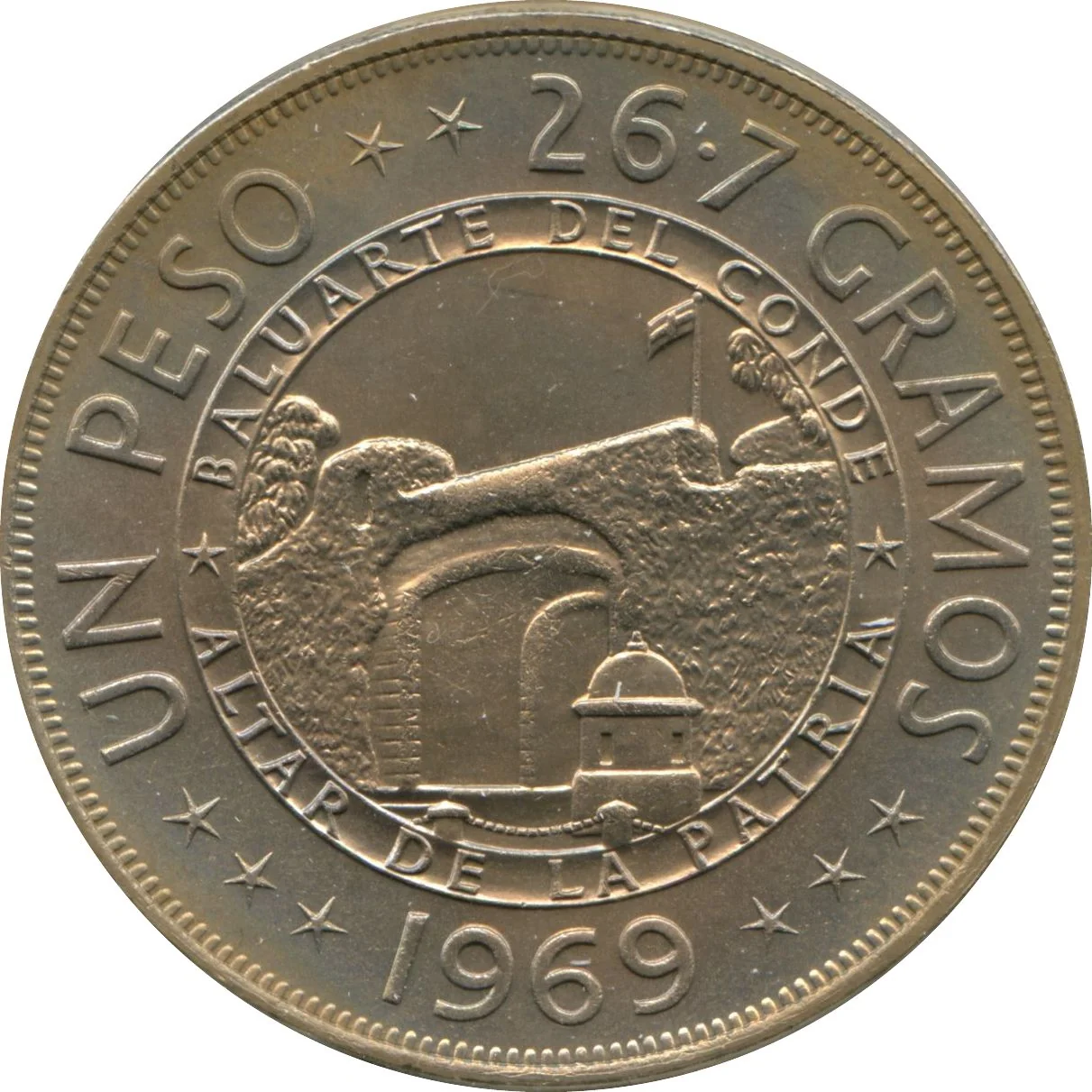
Pueblo entrance in two circles, legend inside. Denomination and weight above, date below.
Inscription:
*** UN PESO ** 26.7 GRAMOS ***
* BALUARTE DEL CONDE * ALTAR DE LA PATRIA
1969
* BALUARTE DEL CONDE * ALTAR DE LA PATRIA
1969
Translation:
*** ONE PESO ** 26.7 GRAMS ***
* BULWARK OF THE COUNT * ALTAR OF THE HOMELAND
1969
* BULWARK OF THE COUNT * ALTAR OF THE HOMELAND
1969
Script: Latin
Language: Spanish
Edge
Reeded
Mints
| Name | Mark |
|---|---|
| Royal Mint (Tower Hill) | — |
Mintings
| Year | Mint Mark | Mintage | Quality | Collection |
|---|---|---|---|---|
| 1969 | — | 30,000 |
Historical background
In 1969, the Dominican Republic's currency situation was characterized by relative stability under the authoritarian rule of President Joaquín Balaguer, who had taken power in 1966. The country was operating with the Dominican peso (RDS), which was pegged to the United States dollar at a fixed rate of 1:1. This peg, a legacy of the long Trujillo era, provided a crucial anchor for the economy, which was still recovering from the political instability and economic disruption following the 1965 civil war and subsequent U.S. military intervention. The government's primary focus was on economic reconstruction and attracting foreign investment, particularly in tourism and export-oriented industries, making exchange rate stability a key policy priority.
However, this stability was maintained through strict exchange controls and the management of the Central Bank of the Dominican Republic. While the official parity was 1:1, a parallel black market for U.S. dollars existed, reflecting underlying pressures. The economy faced significant challenges, including a large trade deficit, high unemployment, and widespread poverty. Balaguer's conservative fiscal policies and reliance on foreign loans, particularly from the United States and international institutions, were instrumental in supporting the peso's fixed rate, but they also contributed to a growing external debt.
Overall, the currency picture in 1969 was one of surface-level calm enforced by government control, masking deeper structural economic weaknesses. The fixed exchange rate provided predictability for the government's development plans and the burgeoning tourism sector, but it was ultimately an artificial stability propped up by capital controls and external borrowing. This setup would face increasing strain in the coming decades, leading to a major devaluation and the eventual abandonment of the fixed peg in the 1980s.
However, this stability was maintained through strict exchange controls and the management of the Central Bank of the Dominican Republic. While the official parity was 1:1, a parallel black market for U.S. dollars existed, reflecting underlying pressures. The economy faced significant challenges, including a large trade deficit, high unemployment, and widespread poverty. Balaguer's conservative fiscal policies and reliance on foreign loans, particularly from the United States and international institutions, were instrumental in supporting the peso's fixed rate, but they also contributed to a growing external debt.
Overall, the currency picture in 1969 was one of surface-level calm enforced by government control, masking deeper structural economic weaknesses. The fixed exchange rate provided predictability for the government's development plans and the burgeoning tourism sector, but it was ultimately an artificial stability propped up by capital controls and external borrowing. This setup would face increasing strain in the coming decades, leading to a major devaluation and the eventual abandonment of the fixed peg in the 1980s.
🌱 Fairly Common