

500 Schilling – Austria
Non-circulating coins
Commemoration: Centennial - Vienna City Hall
Austria

Obverse
Description:
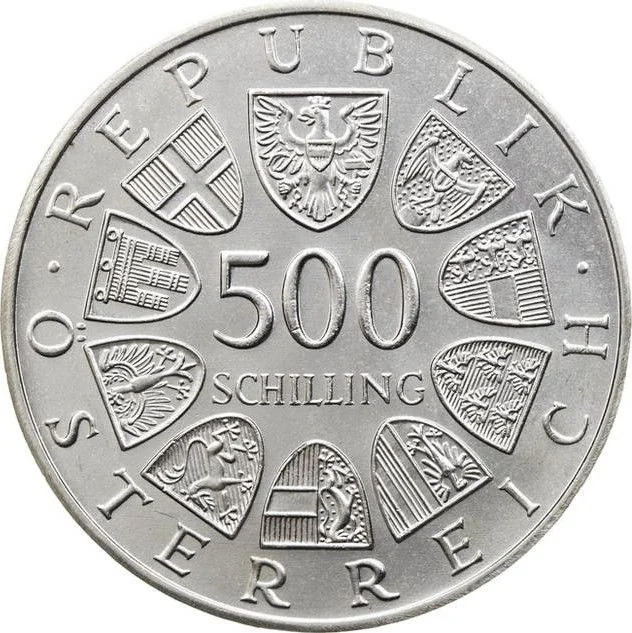
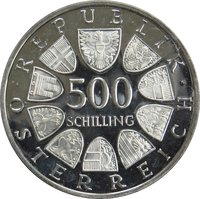
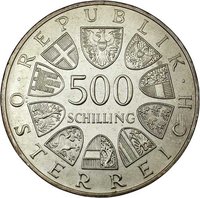
Austrian coat of arms within a ring of shields representing its nine federal states.
Inscription:
REPUBLIK
· ÖSTERREICH ·
500
SCHILLING
· ÖSTERREICH ·
500
SCHILLING
Translation:
REPUBLIC
· OF AUSTRIA ·
500
SCHILLING
· OF AUSTRIA ·
500
SCHILLING
Script: Latin
Language: German
Engraver: Edwin Grienauer
Reverse
Description:
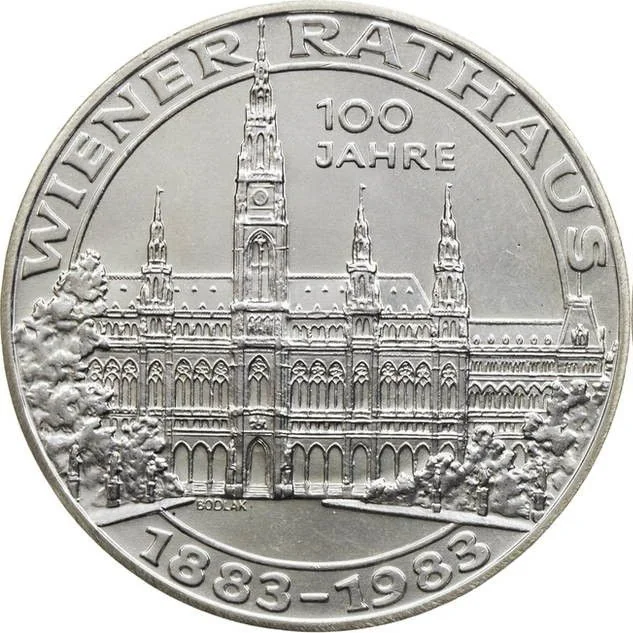
Centennial at Vienna City Hall
Inscription:
WIENER RATHAUS
100 JAHRE
1883-1983
100 JAHRE
1883-1983
Script: Latin
Engraver: Kurt Bodlak
Edge
Plain with engraved lettering
Categories
| Building> Governmental building |
Mints
| Name | Mark |
|---|---|
| Münze Österreich | — |
Mintings
| Year | Mint Mark | Mintage | Quality | Collection |
|---|---|---|---|---|
| 1983 | — | 412,000 | ||
| 1983 | — | 133,800 | Proof |
Historical background
In 1983, Austria's currency situation was characterized by stability and deliberate integration into European monetary mechanisms, a notable achievement amidst the global economic turbulence of the early 1980s. The Austrian schilling was firmly anchored by a hard currency policy (Hartwährungspolitik), unofficially pegging it to the Deutsche Mark (DM). This policy, managed by the Austrian National Bank (OeNB), prioritized low inflation and exchange rate stability over independent monetary maneuvering, effectively importing the credibility of the Bundesbank's anti-inflationary stance. Consequently, Austria enjoyed lower inflation rates than many of its European neighbors, fostering a predictable environment for trade and investment, particularly with its largest trading partner, West Germany.
This stability, however, came with significant constraints. By shadowing the DM, Austria relinquished control over its domestic interest rates, which had to closely follow the often-high rates set by the Bundesbank to combat inflation. This tight monetary policy, while curbing inflation, also acted as a drag on economic growth and employment during a period of recession. Domestically, this tension sparked the "hard currency debate" (Hartwährungsdebatte), with industry and labor unions criticizing the policy for stifling growth and exacerbating unemployment, while the government and central bank defended it as the essential foundation for long-term economic stability.
Internationally, Austria's currency framework was formally embedded within the European Monetary System (EMS), established in 1979. While not a full member of the Exchange Rate Mechanism (ERM), Austria participated in the EMS through its unilateral DM peg, aligning itself closely with the core of European monetary cooperation. This positioning in 1983 reflected Austria's broader economic strategy of seeking stability through alignment with Western European structures, a precursor to its later full integration into the European Union and the eventual adoption of the euro, which would ultimately replace the managed stability of the schilling.
This stability, however, came with significant constraints. By shadowing the DM, Austria relinquished control over its domestic interest rates, which had to closely follow the often-high rates set by the Bundesbank to combat inflation. This tight monetary policy, while curbing inflation, also acted as a drag on economic growth and employment during a period of recession. Domestically, this tension sparked the "hard currency debate" (Hartwährungsdebatte), with industry and labor unions criticizing the policy for stifling growth and exacerbating unemployment, while the government and central bank defended it as the essential foundation for long-term economic stability.
Internationally, Austria's currency framework was formally embedded within the European Monetary System (EMS), established in 1979. While not a full member of the Exchange Rate Mechanism (ERM), Austria participated in the EMS through its unilateral DM peg, aligning itself closely with the core of European monetary cooperation. This positioning in 1983 reflected Austria's broader economic strategy of seeking stability through alignment with Western European structures, a precursor to its later full integration into the European Union and the eventual adoption of the euro, which would ultimately replace the managed stability of the schilling.
⭐ Rare