

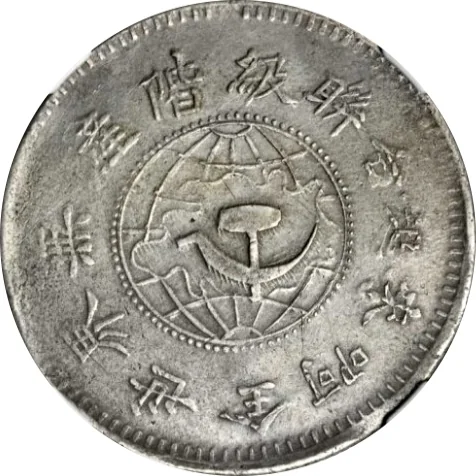
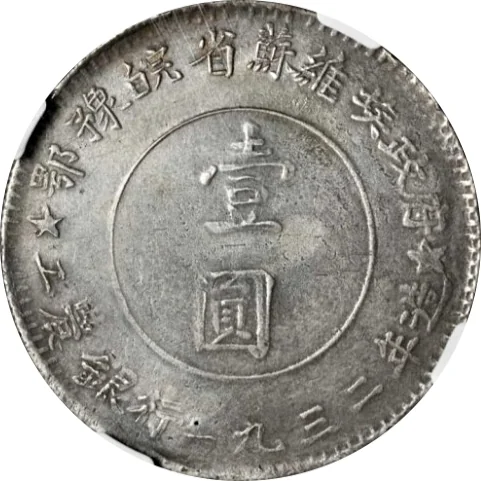
1 Yuan – Hupeh-Honan-Anhwei Soviet
China
Context
Year: 1932
Country: China 
Issuer: Hupeh-Honan-Anhwei Soviet
Issuing organization: Hupeh-Honan-Anhwei Soviet Worker's and Farmer's Bank
Currency:
(1930—1936)
Demonetized: Yes
Material
References
Y: #Click to copy to clipboard504
Numista: #58287
Value
Bullion value: $76.56
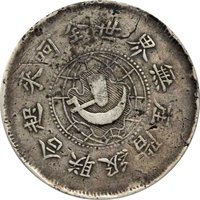
Obverse
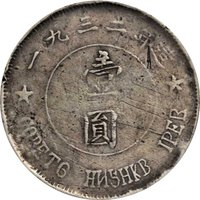
Reverse
Edge
Reeded.
Categories
| Map |
| Symbol> Hammer and sickle |
Mintings
| Year | Mint Mark | Mintage | Quality | Collection |
|---|---|---|---|---|
| 1932 | — | — |
Historical background
During the early 1930s, the Hupeh-Honan-Anhwei (Hubei-Henan-Anhui) Soviet, a key base area for the Chinese Communist Party (CCP), faced severe economic isolation and blockade by the surrounding Kuomintang (KMT) forces. This stranglehold crippled normal trade and cut off access to the Republic of China's official currency, the fabi. In response, the soviet government, under leaders like Zhang Guotao, pursued a dual monetary strategy to facilitate internal economic activity and assert its political sovereignty. The primary goal was to establish a stable financial system that could support the Red Army and the local population while undermining the economic authority of the Nanjing government.
The currency situation was characterized by the parallel circulation of various forms of money. Most importantly, the soviet established its own bank—the Agricultural Bank of the Hubei-Henan-Anhui Soviet—and issued paper notes, often denominated in silver yuan. These soviet notes were intended to replace the fabi within the border regions, but their acceptance was uneven and their value heavily dependent on public confidence and military fortunes. Alongside these, physical silver dollars (especially the popular "Mexican Eagle" coin) and copper coins remained trusted mediums of exchange, particularly for larger transactions or in areas closer to the front lines. Barter was also widespread due to periodic inflation and shortages of hard currency.
Ultimately, the monetary system was fragile and directly tied to the soviet's military viability. Successful Red Army campaigns could bolster confidence and expand the zone where soviet notes were used, while KMT offensives and economic pressure would cause rapid devaluation and a retreat to hard currency or barter. The currency experiment in the Hubei-Henan-Anhui Soviet, like in other CCP base areas, was a crucial learning experience in economic self-reliance. It provided a template for the more unified and successful financial policies later developed in the Yan'an period during the Second Sino-Japanese War.
The currency situation was characterized by the parallel circulation of various forms of money. Most importantly, the soviet established its own bank—the Agricultural Bank of the Hubei-Henan-Anhui Soviet—and issued paper notes, often denominated in silver yuan. These soviet notes were intended to replace the fabi within the border regions, but their acceptance was uneven and their value heavily dependent on public confidence and military fortunes. Alongside these, physical silver dollars (especially the popular "Mexican Eagle" coin) and copper coins remained trusted mediums of exchange, particularly for larger transactions or in areas closer to the front lines. Barter was also widespread due to periodic inflation and shortages of hard currency.
Ultimately, the monetary system was fragile and directly tied to the soviet's military viability. Successful Red Army campaigns could bolster confidence and expand the zone where soviet notes were used, while KMT offensives and economic pressure would cause rapid devaluation and a retreat to hard currency or barter. The currency experiment in the Hubei-Henan-Anhui Soviet, like in other CCP base areas, was a crucial learning experience in economic self-reliance. It provided a template for the more unified and successful financial policies later developed in the Yan'an period during the Second Sino-Japanese War.
✨ Legendary