

1 jiao – Fukien Province
Add to wishlist
China
Context
Year: 1913
Country: China
Issuer: Fukien Province
Period:
(1912—1949)
Currency:
(1896—1949)
Demonetized: Yes
Material
References
Y: #
Numista: #58285
Value
Bullion value: $6.64
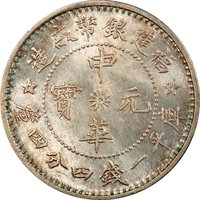
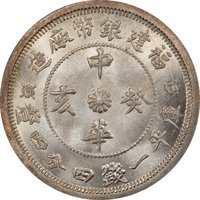
Obverse
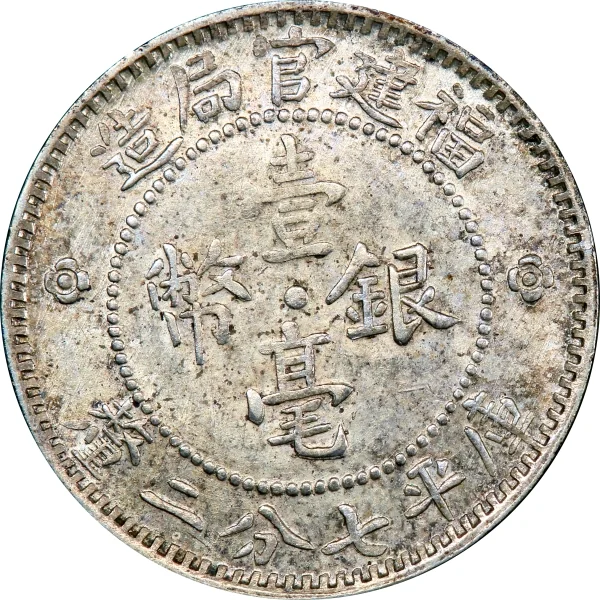
Description:
Four ideograms read vertically, right to left, encircled by more characters.
Inscription:
造局官建福
壹
幣銀
毫
釐二分七平庫
壹
幣銀
毫
釐二分七平庫
Translation:
Mint Official Jianfu
One
Silver Coin
Mace
Candareen Two Candareens Seven Candareens Treasury Standard
One
Silver Coin
Mace
Candareen Two Candareens Seven Candareens Treasury Standard
Language: Chinese
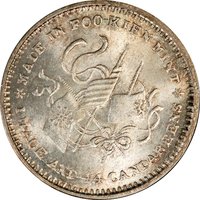
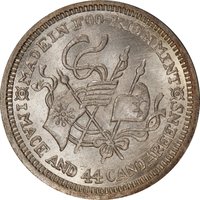
Reverse
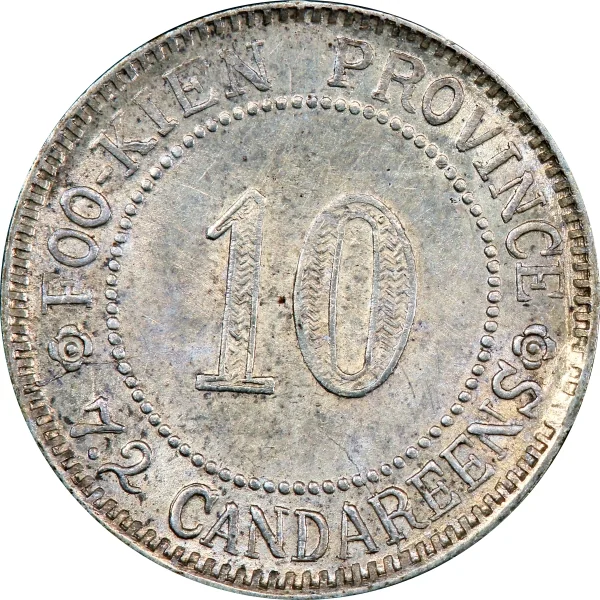
Description:
Value with English legend.
Inscription:
FOO-KIEN PROVINCE
10
7.2 CANDAREENS
10
7.2 CANDAREENS
Edge
Reeded.
Mintings
| Year | Mint Mark | Mintage | Quality | Collection |
|---|---|---|---|---|
| 1913 | — | — |
Historical background
In 1913, Fukien (Fujian) Province found itself in a complex and chaotic monetary situation, a direct legacy of the late Qing dynasty's financial fragmentation and the instability following the 1911 Xinhai Revolution. The province did not have a unified currency; instead, circulation was a tangled mix of old imperial silver sycees (taels), Mexican and later Chinese silver dollars (yuan), and a vast array of copper cash coins. Furthermore, numerous local banks, merchant guilds, and even military authorities issued their own paper notes, known as tiao-pi or "native orders," which were only redeemable within specific localities or trade networks. This created a system where the value and acceptability of money varied drastically from one city or county to the next, severely hindering trade and economic integration.
The political context exacerbated this monetary disorder. Following the revolution, central authority from Beijing was weak, and Fujian was under the control of the Fujian Military Government, led by Sun Daoren, who was nominally loyal to Yuan Shikai's Beijing government. However, real power was often dispersed among local military commanders and civil elites. In this vacuum, provincial and local authorities continued to issue currency to fund their operations, adding to the oversupply of instruments of questionable value. The lack of a strong, centralized provincial bank to regulate issuance meant that inflation and counterfeiting were rampant, and public trust in paper money was low, with a strong preference for silver specie.
Consequently, the Fujian economy in 1913 operated on a precarious dual system. Large-scale and interregional transactions were conducted in silver, while daily small-scale commerce relied on copper cash and localized paper notes. This environment placed merchants and the populace at constant risk of loss through exchange rate fluctuations and bank failures. The situation reflected the broader challenges of the early Republic of China: the struggle to establish national sovereignty, integrate regional economies, and move from a traditional, fragmented monetary system toward a modern, unified one—a goal that remained elusive in Fujian throughout the Warlord Era.
The political context exacerbated this monetary disorder. Following the revolution, central authority from Beijing was weak, and Fujian was under the control of the Fujian Military Government, led by Sun Daoren, who was nominally loyal to Yuan Shikai's Beijing government. However, real power was often dispersed among local military commanders and civil elites. In this vacuum, provincial and local authorities continued to issue currency to fund their operations, adding to the oversupply of instruments of questionable value. The lack of a strong, centralized provincial bank to regulate issuance meant that inflation and counterfeiting were rampant, and public trust in paper money was low, with a strong preference for silver specie.
Consequently, the Fujian economy in 1913 operated on a precarious dual system. Large-scale and interregional transactions were conducted in silver, while daily small-scale commerce relied on copper cash and localized paper notes. This environment placed merchants and the populace at constant risk of loss through exchange rate fluctuations and bank failures. The situation reflected the broader challenges of the early Republic of China: the struggle to establish national sovereignty, integrate regional economies, and move from a traditional, fragmented monetary system toward a modern, unified one—a goal that remained elusive in Fujian throughout the Warlord Era.
💎 Extremely Rare